
New Students arrive in the IB with a quiet fear: that there’s a hidden rule everyone else already knows.
It usually shows up the first time you look at your timetable and realize IB isn’t “pick what you like” or it’s “build a balanced academic life… and then sit exams on it.”
So let’s answer the question cleanly: How many subjects do you need to take in the IB? And how do HL, SL, and the core components affect what you actually revise when exam season gets close?
The quick answer (and the checklist New Students need)
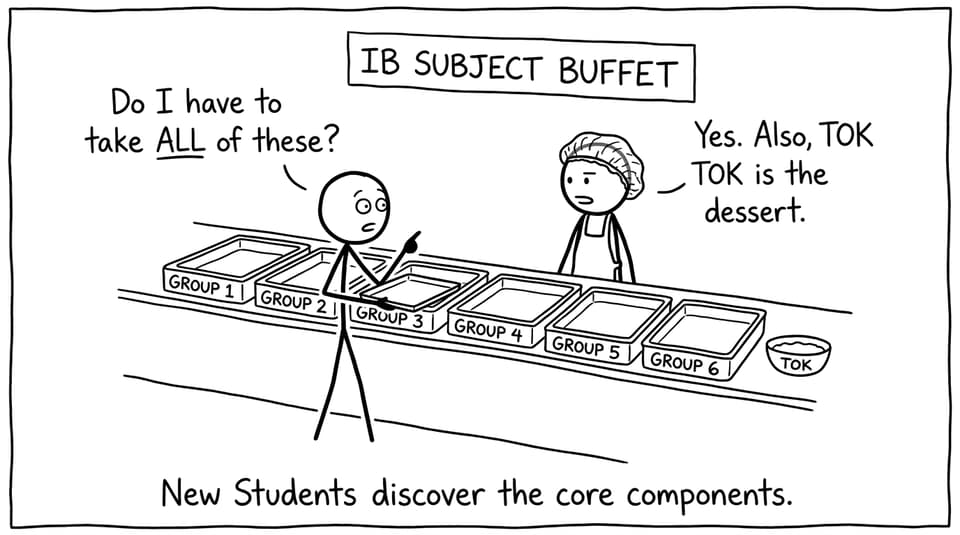
In the IB Diploma Programme, you normally take:
-
Six subjects total (chosen across the six IB subject groups)
-
Usually 3 Higher Level (HL) + 3 Standard Level (SL)
-
Plus the core components: TOK, EE, and CAS
If you want a fuller DP overview for New Students, this broader roadmap is helpful: The complete IB revision guide from subject selection to final exams.
The six IB subject groups (why it’s always six subjects)
The IB is built on breadth. That’s why New Students choose one subject from each group:
-
Group 1: Studies in Language and Literature
-
Group 2: Language Acquisition
-
Group 3: Individuals and Societies
-
Group 4: Sciences
-
Group 5: Mathematics
-
Group 6: The Arts (or a second subject from Groups 1-5)
That last line matters. If Group 6 doesn’t fit your goals, you can often swap it for an extra science, humanities, or language. If you’re deciding how to use Group 6 strategically, read: Is it better to take only one Group 6 subject or more?
New Students who feel stuck choosing subjects (especially with university still blurry) tend to benefit from this guide: Which subjects should I take at IB if I don’t know what to do in university yet?
HL vs SL: the part New Students underestimate
You still take six subjects, but not at the same depth.
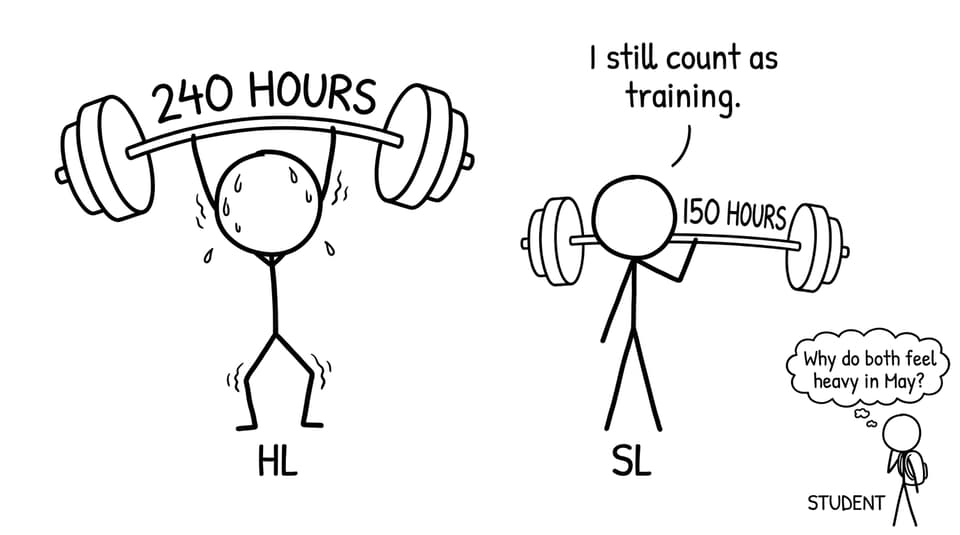
Most students take three subjects at HL and three at SL. HL goes deeper and moves faster.
As a rule of thumb:
-
HL: about 240 teaching hours
-
SL: about 150 teaching hours
That difference becomes real in exam prep. HL often asks you to do the same skill, but with longer chains of reasoning, harder data, or more demanding evaluation.
If you want the simplest explanation of what changes between levels, start here: What’s the difference between HL and SL in IB? and then follow with: Does HL vs SL matter in IB? The honest answer.
Can you take 4 HLs (or 4 SLs)?
Some New Students hear rumors like “4 HL is more impressive” or “4 SL will be easier.” In reality, the IB allows some flexibility, but your school’s timetable and your workload limits matter.
One common question is whether you can design a diploma with 4 SL subjects. This guide explains what’s typically allowed and what’s risky: Can I take 4 SL subjects for the IBDP?.
TOK, EE, and CAS: the “extra subjects” nobody labels that way
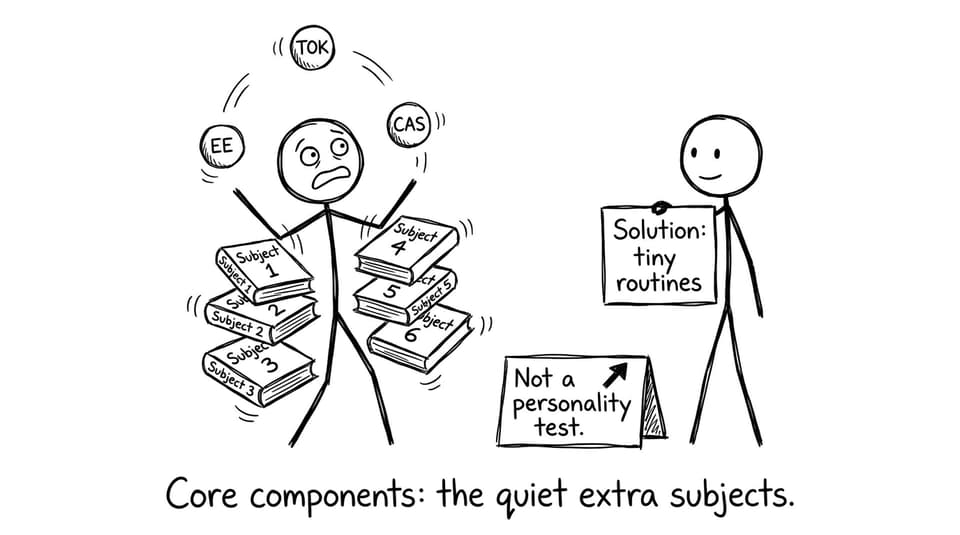
New Students often plan revision time as if the IB is only six subjects. Then TOK deadlines appear, EE meetings land in the same week as a science IA, and CAS reflections quietly multiply.
The core is mandatory:
Theory of Knowledge (TOK)
TOK is your practice in thinking about how knowledge works. It can feel abstract until you realize it trains the exact skill IB examiners reward: clear claims, balanced evaluation, and structured explanation.
Extended Essay (EE)
The EE is a 4,000-word research project. It’s not “extra homework” it’s a long-term stamina test: planning, drafting, feedback, and revision.
Creativity, Activity, Service (CAS)
CAS isn’t graded, but it is required. It’s the IB reminding you that a life that only studies tends to break.
If you want to connect the core into one coherent system (instead of three separate stress streams), this is worth bookmarking: How RevisionDojo unifies reflection across TOK, CAS, and the Extended Essay.
A practical subject-picking lens for exam-focused New Students
When New Students ask “How many subjects do I need?” they’re also asking something more personal: “How do I pick a set I can actually score well in?”
Use this fast filter:
Match prerequisites first, preferences second
Some university pathways genuinely require certain HLs. Lock those in first. Then build the rest to protect your overall points.
Balance effort across the six subjects
You don’t need six “hard” subjects to prove anything. You need six subjects you can revise consistently.
Think about your exam-season system, not your ideal-self system
If your plan requires perfect motivation, it’s not a plan.
A useful reminder for New Students: you don’t have to study every topic equally to succeed. You need coverage plus targeted depth. This piece explains it well: Do you need to study every topic for IB?.
How RevisionDojo helps New Students turn six subjects into a plan
Six subjects is a lot. The difference between “overwhelmed” and “in control” is usually feedback and structure.
RevisionDojo is built for that reality:
-
Study Notes to get clear quickly without rewriting textbooks
-
Flashcards for daily active recall across all six subjects
-
Questionbank practice to turn understanding into marks
-
AI Chat when you’re stuck and need a clean explanation
-
Grading tools to improve essays and structured responses
-
Predicted Papers and Mock Exams to train timing under pressure
-
Coursework Library to understand expectations for internal work
-
Tutors when you need a human who can spot patterns fast
If you’re new to the platform, start here: RevisionDojo for IB.
Closing: the calm truth for New Students
New Students don’t fail the IB because they took the “wrong number” of subjects. Almost everyone takes six subjects, then chooses HL and SL levels, then carries TOK, EE, and CAS alongside.
What separates students in exam season is simpler: having a repeatable system that works even when you’re tired. Build that system early with RevisionDojo’s Study Notes, Flashcards, Questionbank practice, AI Chat support, and timed Mock Exams. Six subjects stops feeling like a storm when you can measure progress in each one.
If you want the next step, explore these related reads: