
If you have ever watched someone confidently say, “I’m a Physics person,” you might have felt the quiet panic of not knowing what kind of “person” you are yet.
Group 4 choices have a funny way of feeling permanent. Not because they truly are, but because the decision happens when your experience of science is still limited: a few labs, a few units, a few tests, and a whole lot of guessing. That’s why Subject Selection for IB sciences should be less about what sounds impressive and more about what fits your mind on a normal Tuesday.
This guide breaks down the main Group 4 options, what they actually demand in exams, and how to decide with fewer regrets and more signal.
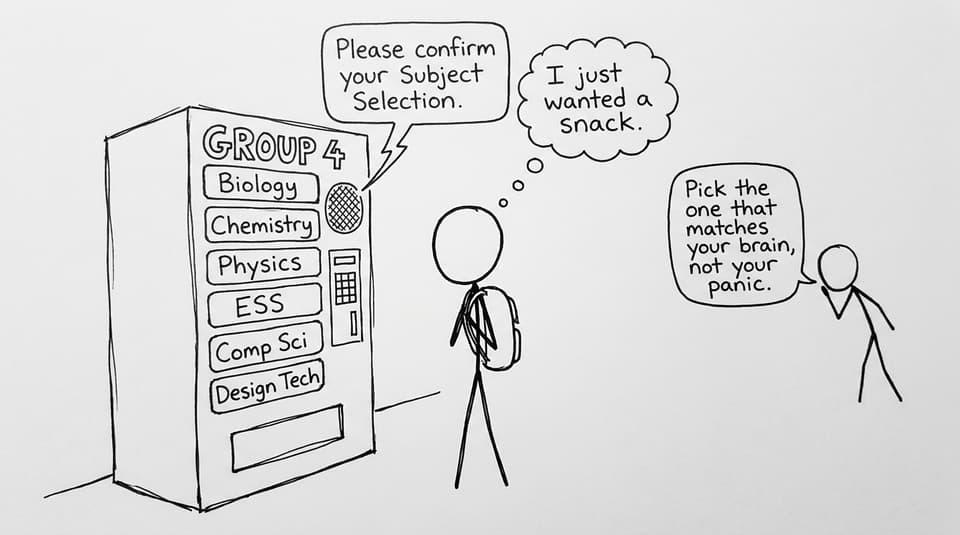
A quick Subject Selection checklist (use this before you commit)
Before you compare syllabi, run a fast self-audit. Good Subject Selection usually comes from matching skills to assessment.
-
Do you prefer memorising terms and processes, or deriving and applying rules?
-
Do you enjoy lab write-ups and evaluation, or do you prefer structured problem sets?
-
Are you aiming for a university path that has required sciences?
-
Which kind of mistake annoys you more: “I forgot the keyword” or “I messed up one step of algebra”?
-
In timed exams, do you do better with explaining or calculating?
If you want a bigger map of what counts as Group 4, bookmark: What Subjects Are in Group 4? A Guide to the IB Sciences.
Understand what Group 4 is really testing
Every Group 4 subject shares a common backbone: scientific thinking, data handling, and clear communication. But the flavour changes.
Your Subject Selection should start with the honest question: “What does this course reward?”
-
Biology often rewards breadth, accurate terminology, and explaining processes clearly.
-
Chemistry rewards conceptual understanding plus consistent quantitative accuracy.
-
Physics rewards modelling, multi-step problem solving, and comfort with abstraction.
-
ESS rewards systems thinking, real-world case study application, and evaluation.
-
Computer Science rewards logical thinking, structured answers, and algorithmic clarity.
-
Design Technology rewards design rationale, iteration, and linking decisions to evidence.
One more reality: difficulty is personal. If you are comparing workload, these posts help you calibrate expectations without myths:
Group 4 options, explained through “what your week feels like”
IB Biology (SL/HL): the story of living systems
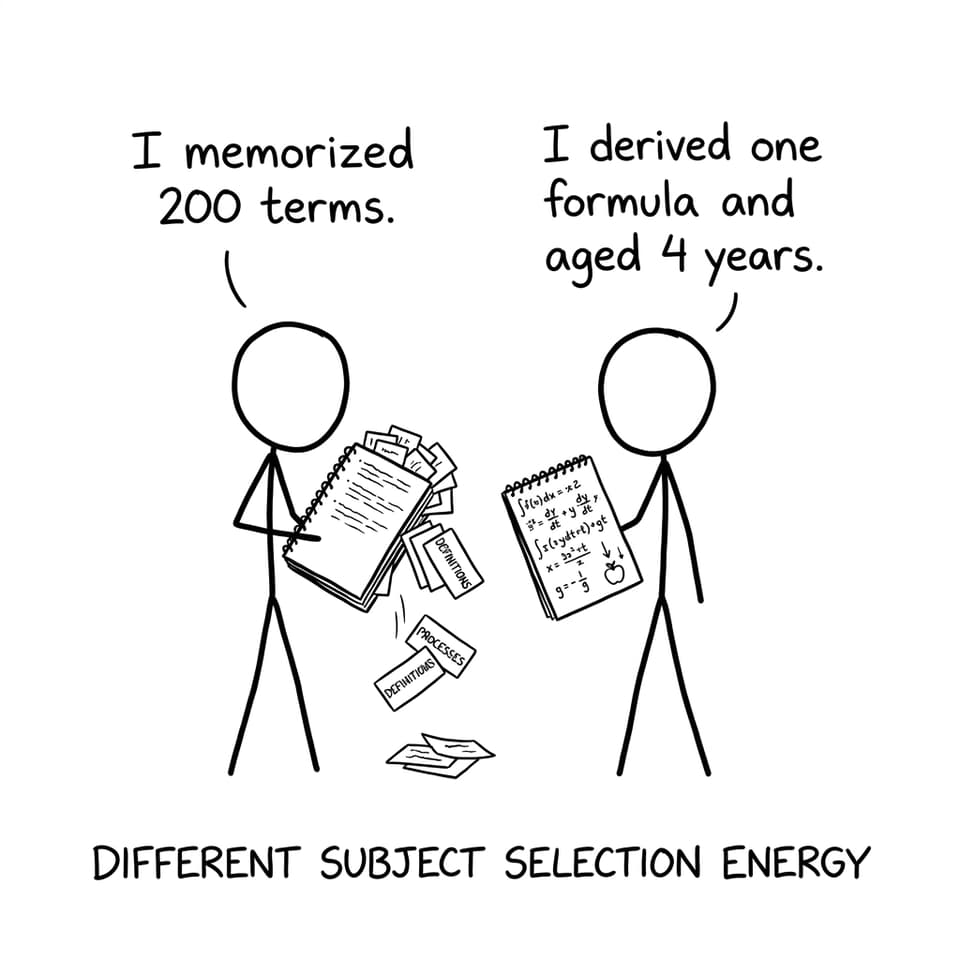
Biology is for students who enjoy learning how small mechanisms create big outcomes: enzymes, membranes, gene expression, ecosystems. A lot of your success comes from being able to name, sequence, and explain.
A strong Biology Subject Selection fit usually looks like this:
-
You are comfortable with lots of vocabulary.
-
You like connecting topics (cells to organisms to ecosystems).
-
You don’t mind revisiting the same processes until they become automatic.
To study it well, you need repetition. Students who do best often pair concise notes with steady active recall, like RevisionDojo’s IB Flashcards with Spaced Repetition (SRS).
IB Chemistry (SL/HL): patterns, precision, and practice loops
Chemistry is often described as “the middle child” between Biology and Physics, but that’s misleading. It has its own personality: conceptual models (bonding, energetics) plus calculations that punish sloppy steps.
Chemistry is a good Subject Selection when:
-
You like structured problem solving.
-
You’re willing to practice until methods feel routine.
-
You can switch between concepts and numbers without losing focus.
If you want to build speed and accuracy, the fastest route is targeted practice. RevisionDojo’s approach is built around that loop (practice, feedback, fix, repeat), and these two resources show how to use it well:
IB Physics (SL/HL): modelling the world with math and logic
Physics is for students who like asking, “What’s the simplest model that still explains reality?” It rewards calm persistence: you set up a problem, choose assumptions, apply principles, and keep your working clean.
Physics is a smart Subject Selection if:
-
You are comfortable with algebra and rearranging equations.
-
You like “puzzle” thinking more than memorising lists.
-
You don’t panic when a question looks unfamiliar.
Your revision needs timed practice early, not late. If you wait until the final stretch to do full-paper sets, timing becomes your hidden enemy.
ESS (SL only): science with a human story attached
Environmental Systems and Societies (ESS) is interdisciplinary by design. You move between ecological principles and human systems: resource use, sustainability, policy trade-offs. The writing and evaluation side matters.
ESS is often the right Subject Selection if:
-
You like real-world application and case studies.
-
You are stronger at explanation and evaluation than heavy calculations.
-
You enjoy linking evidence to conclusions.
If you are specifically weighing ESS, read: Is ESS the Easiest IB science?. The best takeaway is that “easier” usually means “better match,” not “less work.”
Computer Science (SL/HL): thinking in steps
Computer Science is about computational thinking, not just typing code quickly. Many exam marks come from being precise: definitions, tracing, algorithm design, and explaining trade-offs.
Computer Science becomes a great Subject Selection when:
-
You like logic and structured answers.
-
You enjoy building systems and debugging.
-
You can learn from mistakes without taking them personally.
Design Technology (SL/HL): creativity with evidence
Design Tech suits students who like the loop of: identify a need, design, test, improve, justify. You need creativity, but you also need disciplined documentation.
Design Tech is a strong Subject Selection if:
-
You like making and iterating.
-
You can explain why you made each decision.
-
You enjoy projects and applied problem solving.
A practical Subject Selection decision method (3 passes)
Pass one: eliminate by requirements
If a university path requires a specific science, don’t negotiate with that reality. Use your career shortlist to narrow choices early, then choose the best fit within those constraints.
A helpful companion read for future-facing planning: Which IB Science Subject Has the Best University Recognition.
Pass two: match your scoring style
Think about how you reliably earn marks:
-
If you score through explanation and detail, Biology or ESS may fit.
-
If you score through method and consistency, Chemistry may fit.
-
If you score through modelling and multi-step reasoning, Physics may fit.
This is where Subject Selection stops being about interest alone and becomes about repeatable performance.
Pass three: stress test your workload
Your timetable is a system. A science that is “fine” alone may become heavy next to your other HLs.
If you want a realistic benchmark for study hours, use: How Many Hours Should You Study for IB Science Subjects?.
How RevisionDojo helps after Subject Selection (so the choice pays off)
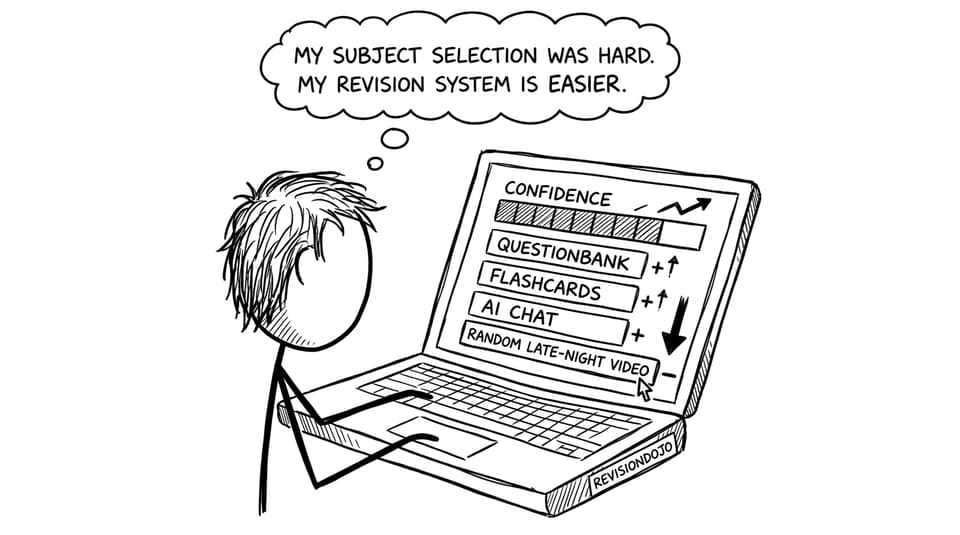
Choosing well matters, but what you do next matters more. RevisionDojo is built for the daily work that turns a good Subject Selection into a high exam score:
-
Study Notes to learn content cleanly without drowning in textbooks.
-
Flashcards to keep definitions, processes, and formulas alive.
-
Questionbank to practice by topic and difficulty and build exam instincts.
-
AI Chat for fast clarification when a concept won’t click.
-
Grading tools to understand what earns marks in structured responses.
-
Predicted Papers and Mock Exams to rehearse timing and stamina under realistic pressure.
-
Coursework Library and Tutors when you need examples or human guidance.
If you are building toward exam season practice, these two are useful next steps:
Closing: make Subject Selection, then build the loop
The best Group 4 Subject Selection is the one you can live with repeatedly: in labs, in revision weeks, and in timed practice when the questions stop looking familiar. Pick the science that matches your scoring style, your future needs, and your tolerance for the kind of effort it requires.
Then stop hunting for perfect motivation and start building a reliable loop: learn with Study Notes, retain with Flashcards, prove it with the Questionbank, and rehearse with Mock Exams and Predicted Papers. If you want that loop in one place, RevisionDojo is built to be your home base for IB science from first topic to final exam.