



If you ask ten IB students which science feels “easiest,” you’ll get ten different answers. But the same subject name shows up again and again in that conversation: IB ESS.
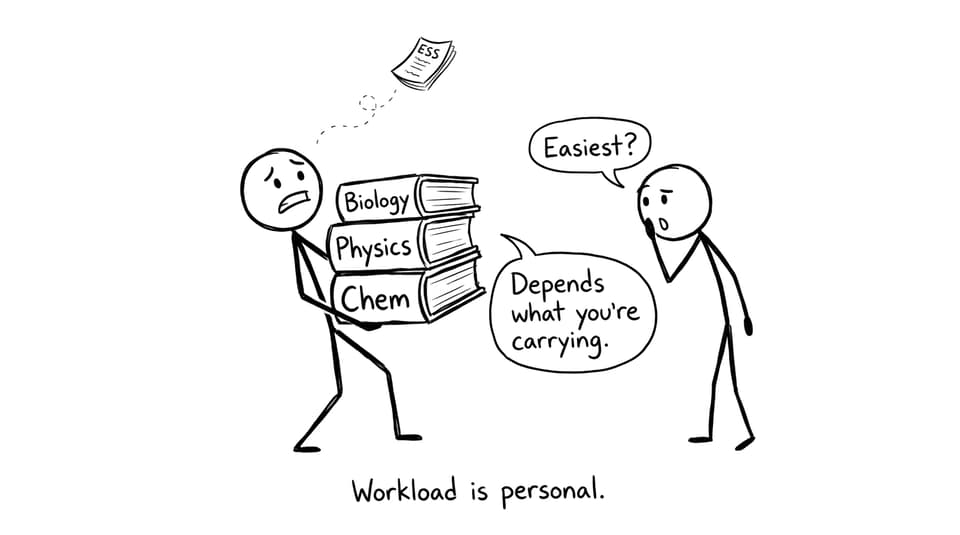
Sometimes it’s said with relief (“Finally, a science I can breathe in”). Sometimes it’s said with suspicion (“Wait… what’s the catch?”). And that’s the right instinct, because “easy” in the IB is rarely about fewer hours. It’s usually about where the difficulty lives: memorisation, maths, evaluation, writing, or handling unfamiliar data under time pressure.
This guide breaks down whether IB ESS is the easiest IB science, what it actually demands, and how to make it feel easier with the right exam strategy.
The quick checklist: when IB ESS feels “easy”
IB ESS tends to feel easier if you:
-
Prefer writing and evaluation over long calculations
-
Like real-world case studies more than abstract theory
-
Can link ideas using systems thinking (cause, consequence, feedback)
-
Enjoy mixing science with ethics, economics, and policy
-
Are comfortable explaining data in plain language
It tends to feel harder if you:
-
Want a subject that’s mostly right/wrong with minimal discussion
-
Struggle to structure arguments under timed conditions
-
Avoid reading news or building a “bank” of examples
If you’re still deciding, pair this article with How to Choose the Right Group 4 Subject for You for a more complete subject-fit check.
What IB ESS actually is (and why that changes “difficulty”)
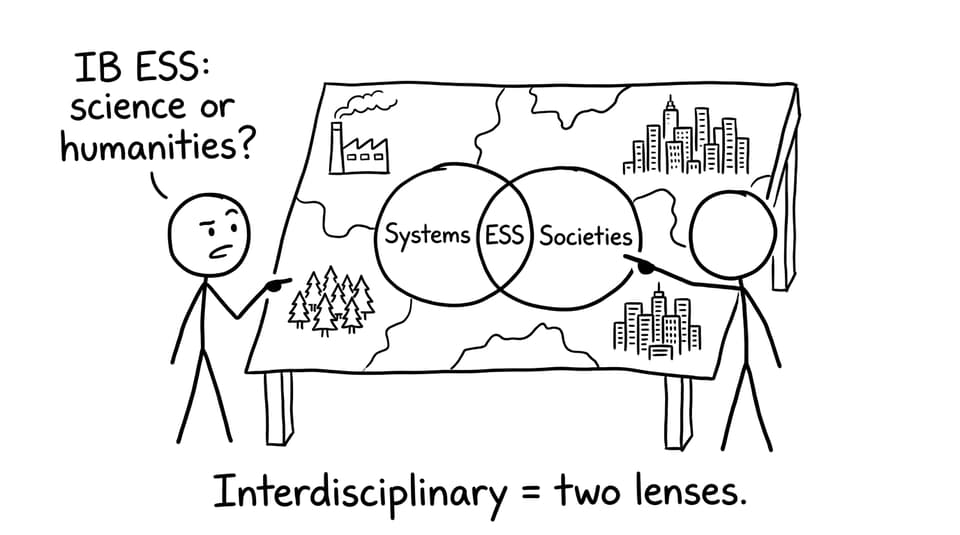
IB ESS is unusual because it’s interdisciplinary: it sits across environmental science and individuals-and-societies style thinking. You’re not only learning how ecosystems function, but also why human systems keep pushing them off balance.
That design changes the skill mix. In IB ESS, you’re rewarded for:
-
Clear definitions
-
Interpreting unfamiliar resources (graphs, short texts, data)
-
Using specific case studies to support claims
-
Evaluating trade-offs (benefits, costs, stakeholders, uncertainty)
If you want to see the full scope of the course, the IB Environmental Systems and Societies (ESS) New Syllabus hub is a helpful map of what you’re actually signing up for.
Is IB ESS easier than Biology, Chemistry, or Physics?
“Easiest” depends on your strengths, but the comparison becomes clearer when you stop comparing reputations and start comparing friction points.
IB ESS vs Biology
Biology often feels heavy because of the sheer volume of detailed content and precise terminology. IB ESS still requires knowledge, but it usually rewards breadth + application more than deep cellular detail.
If you’re choosing between environmental interest and a life-science pathway, IB ESS vs. IB Biology: Which Is More Suitable for Your Career helps clarify what each subject signals.
IB ESS vs Chemistry
Chemistry’s difficulty is often concentrated in multi-step problem solving and comfort with quantitative thinking. IB ESS has data, but far fewer “one wrong step and everything collapses” moments.
IB ESS vs Physics
Physics tends to demand mathematical confidence plus abstract model-building. IB ESS still uses models, but usually communicates them through systems diagrams, written reasoning, and environmental contexts.
If you want a broader difficulty comparison across subjects, use Easiest Science Subjects in IB and Which IB Science Is the Easiest? A Detailed Guide.
The hidden difficulty of IB ESS: case studies and evaluation
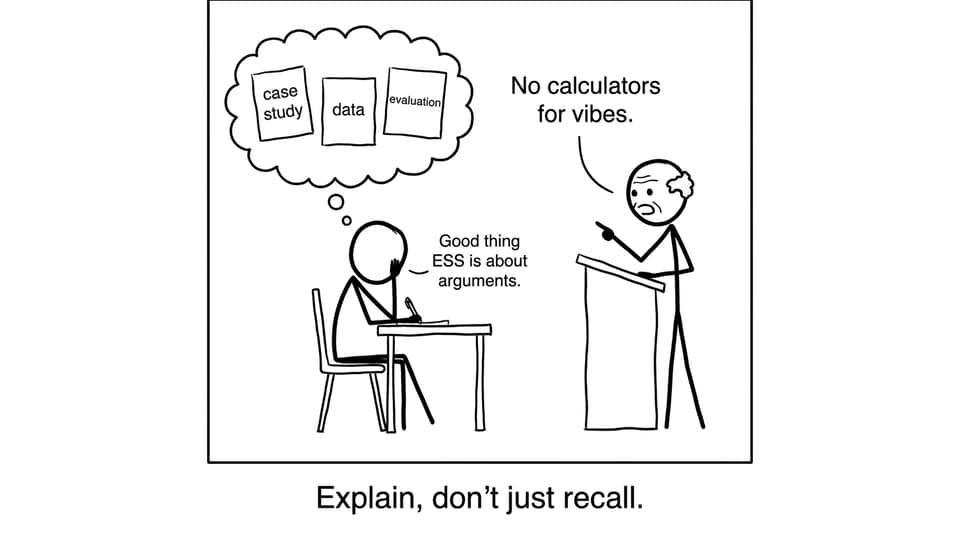
The most common mistake with IB ESS is assuming it’s “light revision.” Then Paper 2 arrives and your brain realises it has opinions, but not evidence.
ESS answers improve dramatically when you can pull out case studies quickly and use them like tools, not like pre-memorised speeches. A good case study in IB ESS has:
-
A named place
-
A specific environmental issue
-
A response or management strategy
-
Measurable outcomes (even approximate)
-
A limitation or trade-off
If you’re unsure how many examples you actually need, IB ESS Case Studies: How Many to Memorize for 2026 lays out a realistic target that prioritises depth over panic.
How to make IB ESS feel easier (without “studying less”)
If IB ESS is the easiest science, it’s usually because students revise it strategically. Here’s a simple approach you can follow.
Build your revision around questions, not notes
Start with concise content, then move fast into practice. RevisionDojo’s ecosystem is built for that rhythm: Study Notes to understand, Flashcards to retain, then Questionbank to apply.
A good starting point is the Topic hub for foundations: Topic 1: Foundation (IB ESS). When you’re ready to test yourself, go straight into Topic 1 Questionbank and practise turning knowledge into marks.
Train the three ESS exam moves
Most high-scoring IB ESS answers quietly do three things:
-
Name the concept precisely
-
Use a case study or data to support it
-
Evaluate (trade-offs, uncertainty, stakeholders)
That’s why tools like RevisionDojo’s AI Chat and Grading tools matter: they help you practise the move from “I know this” to “I can say it like an examiner expects.”
Don’t guess your IA quality
ESS can feel easy until your Internal Assessment becomes a fog of criteria. Use the IB ESS IA Grader to check whether your investigation is actually meeting the rubric, not just sounding scientific.
Simulate pressure early
The students who call IB ESS easy are usually the ones who practise with time limits. On RevisionDojo, pair Mock Exams with Predicted Papers to rehearse pacing, especially for extended responses.
If your goal is a top grade, keep How to Get a 7 in IB ESS (2026 First Assessment) open while you practise; it’s a practical checklist of what examiners reward.
So… is IB ESS the easiest IB science?
IB ESS is often the easiest IB science for students who think clearly in writing, enjoy real-world context, and don’t want their grade to hinge on long calculations. But it’s not a “free” subject. It asks for maturity: systems thinking, evidence, and evaluation.
If you want IB ESS to feel easier, make your revision feel more like the exam: practise with the IB ESS New Syllabus resources, drill weaknesses using topic-based questions, and tighten your IA with the IB ESS IA Grader. Then add RevisionDojo’s Study Notes, Flashcards, Mock Exams, Predicted Papers, and Tutors when you need a faster feedback loop.
In the end, the easiest science is the one you can practise consistently. IB ESS just happens to reward that consistency very quickly.