



If you’re choosing IB subjects while your future feels like static, you’re not behind. You’re normal.
Most students don’t wake up at 16 with a clear university plan. They wake up with a timetable, a growing pile of deadlines, and a quiet fear that one wrong IB choice will lock a door forever.
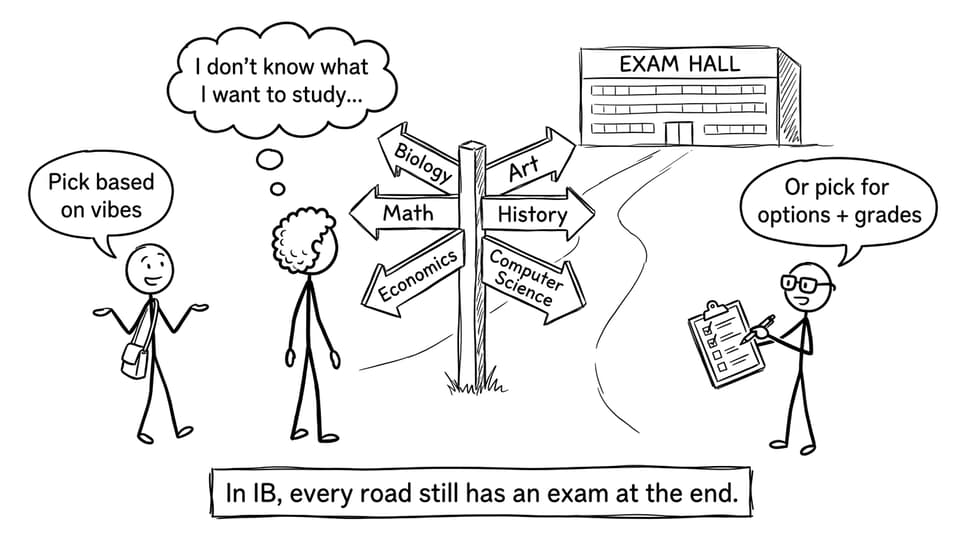
But the IB Diploma Programme is built for breadth. It’s designed to keep options open while still training you in depth. The real goal isn’t to predict your whole life at subject selection time. The goal is to choose an IB combination that (1) protects university pathways, (2) lets you score well, and (3) doesn’t make exam season miserable.
The quick IB subject checklist (keep your options open)
Use this before you commit to any IB combination:
-
Keep at least one strong science if you might go STEM later.
-
Choose the math level that won’t quietly cap your options.
-
Pick one essay-based subject you can actually write well in under time pressure.
-
Protect your grades: “flexible” only helps if your score stays high.
-
Check HL vs SL strategically (not emotionally).
-
Build a revision system early so your subjects feel manageable.
If you want the full structure of how the programme fits together, skim How Many Subjects Do You Take in the IB? (Complete Breakdown). It’s calming in the way a clear map is calming.
What the IB subject groups really mean when you’re undecided
The IB requires six subjects across groups, plus TOK/EE/CAS. The groups are broad on purpose, and that’s good news when university is still a question mark.
When you don’t know your major yet, your best move is to build a “wide base” and then choose HLs that signal either readiness (for selective degrees) or genuine strength (for your final score).
A useful extra read here is the Complete IB Revision Guide: From Subject Selection to Final Exams, because it connects subject choice to the reality of revising for exams.
The safest IB combinations (without being boring)
There is no single perfect IB combo for undecided students. But there are patterns that keep doors open.
A flexible “STEM-open” IB pattern
If there’s even a small chance you’ll apply to medicine, engineering, CS, or natural sciences later, consider:
-
Group 1: Language A (strong writing helps everywhere)
-
Group 2: Language B (practical and widely accepted)
-
Group 3: Economics or Geography (data + essays)
-
Group 4: Biology/Chemistry/Physics (at least one)
-
Group 5: Math AA or AI (choose level carefully)
-
Group 6: An art you enjoy, or a second science/humanities option
The point isn’t to “look impressive.” The point is to avoid accidental dead ends.
If you’re torn on sciences specifically, Which Science Should I Take in IB? Biology vs Chemistry vs Physics helps you match the IB science choice to how you actually think.
A flexible “humanities-open” IB pattern
If you lean toward law, politics, business, psychology, languages, or arts degrees:
-
Group 1: Language A (HL can be powerful if writing is your strength)
-
Group 2: Language B (choose one you can score well in)
-
Group 3: History/Economics/Global Politics (pick what fits your brain)
-
Group 4: One science that you won’t resent revising
-
Group 5: Math AI or AA (enough to stay competitive)
-
Group 6: Arts, or another Group 3 to deepen your profile
For Group 3 decision-making, Choosing the Right IB Group 3 Subject for Your Career Goals is a good compass.
HL vs SL: where most IB students accidentally overcommit
The biggest “I didn’t see this coming” moment in IB is workload. A subject can sound interesting until you’re revising it under a clock.
HL is not just “a bit more content.” HL is pacing, depth, and exam stamina.
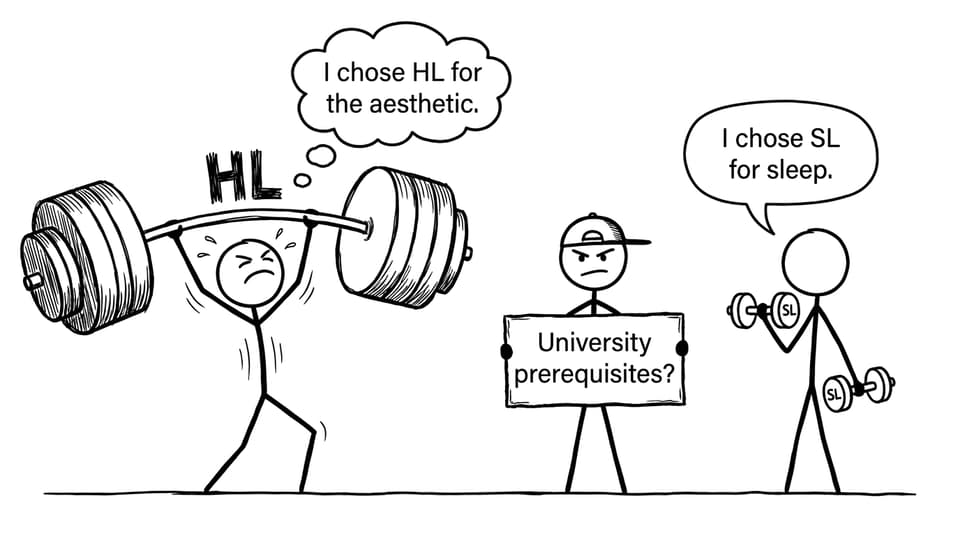
A practical approach when you’re undecided:
-
Make Math and one Science your “option protectors” (often HL, depending on your strength and likely pathways).
-
Make your third HL either (a) your best scoring subject or (b) the one that aligns with your curiosity.
-
Keep at least one SL that feels like a recovery subject in exam season.
If you want a clear framework for this decision, use How Do I Choose My HL Subjects Wisely?. It’s focused on avoiding the classic IB trap: choosing “hard HLs” for status and paying for it later.
Don’t choose “the hardest” or “the easiest” IB subjects blindly
Students ask this because they want certainty. But “hard” in the IB is personal: is it hard because of math, because of writing, because of memorization, or because of time?
If you’re comparing sciences:
-
Use Easiest Science Subjects in IB to understand what feels lighter for many students.
-
Balance that with The Hardest Science Subjects in IB: A Comprehensive Guide so you don’t walk into a workload you can’t sustain.
And if you’re tempted to “take the hardest combo to impress universities,” read Is It Worth It Choosing Hard Subjects at IB?. The article’s underlying message is simple: challenge helps only if it’s a challenge you can score well in.
The RevisionDojo way to stay calm: decide subjects, then build a system
There’s a quiet advantage to the IB: it rewards systems.
When you don’t know your university plan yet, the most powerful thing you can do is stop trying to “solve your future” and start building repeatable exam performance.
RevisionDojo was built for that. You can:
-
Use the Study Notes to learn topics cleanly without rewriting textbooks.
-
Drill weak points with the Questionbank so your revision looks like the exam.
-
Lock in definitions, formulas, and essay plans with Flashcards.
-
Ask AI Chat when you’re stuck, then immediately test the fix.
-
Improve written work with Grading tools that give criterion-style feedback.
-
Reduce coursework stress with the Coursework Library (so IA deadlines don’t sabotage exam prep).
-
Train realism with Predicted Papers and Mock Exams.
-
Add Tutors when you need a human strategy reset.
This matters because the best IB subject choice in the world still fails if you don’t revise in a way that converts effort into marks.
Choosing IB subjects is choosing flexibility, not perfection
If you don’t know what you want to do at university yet, your job isn’t to force certainty. Your job is to choose an IB subject set that keeps options open and supports strong exam performance.
Build breadth. Pick HLs with intent. Protect your grades. Then commit to a revision system that makes your IB workload feel smaller week by week.
When you’re ready to turn subject uncertainty into exam confidence, start with RevisionDojo and use the Questionbank, Study Notes, Flashcards, AI Chat, Grading tools, Predicted Papers, Mock Exams, Coursework Library, and Tutors to make your next decision the only one that really matters: what you’ll do today to earn marks.