
The three pilgrimage festivals can initially look like separate collections of dates, foods and rituals. Yet Pesach, Shavuot and Sukkot form a connected religious journey: liberation from slavery, encounter with Torah, and life under divine protection. For IB World Religions SL, that connection matters more than memorizing isolated customs.
Known collectively as the Shalosh Regalim (שָׁלֹשׁ רְגָלִים), meaning the Three Pilgrimage Festivals, these observances once brought ancient Israelites to the Temple in Jerusalem. Today, they continue through worship, study, storytelling and domestic ritual. They express Judaism key concepts such as covenant, memory, freedom, revelation, responsibility and community.
A strong IB answer should explain what happens, connect practice to belief, reference sacred texts, and acknowledge that Jewish communities do not always interpret or observe each festival identically.
The three festivals at a glance
| Festival | Hebrew meaning | Central associations | Characteristic practices |
|---|---|---|---|
| Pesach (פֶּסַח) | Passover | Exodus, liberation and collective memory | Seder, Haggadah, matzah and avoidance of chametz |
| Shavuot (שָׁבוּעוֹת) | Weeks | Harvest, first fruits and the giving of Torah | Torah study, synagogue readings and counting from Pesach |
| Sukkot (סֻכּוֹת) | Booths | Harvest, wilderness dependence and joy | Dwelling in a sukkah and using the four species |
For revision, check that you can:
- Define each festival using its Hebrew name and historical setting.
- Identify at least one ritual and one primary text for each.
- Explain how the festivals form a theological sequence.
- Compare Orthodox, Conservative or Masorti, and Reform approaches without treating any community as uniform.
Why are they called pilgrimage festivals?
The Hebrew word regel can refer to a foot or a pilgrimage occasion. Exodus 23:14-17 and Deuteronomy 16:16 command appearances before God three times each year, associated with Pesach, Shavuot and Sukkot. In the Temple period, pilgrimage involved travelling to Jerusalem, communal celebration and offerings connected to the agricultural cycle.
The destruction of the Second Temple in 70 CE made the Temple pilgrimage and sacrificial system impossible. Rabbinic Judaism preserved the festivals through prayer, Torah study, synagogue worship and domestic ritual. The physical journey changed, but sacred time, collective memory and covenantal meaning remained.
Some Jewish people visit Jerusalem during these festivals today, but this is not equivalent to performing the biblical Temple rites. Recognizing that distinction demonstrates historical precision in an IB response.
Pesach: freedom remembered through ritual
Pesach, commonly called Passover, recalls the Exodus from slavery in Egypt. Its scriptural foundations include Exodus 12-13, while Deuteronomy 16 connects the festival with pilgrimage and sacrifice. The Hebrew Bible also calls this period Chag HaMatzot, the Festival of Unleavened Bread.
The best-known observance is the seder (סֵדֶר), meaning “order.” This structured meal uses symbolic foods, questions, blessings and narrative to retell the Exodus. Participants read from the Haggadah (הַגָּדָה), meaning “telling,” whose form developed through rabbinic tradition. Mishnah Pesachim 10 is an important early source for the seder’s structure.
Matzah, unleavened bread, can express urgency and hardship. Chametz, food made from specified grains that has leavened, is removed or avoided according to different levels of observance. Orthodox communities generally follow detailed halakhic requirements, while Conservative or Masorti and Reform communities may interpret particular obligations differently. Practice still varies among individuals within each movement.
Pesach supports complementary interpretations. A historical and covenantal reading emphasizes God’s deliverance of Israel and the formation of a people. An ethical reading asks how the memory of slavery should shape responses to oppression, strangers and human dignity. Ritual memory therefore connects a foundational narrative with present responsibility.
Shavuot: from agricultural offering to revelation
Shavuot means “weeks.” It follows the seven-week counting period beginning during Pesach, known as Sefirat HaOmer, the Counting of the Omer. Leviticus 23:15-21 gives the counting instructions, while Exodus 23:16 presents Shavuot as a harvest festival. Deuteronomy 26 describes the offering of first fruits, or bikkurim (בִּכּוּרִים).
The Torah emphasizes harvest, weeks and first fruits. The strong association between Shavuot and the giving of the Torah at Sinai emerges through later Jewish interpretation of biblical chronology. This distinction demonstrates how a festival’s meaning can develop through interpretive tradition rather than remaining static.
Many communities hold a Tikkun Leil Shavuot, an all-night session of Torah study. Synagogues commonly read the Ten Commandments, and the Book of Ruth is traditionally read in many communities. Ruth’s harvest setting, loyalty and acceptance of Israel’s God make the text especially resonant.
Orthodox observance treats Shavuot as a Yom Tov, a festival day governed by religious law. Many Reform communities also celebrate revelation but may emphasize its continuing character, understanding Torah as encountered and interpreted across generations. Students can therefore compare revelation as a decisive event at Sinai with revelation as an ongoing relationship with sacred teaching.
Sukkot: security inside a fragile shelter
Sukkot is the plural of sukkah (סֻכָּה), a temporary booth. Leviticus 23:42-43 connects dwelling in booths with the Israelites’ journey after leaving Egypt. Deuteronomy 16:13-15 presents Sukkot as a harvest celebration marked by joy and inclusion.
Many Jews eat meals in a sukkah, and some sleep there when circumstances and religious rulings permit. Its temporary structure makes vulnerability visible. A person may possess a permanent home yet enter a fragile shelter, remembering that security cannot be reduced to walls or property.
Another central mitzvah, or commandment, involves the arba minim (אַרְבַּעַת הַמִּינִים), the four species named in Leviticus 23:40. They are the lulav or palm branch, hadassim or myrtle branches, aravot or willow branches, and the etrog, a citron. They are held together and waved during worship according to established custom.
One interpretation emphasizes historical memory and God’s protection in the wilderness. Another highlights agricultural gratitude and dependence on the natural world. Contemporary Jews may draw ecological lessons from Sukkot, although this is better presented as a modern application than the festival’s only meaning.
Orthodox practice commonly gives close attention to legal requirements governing a valid sukkah and four species. Conservative or Masorti communities also engage halakhic reasoning, sometimes reaching different conclusions about participation and obligation. Reform settings may emphasize community, hospitality, gratitude and ethical meaning while retaining traditional rituals.
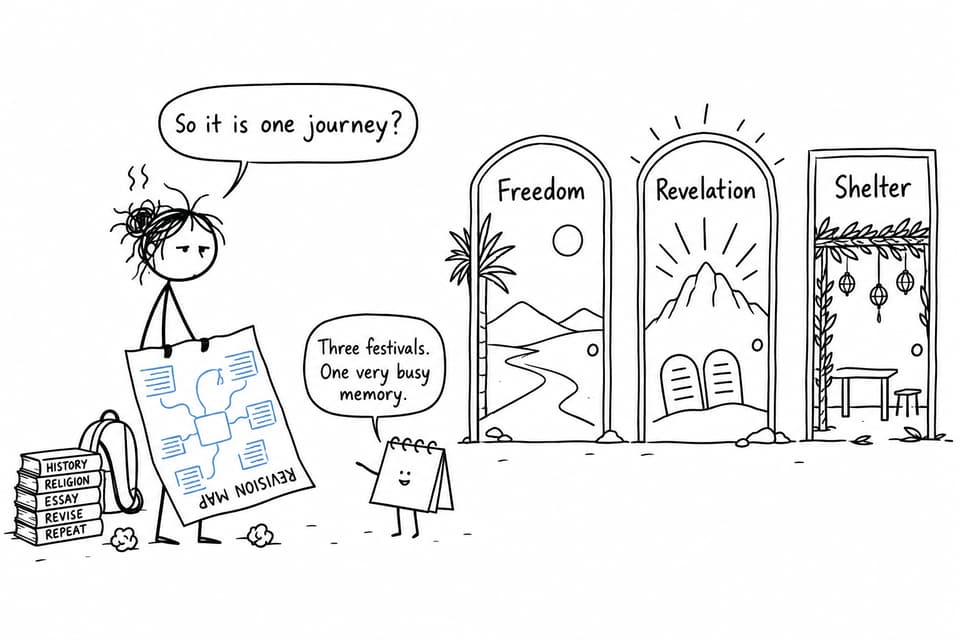
One cycle: liberation, revelation and dependence
The festivals become easier to understand when treated as a sequence:
- Pesach asks what freedom is for. Liberation creates possibility, but freedom alone does not supply direction.
- Shavuot connects freedom with covenant. Torah gives liberated life a framework of teaching, worship and responsibility.
- Sukkot challenges the illusion of control. Covenant life is lived with gratitude, vulnerability and dependence on God and community.
This sequence is an interpretation, not a substitute for each festival’s agricultural history. Its value lies in showing how ritual time tells a theological story. Judaism remembers freedom, receives responsibility, and celebrates despite uncertainty.
The three fundamental questions
The IB World Religions course organizes study around three fundamental questions. The pilgrimage festivals offer nuanced Jewish responses to each.
What is the human condition?
Human beings can experience oppression, forgetfulness and insecurity. Pesach confronts bondage, Shavuot addresses the need for moral and sacred orientation, and Sukkot exposes vulnerability. Yet people can also remember, learn, celebrate and act within a community.
Where are we going?
Jewish understandings of personal and collective destiny may include covenantal faithfulness, a repaired or redeemed world, messianic hope and Olam HaBa, the World to Come. These festivals focus primarily on collective sacred history and faithful life rather than offering one systematic account of the afterlife.
How do we get there?
The cycle points toward mitzvot (commandments), remembrance, Torah study, ethical action, worship and communal participation. Transformation is not merely inward belief. It is practised through repeated actions connecting the individual to God, Jewish history and other people.
Connecting the festivals to the five themes
For rituals, compare the seder, night study and sukkah. For sacred texts, use Exodus 12-13, Leviticus 23 and Deuteronomy 16, then explain how the Haggadah and rabbinic interpretation shape practice. For doctrines and beliefs, discuss covenant, divine liberation, revelation and providence.
For religious experience, examine how taste, storytelling, study and temporary dwelling make inherited memory immediate. For ethics and moral conduct, connect freedom with responsibility, harvest with generosity, and hospitality with care for others. RevisionDojo’s guide to common IB World Religions misconceptions helps clarify why description alone is not analysis.
How to revise the festivals effectively
Begin with a three-column comparison grid covering text, ritual and meaning. Turn vocabulary such as seder, Omer, bikkurim, sukkah and arba minim into Flashcards. Then practise paragraphs that make a claim, cite a primary text, explain a ritual and add an interpretive or denominational qualification.
RevisionDojo brings this process into one place. Study Notes establish accurate foundations, while the Questionbank and AI Chat expose gaps in understanding. Grading tools help determine whether an answer has moved from description to analysis, and IB World Religions mock exam preparation supports timed application. Predicted Papers and Mock Exams introduce unfamiliar prompts, while the World Religions Coursework Library and Tutors support research and feedback.
Students building their foundations can read what to expect in first-term IB World Religions. Those planning independent research can consult the World Religions IA timeline and explore focused World Religions research topics.
Remember the journey, not only the objects
Matzah, Torah study and a sukkah are memorable, but each points beyond itself. Pesach turns freedom into obligation. Shavuot turns harvest and revelation into study. Sukkot turns a fragile shelter into gratitude and trust.
Describe carefully, interpret respectfully, compare without stereotyping, and support claims with texts. RevisionDojo then provides the connected tools to transform those ideas into precise, exam-ready analysis.