


When people say the IB is “a marathon,” Group 4 is usually the hill that appears halfway through the course, right when you were starting to feel confident.
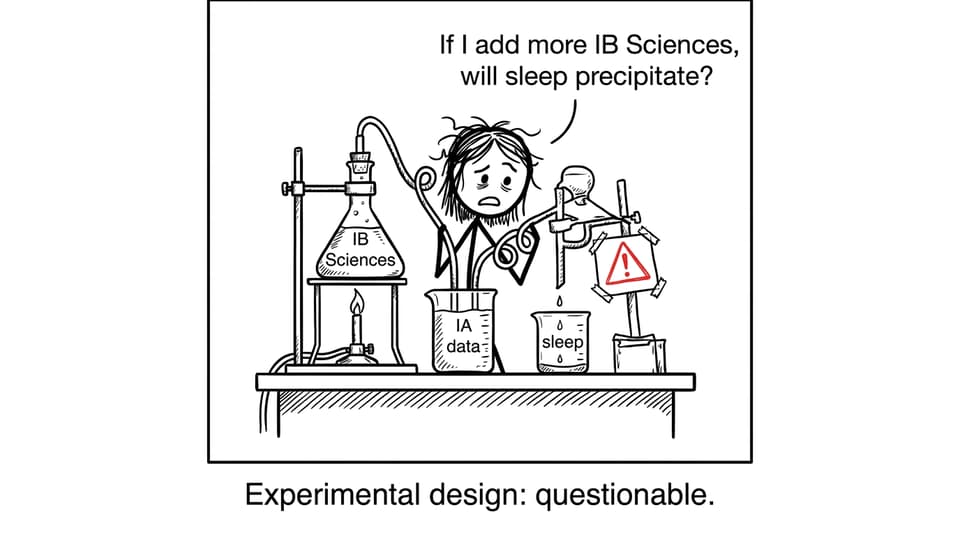
You open a syllabus, see experiments, data processing, unfamiliar command terms, and suddenly you’re not just revising facts. You’re revising how to think.
That’s the quiet promise of IB Sciences: they don’t reward the student who “reads more.” They reward the student who practises doing science: explaining, modelling, evaluating, and staying calm when the numbers look wrong.
This guide breaks down what subjects sit inside Group 4, what each one is really like in practice, and how to choose and revise strategically for exams.
What is Group 4 in the IB Sciences?
Group 4 is the experimental sciences group in the IB Diploma Programme. Most schools offer a core set of IB Sciences that train you to:
-
Understand concepts and apply them to new contexts
-
Design investigations and handle experimental uncertainty
-
Analyse data (not just calculate it)
-
Communicate scientific reasoning clearly under time pressure
You must take at least one Group 4 subject for the full diploma. If you’re wondering whether there’s any “workaround,” read Is It Possible to Skip Group 4 (Science) in IB?.
Quick checklist: how to pick your IB Sciences subject
Before you choose based on vibes (we’ve all done it), run this quick filter:
-
Your future plans: medicine, engineering, environmental policy, software, design
-
Your strengths: writing vs calculations vs memorising vs building systems
-
Your tolerance for uncertainty: labs rarely behave; some subjects punish that more
-
Your timetable reality: what your school actually offers at HL/SL
-
Your revision style: flashcards, problem sets, data-based questions, essays
If you’re also thinking about SL/HL combinations, this is useful: IB Sciences: Mixing SL and HL in Group 4 (Rules + Combos).
What subjects are in Group 4? The core IB Sciences list
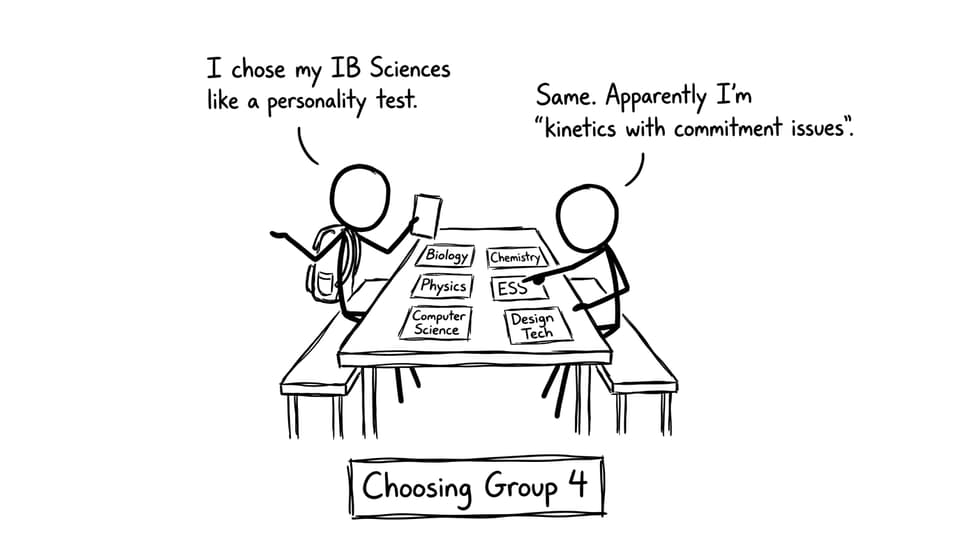
Schools vary, but these are the most common Group 4 IB Sciences options.
IB Biology (SL and HL)
Biology is the science of living systems, which means the content can feel comforting (because it’s familiar) and overwhelming (because it’s everywhere). You’ll move from molecules to ecosystems, and the hardest part is often not understanding a concept once; it’s recalling it cleanly under exam conditions.
You’ll study things like:
-
Cell biology and membranes
-
Genetics, inheritance, and gene expression
-
Evolution and natural selection
-
Human physiology
-
Ecology and conservation
Biology tends to fit you if: you’re patient with detail, good at explaining processes, and willing to practise drawing and labelling structures from memory.
For an exam-focused breakdown, use IB Biology: Complete Guide for IB Exam Prep and pair it with RevisionDojo’s Questionbank, Study Notes, and Flashcards to turn “I understand” into “I can answer in 90 seconds.”
IB Chemistry (SL and HL)
Chemistry is the subject where your understanding can feel invisible until you’re forced to predict outcomes. It’s a course of patterns: bonding, energetics, equilibrium, and kinetics. Then the exam asks you to combine three patterns at once.
You’ll study things like:
-
Atomic structure and periodicity
-
Bonding and structure
-
Energetics and thermochemistry
-
Kinetics and rates
-
Organic chemistry foundations
Chemistry tends to fit you if: you like rules that explain reality, you can handle multi-step problems, and you’re comfortable learning a language of mechanisms and definitions.
If equilibrium makes your brain fog over, start here: IB Chemistry: Dynamic Equilibrium, Finally Clear. For full topic practice, RevisionDojo’s AI Chat and Grading tools can help you tighten explanations to markscheme style.
IB Physics (SL and HL)
Physics is often described as “hard,” but that’s not the whole story. It’s hard in a specific way: you must translate the real world into models, then use mathematics as the grammar. When it clicks, it feels clean. When it doesn’t, it feels like you’re arguing with the universe.
You’ll study things like:
-
Mechanics and motion
-
Thermal physics and energy transfers
-
Waves and optics
-
Electricity and magnetism
-
Atomic and nuclear ideas
Physics tends to fit you if: you enjoy problem solving, you don’t panic when an answer doesn’t match the back of your notebook, and you’re willing to practise under timed conditions.
A motivating read for the mindset side is The Quest for a 7 in IB Physics. For targeted revision, RevisionDojo’s Mock Exams and Predicted Papers help you practise the timing and structure that physics demands.
IB Environmental Systems and Societies (ESS) (SL only)
ESS is interdisciplinary: part science, part geography, part policy. That makes it feel “easier” to some students and strangely difficult to others. The content is readable, but the assessment rewards synthesis: connecting evidence, stakeholders, and trade-offs.
You’ll study things like:
-
Ecosystems and biodiversity
-
Sustainability and resource use
-
Pollution, climate, and human impacts
-
Environmental value systems and decision-making
ESS tends to fit you if: you write well, like real-world case studies, and can balance scientific evidence with evaluation.
If you’re comparing workload and difficulty, read Is ESS Really the Easiest IB Subject? and Which IB Science Is the Easiest? A Detailed Guide.
IB Computer Science (SL and HL)
Computer Science is a Group 4 option in many schools, and it’s not “just coding.” It’s computational thinking: how to represent problems, design algorithms, and reason about systems. Your IA can be a huge advantage if you build something you actually understand.
You’ll study things like:
-
Algorithms and data structures
-
Software development thinking
-
System fundamentals (hardware, networks, data)
-
Broader impacts of technology
Computer Science tends to fit you if: you like structured logic, you learn by building, and you’re willing to debug patiently.
RevisionDojo’s Coursework Library and Tutors are especially useful here because strong projects come from clear scope and steady feedback, not last-minute ambition.
IB Design Technology (SL and HL)
Design Tech is science through making: you’ll think about users, materials, sustainability, modelling, and iteration. It’s creative, but not vague. You’re graded on justification, testing, evaluation, and how well your decisions are linked to evidence.
You’ll study things like:
-
Design thinking and product development
-
Modelling and prototyping
-
Sustainability and life-cycle considerations
-
Manufacturing processes and systems
Design Tech tends to fit you if: you like solving practical problems and can write clearly about why your design choices make sense.
The hidden curriculum of IB Sciences: what exams really reward
Most students revise IB Sciences like they’re revising history: “cover content, make notes, hope.” But science exams reward a tighter loop:
-
Active recall (flashcards, blank-page blurting)
-
Exam-style practice (especially data-based questions)
-
Mark-efficient explanations (command terms matter)
-
Error tracking (fix patterns, not single questions)
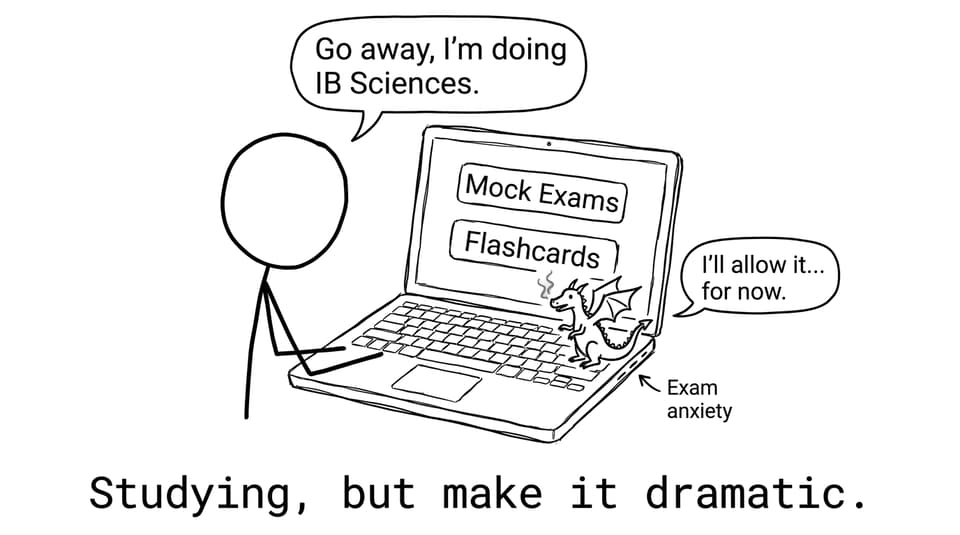
A realistic plan helps more than motivation. Use What Is the Best Study Schedule for IB Group 4 Sciences to build weekly structure, then execute with RevisionDojo’s Questionbank, Study Notes, Flashcards, Mock Exams, and AI Chat.
Closing: choose your IB Sciences, then build your system
Group 4 can feel like six different worlds, but the goal is the same in every one: learn to think clearly when the question is unfamiliar.
Pick the Group 4 IB Sciences subject that matches your strengths and your future plans, then commit to a simple routine: exam-style questions, honest correction, and steady recall. When you’re ready to turn effort into points, RevisionDojo is built for exactly that, with a Questionbank for targeted practice, Study Notes for clarity, Flashcards for recall, AI Chat for explanations, Grading tools for feedback, Predicted Papers and Mock Exams for exam readiness, plus a Coursework Library and Tutors when you need expert support.
If you want extra guidance across Group 4 topics, browse the IB Sciences tag hub and the Group 4 tag hub.