

The uncomfortable truth about studying every topic for IB
The night before an IB mock, a student I know sat at their desk with a beautiful plan: every topic, color-coded, highlighted, and re-highlighted. It looked like control.
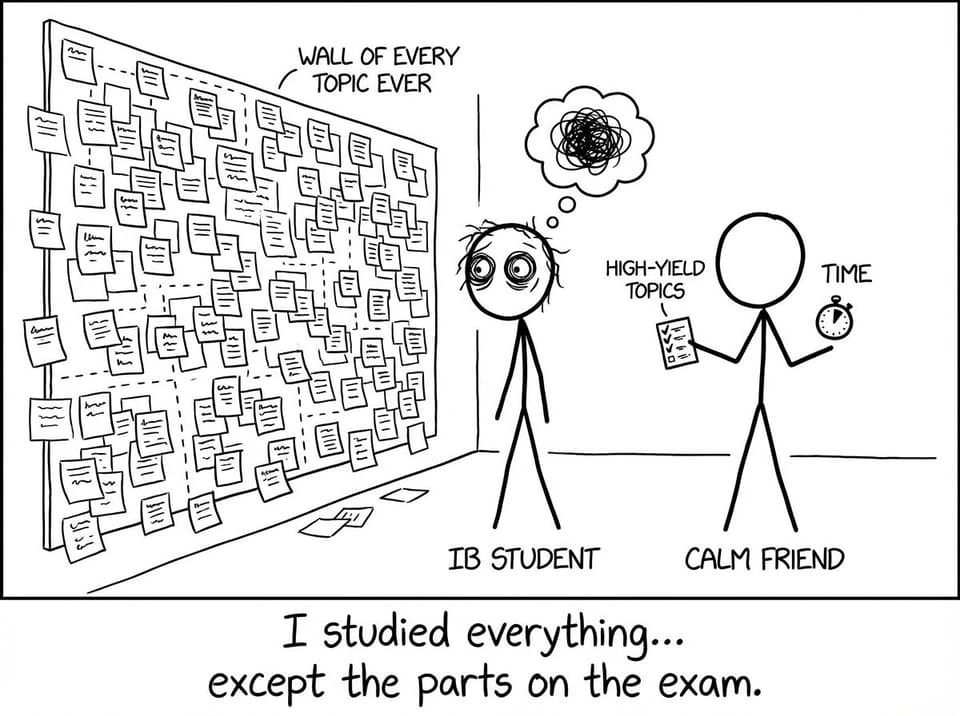
But the next morning, they froze on questions they had "covered." Not because they were lazy. Because "covering" is not the same as being able to perform under pressure.
That's the quiet trap of IB revision: the syllabus is large enough that "study everything" sounds responsible, but vague enough that it becomes a kind of procrastination. You stay busy. You feel safe. And sometimes you still lose marks.
So, do you need to study every topic for IB?
Not in the way most students mean it. You need coverage for confidence, and depth for marks. Those are different jobs, and the best IB students treat them differently.
Quick IB checklist: study smarter without skipping the syllabus
Use this quick checklist before you decide what to revise next in IB:
- Identify which papers you're actually sitting (per subject, SL/HL).
- Build "baseline coverage" for the full IB syllabus (light touch).
- Prioritize "high-yield + weak spots" for deep practice.
- Spend most time on active recall (Flashcards + questions), not rewriting.
- Prove readiness with timed practice (Mock Exams and predicted sets).
- Use fast feedback loops (AI Chat, Grading tools, markscheme-style feedback).
If you want the full workflow in one place, start with RevisionDojo for IB and then anchor your daily practice to the Questionbank.
What "study every topic" really means in IB
In IB, students usually mean one of two things:
"I want to understand everything"
That's a healthy impulse. IB rewards connected understanding. But understanding every detail of every subtopic is not the same as scoring well. Exams reward selective precision: the right idea, applied in the right format, at the right time.
"I'm scared of missing something"
Also normal. IB exams can feel like a foggy map. The response is often to over-pack: more notes, more summaries, more hours. But fear doesn't disappear from quantity. It disappears from evidence.
Evidence looks like this:
- you can answer exam-style questions without hints
- you can explain mistakes clearly
- you can hit timing without panic
That is why RevisionDojo is built as a loop, not a library: Study Notes to learn, Flashcards to retain, Questionbank to apply, AI Chat to unblock, Mock Exams and Predicted Papers to simulate, plus Grading tools and the Coursework Library when coursework pressure leaks into exam season.
For a structured guide, see How to Study for IB Exams: Step-by-Step Guide.
The 80/20 rule (and why IB makes it feel risky)
Most IB subjects have a familiar pattern: a smaller set of concepts and skills show up again and again, but in different disguises.
That doesn't mean you "skip" the other 80%.
It means you treat revision like finance:
- Coverage is your insurance.
- Depth is your investment.
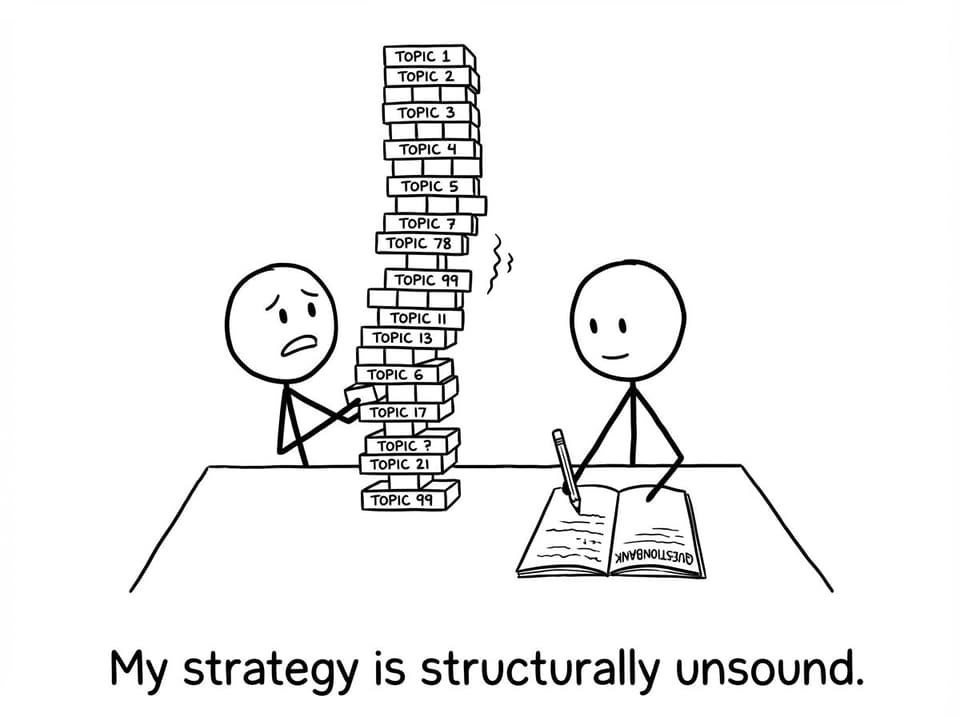
Coverage prevents blind spots.
Depth produces marks.
The best IB strategy is not "study everything equally." It's "touch everything, master the parts that move your grade."
A practical way to decide what to prioritize in IB
Here's a calm, repeatable model you can use across IB subjects.
Build a two-layer syllabus plan
Layer 1: Baseline coverage (touch every topic)
Goal: recognition and basic recall.
How:
- Use short, syllabus-aligned summaries.
- Make quick Flashcards for definitions, formulas, diagrams, and core processes.
- Do a small set of topic questions to check you're not completely lost.
RevisionDojo makes this faster because you can start with examiner-written materials and go straight into practice: Notes + Flashcards + Question Bank (Free).
Layer 2: High-yield mastery (go deep where it matters)
Goal: exam performance.
How:
- Drill the question types you keep missing.
- Track errors and re-attempt after 48-72 hours.
- Use timed sets to train pacing.
A good place to build this habit is Comprehensive IB Question Bank: Thousands of Practice Questions.
When you do need broad coverage for IB (and when you don't)
You need broad coverage when:
You're still early in the course
Early IB success comes from building a mental map. If you only study what feels "important," you can accidentally build a map with missing roads. Baseline coverage keeps subjects coherent.
Your subject links topics together
Many IB questions reward connections. Even when a question targets one unit, the best answers often borrow language or concepts from another.
Your confidence is fragile
Not the dramatic kind. The quiet kind: you avoid certain topics because you're afraid they'll confirm you're behind. Baseline coverage is a gentle way to remove that fear.
You don't need equal depth across the entire IB syllabus when:
You're in the final stretch
Close to exams, time is the real constraint. Your best use of time is improving the next mark you're likely to earn.
Your results show clear weak patterns
If your mistakes cluster, your revision should cluster. A Questionbank plus analytics-style review is more honest than a schedule that treats every topic as equally urgent.
If you need a realistic structure for the final weeks, use the planning logic in IB revision timetable.
The best IB revision metric isn't "topics covered"
The most dangerous sentence in IB is: "I've done that topic."
Replace it with questions that measure performance:
- Can I answer questions on this topic without notes?
- Can I explain why the markscheme gives marks where it does?
- Can I do it under time pressure?
- Can I repeat it correctly a week later?
This is exactly why RevisionDojo's ecosystem works as a system:
- Study Notes reduce confusion quickly.
- Flashcards make forgetting visible (and fixable).
- Questionbank forces you to produce IB-shaped answers.
- AI Chat (Jojo) helps you recover momentum at the exact moment you would normally stall.
- Mock Exams and Predicted Papers make the exam feel familiar.
- Grading tools and the Coursework Library stop coursework from consuming the whole calendar.
- Tutors provide human correction when you need it.
To see the "all-in-one" loop explained clearly, read RevisionDojo App: The Smarter Way to Prep for IB Exams.

A simple weekly plan that balances breadth and depth for IB
Here's a practical weekly routine that works for most IB students (adjust per subject load).
Two sessions for coverage
- 20-30 minutes: Study Notes on a smaller subtopic
- 10 minutes: Flashcards (new + review)
- 20 minutes: a short Questionbank set to confirm basics
Three sessions for mastery
- 40-60 minutes: targeted Questionbank practice on your weakest subtopics
- 10 minutes: error log (what went wrong, what to do next)
- 10 minutes: Flashcards built from mistakes
One timed session for realism
- Timed section or mini-mock
- Review immediately, then pick 1-2 topics to attack next week
If you're not doing timed practice yet, start with How to Run Timed IB Mock Exams in RevisionDojo (Exam Mode + Test Builder) and then commit to one session per week.
The "selective depth" mindset: you're not skipping, you're sequencing
The healthiest way to think about IB is this:
You are not allowed to ignore the syllabus.
But you are allowed to choose the order in which you master it.
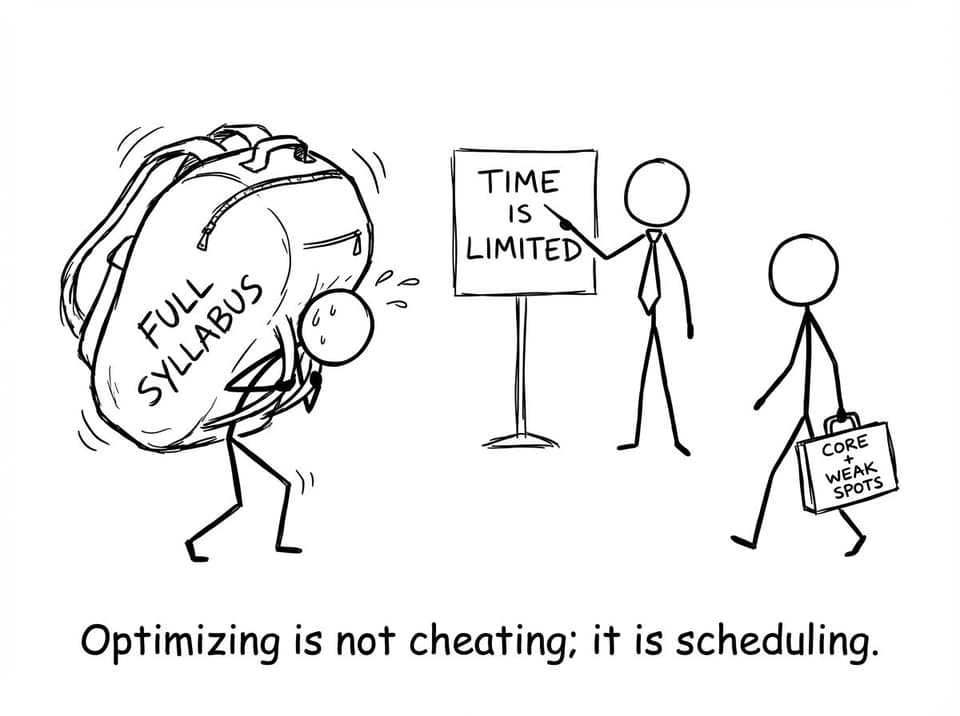
Selective depth is not a shortcut. It's an acceptance of how time works.
If you try to master everything at once, you end up with shallow familiarity.
If you build baseline coverage, then deepen the topics that are both high-yield and personally weak, you build something sturdier: performance.
Closing: The IB isn't asking for perfection, it's asking for proof
If you're preparing for IB exams, the goal is not to become a person who has read everything.
The goal is to become a person who can answer.
So yes, you should touch every topic in IB. But you don't need to master every topic equally, all at once. Build baseline coverage so nothing is unfamiliar. Then go deep where marks are being lost, using active recall and exam-style practice until your performance changes.
If you want that process to feel calmer and more direct, use RevisionDojo as your IB control panel: Study Notes for clarity, Flashcards for daily recall, Questionbank for targeted drills, AI Chat when you're stuck, Mock Exams and Predicted Papers for realism, plus Grading tools, the Coursework Library, and Tutors when coursework and pressure peak.
Start with International Baccalaureate (IB) hub, then build your next session around evidence: one topic, a set of questions, and honest feedback.