


RevisionDojo logoRevisionDojo logo
FeaturesPricingSchools
Study Notes

Understand the syllabus without the clutter

Move from the syllabus to clear, examiner-informed explanations, diagrams, and examples without losing your place.

Browse Study Notes

Eukaryotic Cells Divide Labour Among Membrane-Bound Organelles

Definition

Eukaryote

A eukaryote is a type of cell that contains a nucleus and membrane-bound organelles, enabling it to carry out specialized and coordinated functions. These cells are found in plants, animals, fungi, and protists.
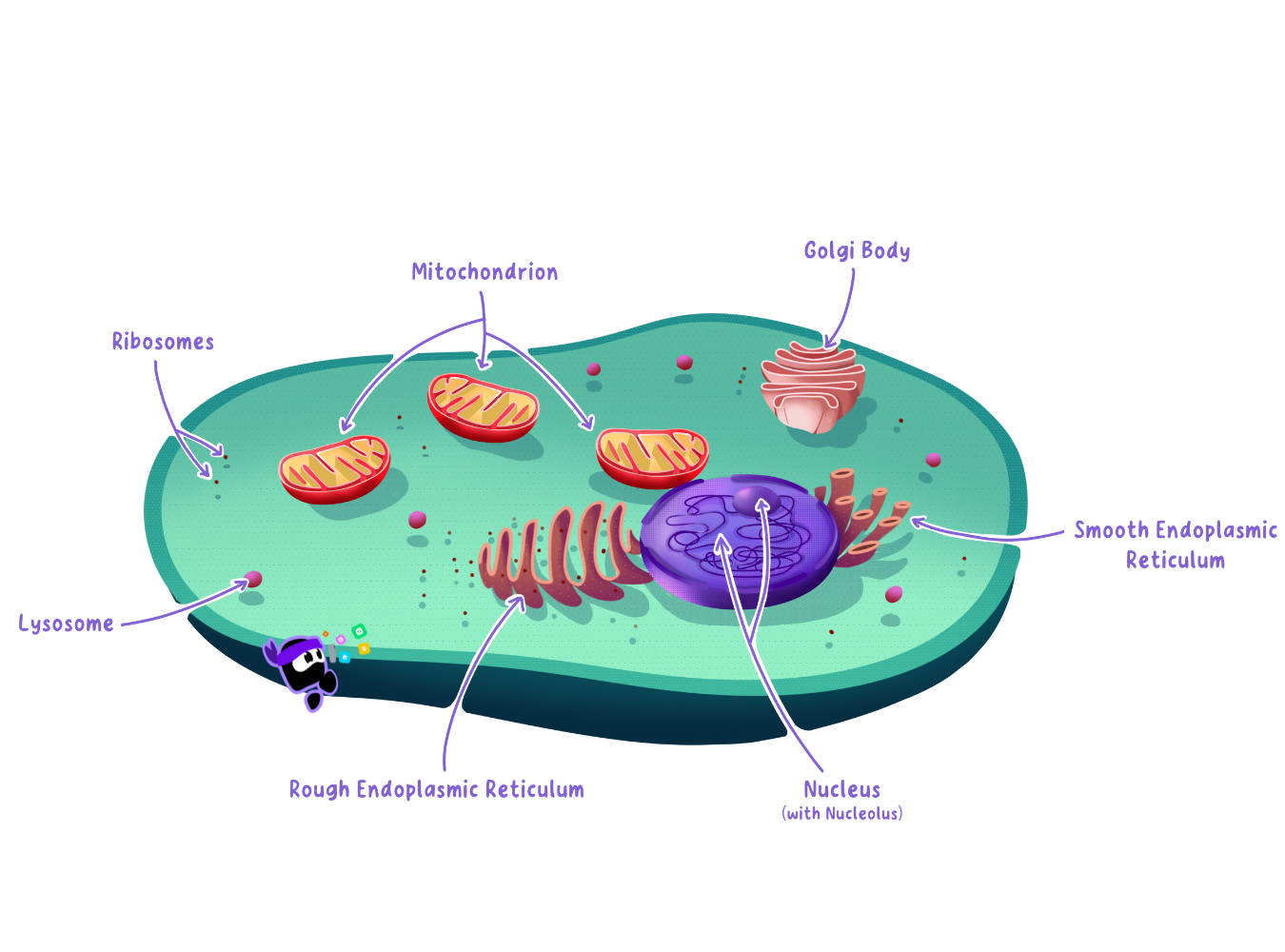
Eukaryotic Cell
Eukaryotic Cell
  1. A eukaryotic cell keeps its DNA inside a nucleus and splits its work among separate organelles.
  2. Each organelle handles one job, and together they keep the whole cell alive.

The Plasma Membrane Controls What Enters and Leaves

Definition

Plasma membrane

The plasma membrane is the thin, flexible boundary that surrounds a cell, separating its internal environment from the external surroundings. It is composed of a phospholipid bilayer with embedded proteins, cholesterol, and carbohydrates.
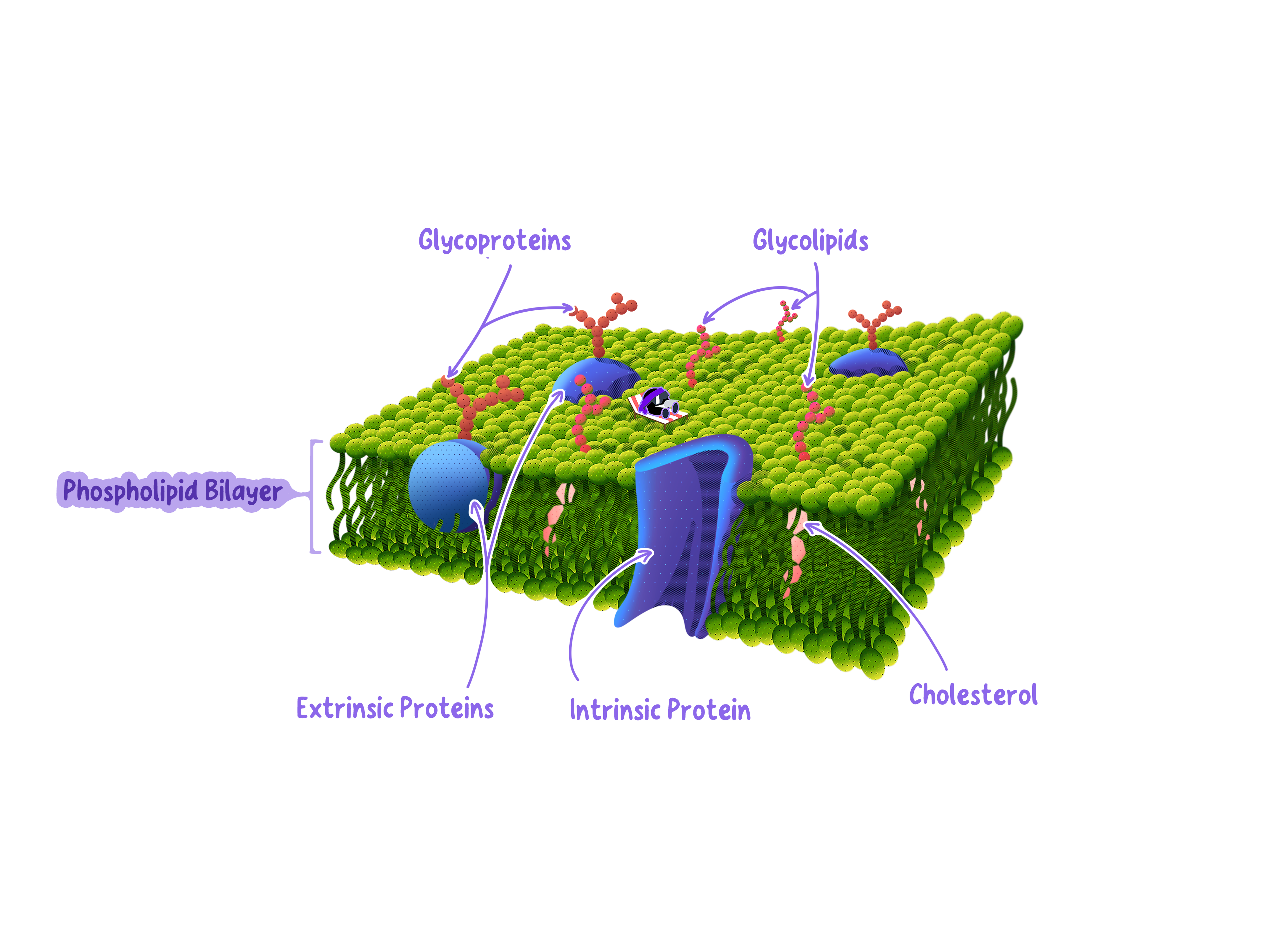
Plasma Membrane and its Phospholipid Bilayer
  1. The plasma membrane regulates the exchange of substances, letting nutrients in and waste out.
  2. It keeps the inside of the cell stable and maintains homeostasis.
  3. It also carries receptors for cell communication with the surroundings.
Tip
  • The membrane is more than a barrier.
  • It takes an active part in signalling and transport.

The Cytoplasm Is Where Most Reactions Happen

Definition

Cytoplasm

The cytoplasm is the jelly-like substance inside a cell, excluding the nucleus, where various cellular activities occur.

  1. The cytoplasm is the site of many metabolic reactions.
  2. It holds the organelles, allowing compartmentalisation so different reactions run at once in separate places.

80S Ribosomes Build the Cell's Proteins

Definition

80S Ribosomes

80S ribosomes are larger ribosomes found in eukaryotic cells that synthesize proteins.

  1. Ribosomes are found free in the cytoplasm or attached to the rough endoplasmic reticulum.
  2. They translate mRNA into proteins that the cell needs to grow and work.
Common Mistake
  • Eukaryotes have 80S ribosomes, while prokaryotes have 70S ribosomes.
  • The 80S ribosome is the larger of the two.

The Nucleus Stores DNA and Directs the Cell
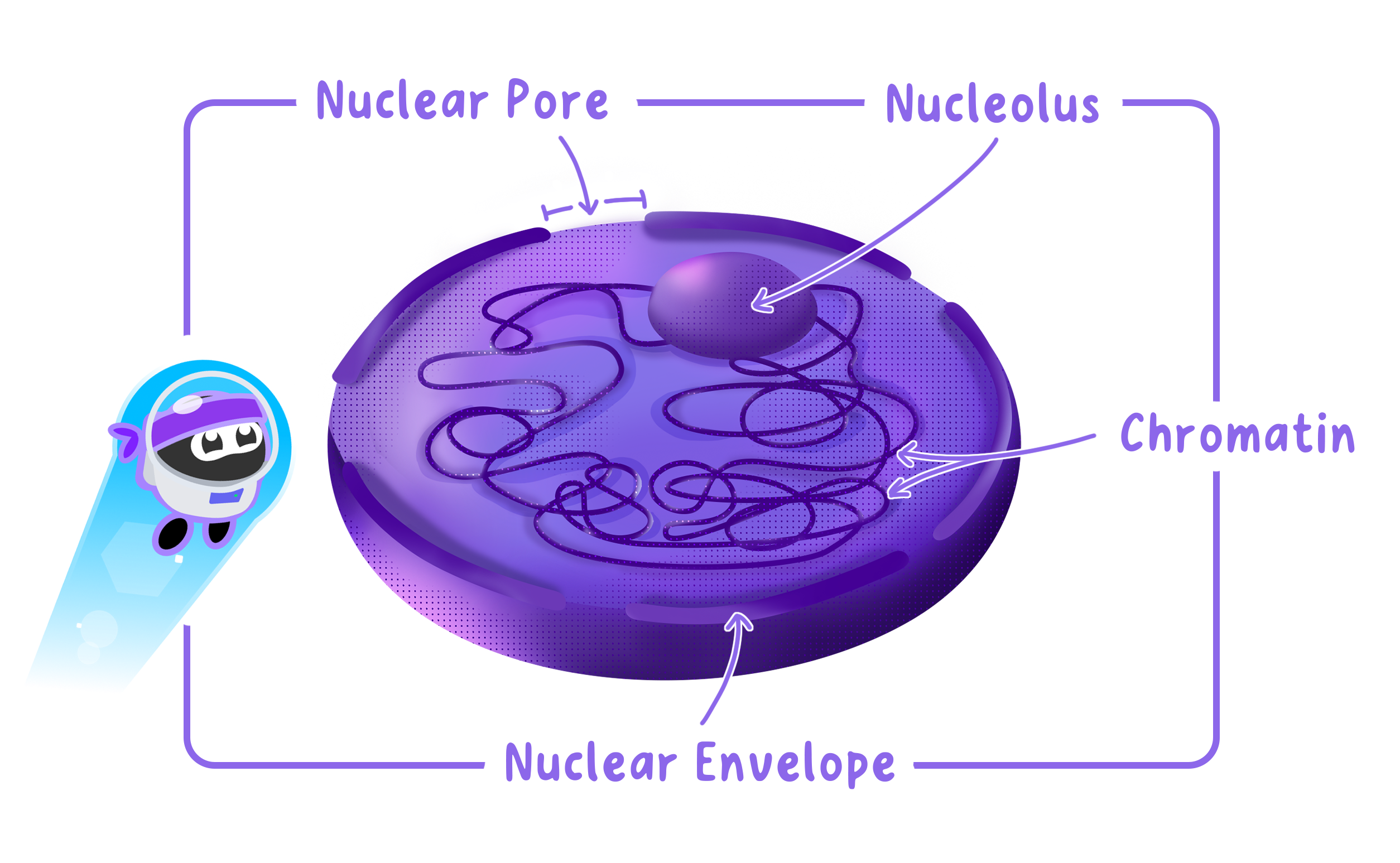
Structure of Nucleus
Definition

Nucleus

The nucleus is a double-membrane-bound organelle containing the cell’s DNA.

  1. The nucleus holds linear chromosomes made of DNA wound around histone proteins.
  2. The nuclear envelope has pores that control which RNA and proteins pass through.
  3. It directs the cell by controlling gene expression and passing on genetic information during cell division.
Analogy
  • Nuclear pores work like security checkpoints on an administrative building.
  • Only approved molecules are allowed in or out.

Membrane-Bound Organelles Separate the Cell's Jobs

Note
  • Unlike prokaryotes, eukaryotic cells contain membrane-bound organelles in the cytoplasm.
  • Examples include the mitochondria and endoplasmic reticulum.

Mitochondria Release Energy for the Cell
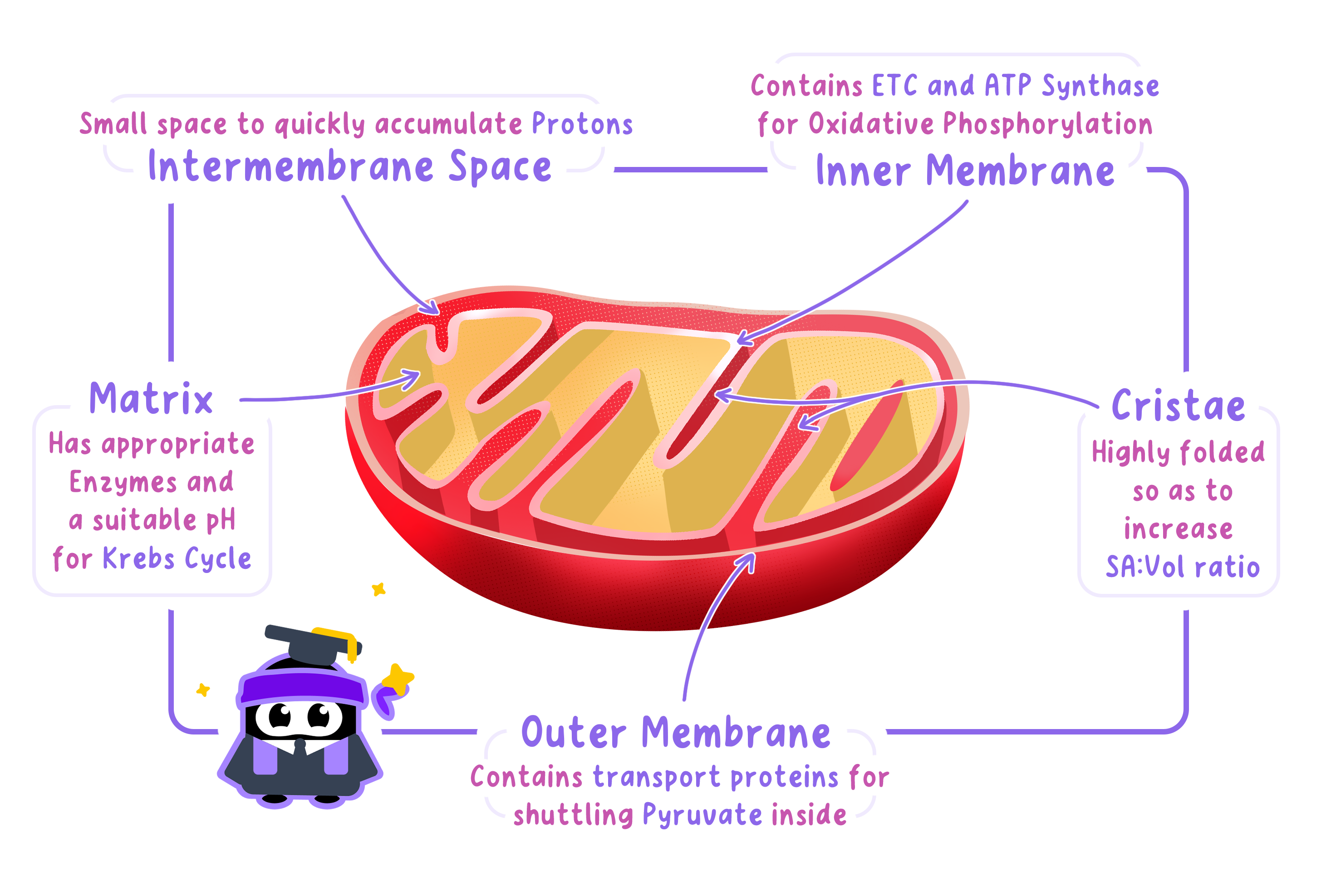
Structure of Mitochondria
Definition

Mitochondria

Mitochondria are double-membrane-bound organelles responsible for producing ATP through aerobic respiration.

  1. The inner membrane folds into cristae that increase the surface area for energy release.
  2. The matrix holds the enzymes for the Krebs cycle and other pathways.
Note
  • Mitochondria contain their own DNA and ribosomes.
  • This unusual feature is explored further in the HL topic on the origin of organelles.

The Endoplasmic Reticulum Makes and Moves Molecules

Definition

Endoplasmic Reticulum

A network of membranes involved in synthesis and transport.

  1. The endoplasmic reticulum is a network of membranes that moves materials through the cell.
  2. Rough ER is studded with ribosomes and makes proteins for secretion or for membranes.
  3. Smooth ER has no ribosomes and handles lipid synthesis, detoxification, and calcium storage.
Analogy
  • The ER is like the highway system of the cell, carrying goods to where they are needed.
  • Rough ER is the assembly line for proteins, and smooth ER is the chemical plant for lipids.

The Golgi Apparatus Modifies and Ships Products
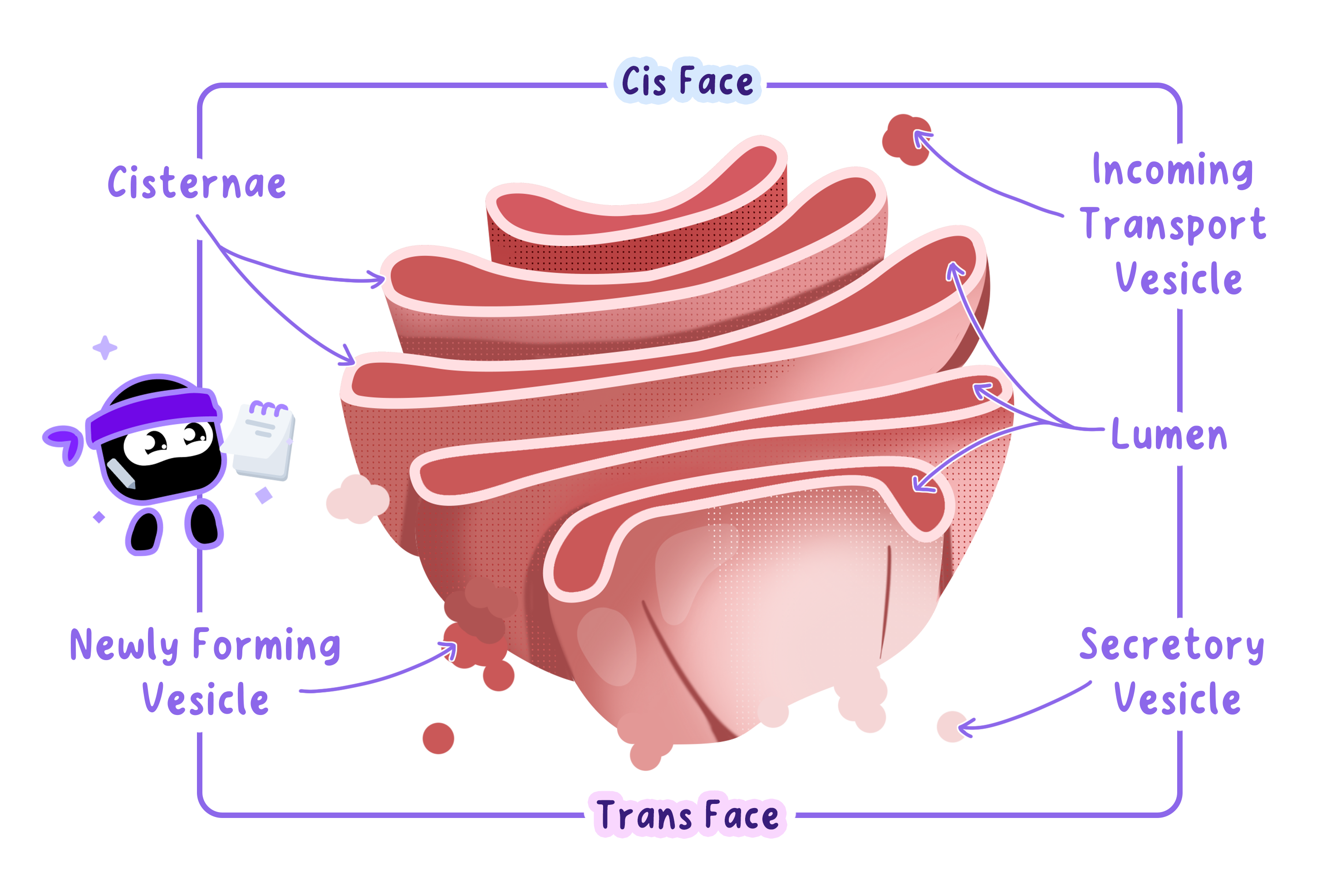
Structure of Golgi apparatus
Definition

Golgi apparatus

A stack of flattened, membrane-bound sacs that process, package, and distribute proteins and lipids.

  1. The Golgi apparatus modifies molecules, for example by adding sugars to proteins.
  2. It then packages them into vesicles for delivery.
Analogy
  • Think of the Golgi as the cell's post office, labelling and shipping each product.

Vesicles, Lysosomes and Vacuoles Store and Recycle Materials

Definition

Vesicles

Vesicles are small, membrane-bound sacs composed of a phospholipid bilayer. They enclose a fluid-filled space and can carry various substances.

Definition

Vacuoles

Larger compartments, especially prominent in plant cells, where they store water, nutrients, or waste.

  1. Vesicles are small membrane sacs that store or transport substances.
  2. Lysosomes hold hydrolytic enzymes that digest waste and pathogens.
  3. The large central vacuole, prominent in plant cells, stores water and ions and provides turgor pressure.
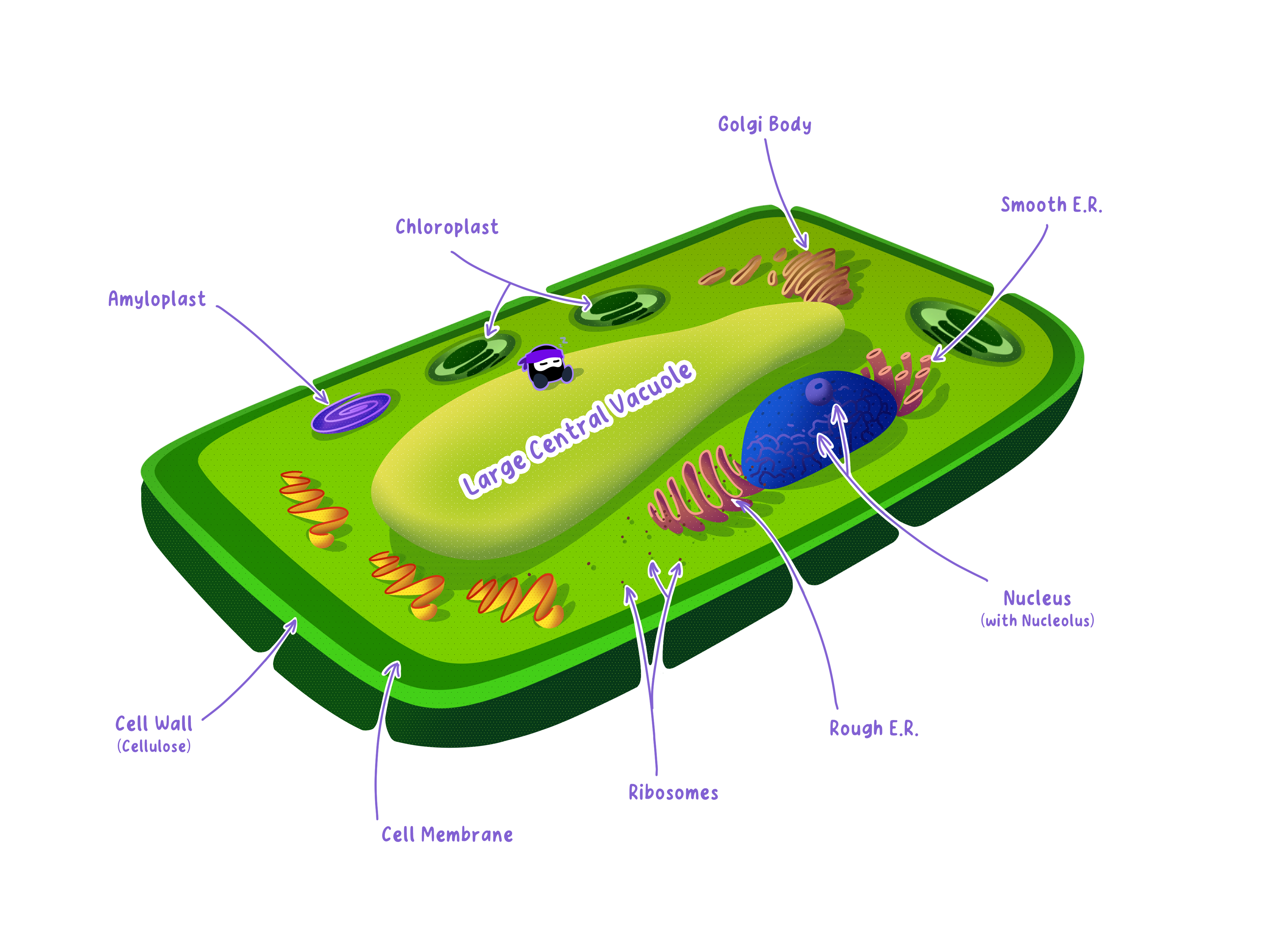
Large Vacuole in Plant Cell
Definition

Lysosome

Lysosomes are specialized vesicles containing digestive enzymes.

Common Mistake
  • Do not confuse lysosomes with vacuoles.
  • Lysosomes specialise in digestion and recycling, not just storage.

The Cytoskeleton Gives Shape and Guides Transport

Definition

Cytoskeleton

A network of protein fibers, including microtubules, microfilaments, and intermediate filaments.

  1. The cytoskeleton is a network of fibres that supports the cell and moves things around inside it.
  2. Microtubules are hollow tubes that hold the cell's shape and act as tracks for organelle movement.
  3. Microfilaments are thin fibres that support shape and enable movement, such as in muscle cells.
Analogy
  • Microtubules act like train tracks that guide vesicles to their destinations.

Chloroplasts Capture Light Energy for Photosynthesis
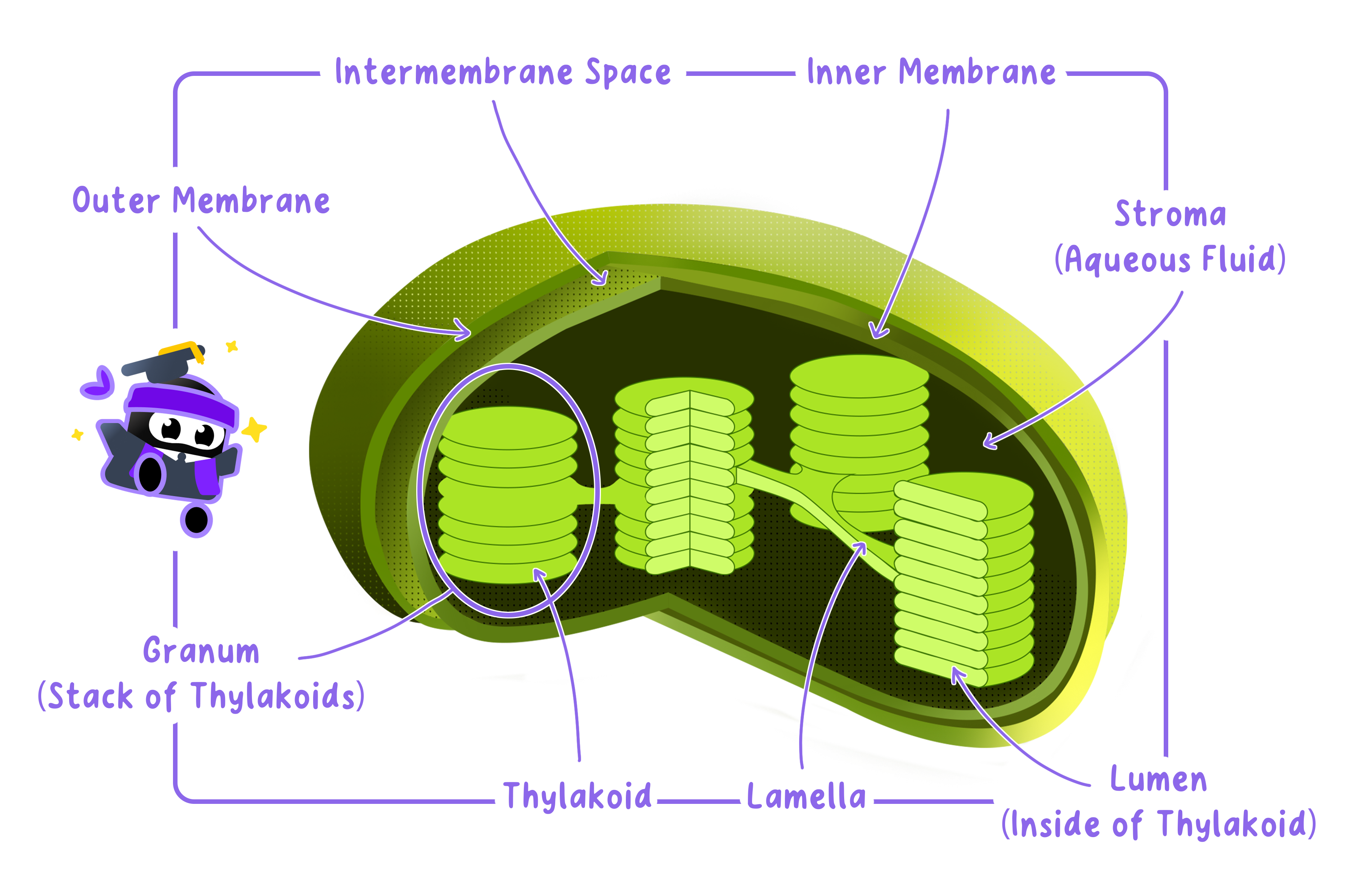
Structure of Chloroplasts
Definition

Chloroplast

An organelle found in plant and algal cells that is responsible for photosynthesis, the process of converting light energy into chemical energy

  1. Chloroplasts have a double membrane with internal thylakoid membranes stacked into grana.
  2. They are the site of photosynthesis, and they occur in plant and algal cells.

The Organelles Work Together as One System

  1. The plasma membrane controls exchanges with the environment.
  2. The nucleus directs the cell, and the mitochondria supply energy.
  3. The ER, Golgi apparatus, and vesicles handle production, packaging, and transport.
Theory of Knowledge
  • The way a cell divides labour among its organelles mirrors how a society divides work among its members.
Active recall
  • What is the function of the pores in the nuclear envelope?
  • How do rough ER and smooth ER differ in structure and role?
  • What do cristae do inside a mitochondrion?
  • What is one difference between a lysosome and a vacuole?
  • Name the ribosome type found in eukaryotes and state its size.

Expert-Written, Bite-Sized Notes

Turn dense IB content into clear, syllabus-aligned notes that make every topic easier to understand and revisit.

Expert-Written, Bite-Sized Notes

Turn dense IB content into clear, syllabus-aligned notes that make every topic easier to understand and revisit.

01

Highlight what matters

Select any sentence as you read, then highlight it or save a note without losing your place in the article.

Eukaryotic Cells Divide Labour Among Membrane-Bound Organelles

Definition

Eukaryote

A eukaryote is a type of cell that contains a nucleus and membrane-bound organelles, enabling it to carry out specialized and coordinated functions. These cells are found in plants, animals, fungi, and protists.

Eukaryotic Cell
Eukaryotic Cell
  1. A eukaryotic cell keeps its DNA inside a nucleus and splits its work among separate organelles.
  2. Each organelle handles one job, and together they keep the whole cell alive.

The Plasma Membrane Controls What Enters and Leaves

Definition

Plasma membrane

The plasma membrane is the thin, flexible boundary that surrounds a cell, separating its internal environment from the external surroundings. It is composed of a phospholipid bilayer with embedded proteins, cholesterol, and carbohydrates.

Plasma Membrane and its Phospholipid Bilayer
  1. The plasma membrane regulates the exchange of substances, letting nutrients in and waste out.
  2. It keeps the inside of the cell stable and maintains homeostasis.
  3. It also carries receptors for cell communication with the surroundings.
Tip
  • The membrane is more than a barrier.
  • It takes an active part in signalling and transport.

The Cytoplasm Is Where Most Reactions Happen

Definition

Cytoplasm

The cytoplasm is the jelly-like substance inside a cell, excluding the nucleus, where various cellular activities occur.

  1. The cytoplasm is the site of many metabolic reactions.
  2. It holds the organelles, allowing compartmentalisation so different reactions run at once in separate places.

80S Ribosomes Build the Cell's Proteins

Definition

80S Ribosomes

80S ribosomes are larger ribosomes found in eukaryotic cells that synthesize proteins.

  1. Ribosomes are found free in the cytoplasm or attached to the rough endoplasmic reticulum.
  2. They translate mRNA into proteins that the cell needs to grow and work.
Common Mistake
  • Eukaryotes have 80S ribosomes, while prokaryotes have 70S ribosomes.
  • The 80S ribosome is the larger of the two.

The Nucleus Stores DNA and Directs the Cell

Structure of Nucleus
Definition

Nucleus

The nucleus is a double-membrane-bound organelle containing the cell’s DNA.

  1. The nucleus holds linear chromosomes made of DNA wound around histone proteins.
  2. The nuclear envelope has pores that control which RNA and proteins pass through.
  3. It directs the cell by controlling gene expression and passing on genetic information during cell division.
Analogy
  • Nuclear pores work like security checkpoints on an administrative building.
  • Only approved molecules are allowed in or out.

Membrane-Bound Organelles Separate the Cell's Jobs

Note
  • Unlike prokaryotes, eukaryotic cells contain membrane-bound organelles in the cytoplasm.
  • Examples include the mitochondria and endoplasmic reticulum.

Mitochondria Release Energy for the Cell

Structure of Mitochondria
Definition

Mitochondria

Mitochondria are double-membrane-bound organelles responsible for producing ATP through aerobic respiration.

  1. The inner membrane folds into cristae that increase the surface area for energy release.
  2. The matrix holds the enzymes for the Krebs cycle and other pathways.
Note
  • Mitochondria contain their own DNA and ribosomes.
  • This unusual feature is explored further in the HL topic on the origin of organelles.

The Endoplasmic Reticulum Makes and Moves Molecules

Definition

Endoplasmic Reticulum

A network of membranes involved in synthesis and transport.

  1. The endoplasmic reticulum is a network of membranes that moves materials through the cell.
  2. Rough ER is studded with ribosomes and makes proteins for secretion or for membranes.
  3. Smooth ER has no ribosomes and handles lipid synthesis, detoxification, and calcium storage.
Analogy
  • The ER is like the highway system of the cell, carrying goods to where they are needed.
  • Rough ER is the assembly line for proteins, and smooth ER is the chemical plant for lipids.

The Golgi Apparatus Modifies and Ships Products

Structure of Golgi apparatus
Definition

Golgi apparatus

A stack of flattened, membrane-bound sacs that process, package, and distribute proteins and lipids.

  1. The Golgi apparatus modifies molecules, for example by adding sugars to proteins.
  2. It then packages them into vesicles for delivery.
Analogy
  • Think of the Golgi as the cell's post office, labelling and shipping each product.

Vesicles, Lysosomes and Vacuoles Store and Recycle Materials

Definition

Vesicles

Vesicles are small, membrane-bound sacs composed of a phospholipid bilayer. They enclose a fluid-filled space and can carry various substances.

Definition

Vacuoles

Larger compartments, especially prominent in plant cells, where they store water, nutrients, or waste.

  1. Vesicles are small membrane sacs that store or transport substances.
  2. Lysosomes hold hydrolytic enzymes that digest waste and pathogens.
  3. The large central vacuole, prominent in plant cells, stores water and ions and provides turgor pressure.
Large Vacuole in Plant Cell
Definition

Lysosome

Lysosomes are specialized vesicles containing digestive enzymes.

Common Mistake
  • Do not confuse lysosomes with vacuoles.
  • Lysosomes specialise in digestion and recycling, not just storage.

The Cytoskeleton Gives Shape and Guides Transport

Definition

Cytoskeleton

A network of protein fibers, including microtubules, microfilaments, and intermediate filaments.

  1. The cytoskeleton is a network of fibres that supports the cell and moves things around inside it.
  2. Microtubules are hollow tubes that hold the cell's shape and act as tracks for organelle movement.
  3. Microfilaments are thin fibres that support shape and enable movement, such as in muscle cells.
Analogy
  • Microtubules act like train tracks that guide vesicles to their destinations.

Chloroplasts Capture Light Energy for Photosynthesis

Structure of Chloroplasts
Definition

Chloroplast

An organelle found in plant and algal cells that is responsible for photosynthesis, the process of converting light energy into chemical energy

  1. Chloroplasts have a double membrane with internal thylakoid membranes stacked into grana.
  2. They are the site of photosynthesis, and they occur in plant and algal cells.

The Organelles Work Together as One System

  1. The plasma membrane controls exchanges with the environment.
  2. The nucleus directs the cell, and the mitochondria supply energy.
  3. The ER, Golgi apparatus, and vesicles handle production, packaging, and transport.
Theory of Knowledge
  • The way a cell divides labour among its organelles mirrors how a society divides work among its members.
Active recall
  • What is the function of the pores in the nuclear envelope?
  • How do rough ER and smooth ER differ in structure and role?
  • What do cristae do inside a mitochondrion?
  • What is one difference between a lysosome and a vacuole?
  • Name the ribosome type found in eukaryotes and state its size.

02

Ask Jojo about any passage

Open Jojo beside the article and ask a focused question about the exact passage you are studying.

Eukaryotic Cells Divide Labour Among Membrane-Bound Organelles

Definition

Eukaryote

A eukaryote is a type of cell that contains a nucleus and membrane-bound organelles, enabling it to carry out specialized and coordinated functions. These cells are found in plants, animals, fungi, and protists.

Eukaryotic Cell
Eukaryotic Cell
  1. A eukaryotic cell keeps its DNA inside a nucleus and splits its work among separate organelles.
  2. Each organelle handles one job, and together they keep the whole cell alive.

The Plasma Membrane Controls What Enters and Leaves

Definition

Plasma membrane

The plasma membrane is the thin, flexible boundary that surrounds a cell, separating its internal environment from the external surroundings. It is composed of a phospholipid bilayer with embedded proteins, cholesterol, and carbohydrates.

Plasma Membrane and its Phospholipid Bilayer
  1. The plasma membrane regulates the exchange of substances, letting nutrients in and waste out.
  2. It keeps the inside of the cell stable and maintains homeostasis.
  3. It also carries receptors for cell communication with the surroundings.
Tip
  • The membrane is more than a barrier.
  • It takes an active part in signalling and transport.

The Cytoplasm Is Where Most Reactions Happen

Definition

Cytoplasm

The cytoplasm is the jelly-like substance inside a cell, excluding the nucleus, where various cellular activities occur.

  1. The cytoplasm is the site of many metabolic reactions.
  2. It holds the organelles, allowing compartmentalisation so different reactions run at once in separate places.

80S Ribosomes Build the Cell's Proteins

Definition

80S Ribosomes

80S ribosomes are larger ribosomes found in eukaryotic cells that synthesize proteins.

  1. Ribosomes are found free in the cytoplasm or attached to the rough endoplasmic reticulum.
  2. They translate mRNA into proteins that the cell needs to grow and work.
Common Mistake
  • Eukaryotes have 80S ribosomes, while prokaryotes have 70S ribosomes.
  • The 80S ribosome is the larger of the two.

The Nucleus Stores DNA and Directs the Cell

Structure of Nucleus
Definition

Nucleus

The nucleus is a double-membrane-bound organelle containing the cell’s DNA.

  1. The nucleus holds linear chromosomes made of DNA wound around histone proteins.
  2. The nuclear envelope has pores that control which RNA and proteins pass through.
  3. It directs the cell by controlling gene expression and passing on genetic information during cell division.
Analogy
  • Nuclear pores work like security checkpoints on an administrative building.
  • Only approved molecules are allowed in or out.

Membrane-Bound Organelles Separate the Cell's Jobs

Note
  • Unlike prokaryotes, eukaryotic cells contain membrane-bound organelles in the cytoplasm.
  • Examples include the mitochondria and endoplasmic reticulum.

Mitochondria Release Energy for the Cell

Structure of Mitochondria
Definition

Mitochondria

Mitochondria are double-membrane-bound organelles responsible for producing ATP through aerobic respiration.

  1. The inner membrane folds into cristae that increase the surface area for energy release.
  2. The matrix holds the enzymes for the Krebs cycle and other pathways.
Note
  • Mitochondria contain their own DNA and ribosomes.
  • This unusual feature is explored further in the HL topic on the origin of organelles.

The Endoplasmic Reticulum Makes and Moves Molecules

Definition

Endoplasmic Reticulum

A network of membranes involved in synthesis and transport.

  1. The endoplasmic reticulum is a network of membranes that moves materials through the cell.
  2. Rough ER is studded with ribosomes and makes proteins for secretion or for membranes.
  3. Smooth ER has no ribosomes and handles lipid synthesis, detoxification, and calcium storage.
Analogy
  • The ER is like the highway system of the cell, carrying goods to where they are needed.
  • Rough ER is the assembly line for proteins, and smooth ER is the chemical plant for lipids.

The Golgi Apparatus Modifies and Ships Products

Structure of Golgi apparatus
Definition

Golgi apparatus

A stack of flattened, membrane-bound sacs that process, package, and distribute proteins and lipids.

  1. The Golgi apparatus modifies molecules, for example by adding sugars to proteins.
  2. It then packages them into vesicles for delivery.
Analogy
  • Think of the Golgi as the cell's post office, labelling and shipping each product.

Vesicles, Lysosomes and Vacuoles Store and Recycle Materials

Definition

Vesicles

Vesicles are small, membrane-bound sacs composed of a phospholipid bilayer. They enclose a fluid-filled space and can carry various substances.

Definition

Vacuoles

Larger compartments, especially prominent in plant cells, where they store water, nutrients, or waste.

  1. Vesicles are small membrane sacs that store or transport substances.
  2. Lysosomes hold hydrolytic enzymes that digest waste and pathogens.
  3. The large central vacuole, prominent in plant cells, stores water and ions and provides turgor pressure.
Large Vacuole in Plant Cell
Definition

Lysosome

Lysosomes are specialized vesicles containing digestive enzymes.

Common Mistake
  • Do not confuse lysosomes with vacuoles.
  • Lysosomes specialise in digestion and recycling, not just storage.

The Cytoskeleton Gives Shape and Guides Transport

Definition

Cytoskeleton

A network of protein fibers, including microtubules, microfilaments, and intermediate filaments.

  1. The cytoskeleton is a network of fibres that supports the cell and moves things around inside it.
  2. Microtubules are hollow tubes that hold the cell's shape and act as tracks for organelle movement.
  3. Microfilaments are thin fibres that support shape and enable movement, such as in muscle cells.
Analogy
  • Microtubules act like train tracks that guide vesicles to their destinations.

Chloroplasts Capture Light Energy for Photosynthesis

Structure of Chloroplasts
Definition

Chloroplast

An organelle found in plant and algal cells that is responsible for photosynthesis, the process of converting light energy into chemical energy

  1. Chloroplasts have a double membrane with internal thylakoid membranes stacked into grana.
  2. They are the site of photosynthesis, and they occur in plant and algal cells.

The Organelles Work Together as One System

  1. The plasma membrane controls exchanges with the environment.
  2. The nucleus directs the cell, and the mitochondria supply energy.
  3. The ER, Golgi apparatus, and vesicles handle production, packaging, and transport.
Theory of Knowledge
  • The way a cell divides labour among its organelles mirrors how a society divides work among its members.
Active recall
  • What is the function of the pores in the nuclear envelope?
  • How do rough ER and smooth ER differ in structure and role?
  • What do cristae do inside a mitochondrion?
  • What is one difference between a lysosome and a vacuole?
  • Name the ribosome type found in eukaryotes and state its size.

Why are eukaryotic cells able to perform more specialised functions?
03

Check your understanding

Finish each article with recap questions that turn the explanation you just read into active practice.

Questions

Recap questions

1 of 2
Question 1Multiple choice

What allows eukaryotic cells to carry out several specialised processes efficiently?

AThey contain no internal membranes.
BTheir DNA is always stored outside the cell.
CMembrane-bound organelles separate specialised processes.
DEvery organelle performs the same function.

0+

pages of study notes

0+

topics covered

0+

students

Start studying in a couple of minutes

A free account saves your progress, remembers what you have covered, and picks up where you left off on any device.

Browse Study Notes

Explore related features

One connected toolkit for learning, practice, and coursework.

Interactive Lessons

Step-by-step teaching with active checks

Flashcards

Active recall with spaced repetition

Videos

Focused explanations and worked examples

Jojo holding a cookie

This site uses cookie tracking technologies. Learn more in our Cookie Policy.

Join 650k+ students breezing through the IBReady to breeze through the IB?

Footer

General

  • For parents
  • For schools
  • Pricing
  • Gift RevisionDojo
  • Tutoring
  • IB syllabus
  • MYP syllabus
  • Blog
  • Research

Features

  • Question Bank
  • Test Builder & Exam Mode
  • Predicted Papers
  • Past Papers
  • Study Notes
  • Interactive Lessons
  • Flashcards
  • Videos
  • Cheatsheets
  • Teach Jojo
  • Coursework Grader
  • Coursework Exemplars

Research

  • State of learning survey
  • IB Moderation Analysis
  • Jojo AI vs ChatGPT
  • Jojo AI vs Gemini
  • Jojo AI vs Perplexity
  • Jojo AI vs Claude
  • Jojo AI vs Poe

Platform

  • RevisionDojo vs Others
  • Content philosophy
  • Trustpilot
  • Join usWe're hiring
  • Terms and conditions
  • Privacy policy
  • Cookie policy
  • Trust Center

MYP Subjects

  • MYP Biology
  • MYP Chemistry
  • MYP English Lang & Lit
  • MYP Extended Mathematics
  • MYP History
  • MYP Individuals & Societies
  • MYP Physics
  • MYP Standard Mathematics
  • MYP Biology
  • MYP Chemistry
  • MYP English Lang & Lit
RevisionDojo logo

© 2022 - 2026 RevisionDojo (MyDojo Inc)

RevisionDojo was developed independently of the IBO and as such is not endorsed by it in any way.

  • Coursework Guides
  • AI & Plagiarism Checker
  • IO Grader
  • IB grade calculator
  • Grade boundaries
  • MYP Extended Mathematics
    • MYP History
    • MYP Individuals & Societies
    • MYP Physics
    • MYP Standard Mathematics

    IB Subjects

    • Arabic ab initio
    • Arabic B
    • Biology
    • Business Management
    • Chemistry
    • Chinese A Lang & Lit
    • Chinese B
    • Computer Science (CS)
    • Computer Science (First Exam 2027)
    • Design Technology (DT)
    • Design Technology (First Exam 2027)
    • Digital Society (DS)
    • Economics
    • English A Lang & Lit
    • English A Lit
    • English B
    • Environmental systems and societies (ESS)
    • French A
    • French ab initio
    • French B
    • Geography
    • German A
    • German ab initio
    • German B
    • Global Politics
    • History
    • Mathematics Analysis and Approaches (AA)
    • Mathematics Applications & Interpretation (AI)
    • Philosophy
    • Physics
    • Psychology
    • Psychology (First Exam 2027)
    • Arabic ab initio
    • Arabic B
    • Biology
    • Business Management
    • Chemistry
    • Chinese A Lang & Lit
    • Chinese B
    • Computer Science (CS)
    • Computer Science (First Exam 2027)
    • Design Technology (DT)
    • Design Technology (First Exam 2027)
    • Digital Society (DS)
    GDPR compliant
    Download on the App Store
  • Spanish A
  • Spanish ab initio
  • Spanish B
  • Sports, exercise and health science (SEHS)
  • Theory of Knowledge (TOK)
  • Economics
  • English A Lang & Lit
  • English A Lit
  • English B
  • Environmental systems and societies (ESS)
  • French A
  • French ab initio
  • French B
    • Geography
    • German A
    • German ab initio
    • German B
    • Global Politics
    • History
    • Mathematics Analysis and Approaches (AA)
    • Mathematics Applications & Interpretation (AI)
    • Philosophy
    • Physics
    • Psychology
    • Psychology (First Exam 2027)
    • Spanish A
    • Spanish ab initio
    • Spanish B
    • Sports, exercise and health science (SEHS)
    • Theory of Knowledge (TOK)