

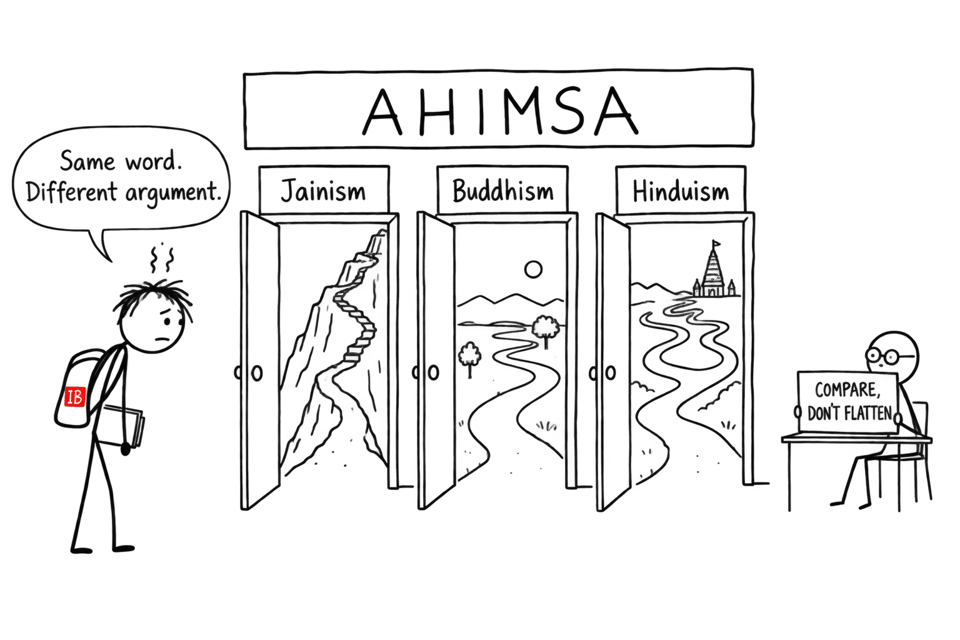
Non-violence in Indian religions is often summarized with one word: ahimsa. That shared vocabulary can be helpful, but it can also create the illusion that Jainism, Buddhism and Hinduism teach exactly the same ethic.
They do not. Jain traditions generally connect rigorous non-harming to the liberation of the soul from karmic matter. Buddhist traditions place abstention from killing within a path that transforms intention, craving and suffering. Hindu traditions contain influential teachings on ahimsa, yet they also debate how non-harming relates to duty, social responsibility and the protection of dharma.
For IB World Religions SL students, the strongest comparison therefore begins with similarity and then asks a better question: why does each tradition value non-violence, and what happens when the ideal meets ordinary life?
The comparison at a glance
Use this checklist before building an essay paragraph:
- Define ahimsa as non-harming, not merely the absence of warfare.
- Identify the religious goal behind the teaching.
- Distinguish monastic or ascetic expectations from lay practice.
- Support each claim with a text, teaching or lived example.
- Recognize diversity within every tradition.
- Compare reasons and applications, not just vocabulary.
- Link the evidence directly to the question or stimulus.
Students beginning the course can place this topic within the wider syllabus through the IB World Religions resources and the first-term World Religions overview.
| Comparative lens | Jain traditions | Buddhist traditions | Hindu traditions |
|---|---|---|---|
| Ethical focus | Avoiding harm to living beings and limiting karmic bondage | Abstaining from killing while transforming harmful intentions | Non-harming as a virtue, interpreted alongside dharma and other duties |
| Religious framework | Jiva, karma, rebirth and liberation | Karma, suffering, compassion and nirvana | Karma, rebirth, liberation, yoga and duty, with variation among schools |
| Practical distinction | Great vows for ascetics and limited vows for householders | Different precepts and disciplines for monastics and laypeople | Practice varies by philosophical school, community, vocation and life situation |
| Useful example | Careful movement, vegetarian discipline and restrictions intended to reduce injury | The first precept, loving-kindness and compassion | The Yoga Sutras, the Bhagavad Gita and Gandhi's interpretation of ahimsa |
Jainism: non-violence as disciplined liberation
In Jain thought, living beings possess jiva, commonly translated as soul or living self. Actions driven by passions such as anger, greed and attachment bind the soul within the cycle of rebirth. Ahimsa is therefore not simply kindness. It is a disciplined response to a universe filled with life, including forms of life that may be overlooked in ordinary human activity.
The Acaranga Sutra, an early Jain text, presents violence toward living beings as a source of bondage and an obstacle to liberation. Jain ethical analysis can include direct harm, ordering another person to cause harm and approving of harmful action. Physical conduct matters, but speech and thought also fall within the moral field.
A crucial distinction is the one between ascetics and householders. Jain monks and nuns undertake the five great vows, or mahavratas, including an extensive commitment to ahimsa. Lay Jains take limited vows, or anuvratas, which adapt the ideal to household life. This does not make lay ethics unimportant. It acknowledges that cooking, travel, employment and other ordinary activities may cause forms of unavoidable harm.
Practices can include vegetarianism, filtering water and avoiding work that directly involves killing. Some ascetics inspect where they walk or use a mouth covering. These examples show how belief about life becomes embodied discipline, but they should not be presented as universal among all Jains.
Buddhism: restraint shaped by intention and compassion
The first Buddhist precept is usually expressed as an undertaking to abstain from taking life. It applies to lay Buddhists, while monastic codes contain more detailed rules. Yet Buddhist ethics cannot be reduced to a checklist of forbidden actions.
In the Nibbedhika Sutta (Anguttara Nikaya 6.63), the Buddha identifies intention, or cetana, as central to karma. This makes motivation especially significant. A harmful action rooted in hatred or cruelty shapes both the victim's experience and the moral character of the person acting.
The positive counterparts to non-killing are also important. Metta means loving-kindness, while karuna means compassion toward beings experiencing suffering. The Dhammapada teaches that beings fear violence and value life, inviting practitioners to recognize themselves in others. Non-violence consequently involves cultivating a mind less governed by hatred, not merely keeping one's hands clean.
Practice differs among Buddhist communities. The Jivaka Sutta rejects meat when a monastic has seen, heard or suspected that the animal was killed specifically for them. Some Mahayana texts and communities advocate vegetarianism more strongly, showing how a shared precept can produce different applications.
Compared with Jain ethics, Buddhist traditions often give more explicit analytical weight to intention. That contrast must still be qualified because Jain thinkers also discuss passions and intentionality. A careful answer says that the traditions configure intention, action and karmic consequence differently, not that one cares only about outcomes and the other only about motives.
Hinduism: ahimsa within a plural field of duty
Hindu traditions include diverse philosophical schools, devotional communities and texts. Claims about Hindu non-violence should therefore identify the source rather than imply that one interpretation speaks for every Hindu.
In Patanjali's Yoga Sutras 2.30, ahimsa is the first of the five yamas, or ethical restraints. Within this yogic framework, non-harming is part of the discipline that prepares a practitioner for spiritual freedom. The Bhagavad Gita 16.2 also lists ahimsa among qualities associated with a divine disposition.
Yet the Bhagavad Gita is spoken on a battlefield. Arjuna hesitates to fight his relatives and teachers, while Krishna tells him to understand his duty as a warrior and to act without selfish attachment. This does not amount to a simple celebration of violence. It creates an ethical tension among non-harming, rightful action, motivation and responsibility for sustaining dharma.
That tension makes Hindu material especially useful in comparative religion. Jain ascetic ethics tends to push toward minimizing injurious activity as far as possible. The Gita asks whether refusing to act can itself become morally irresponsible when a person has a legitimate duty. Different Hindu interpreters answer the resulting questions in different ways.
Mahatma Gandhi offers one influential modern interpretation. He combined ahimsa with satyagraha, resistance grounded in truth, and treated non-violence as active moral courage rather than passive surrender. Gandhi was a Hindu thinker shaped by several religious and philosophical influences. He should be used as a specific interpreter, not as proof that every Hindu understands ahimsa identically.
The comparison that produces analysis
Weak comparison collects three descriptions. Strong comparison identifies a common problem and shows how different frameworks address it.
Consider accidental harm. A Jain response may emphasize vigilance because even unintended injury affects living beings, although intention can influence karmic analysis. A Buddhist response may focus on whether the act was intentional and what mental state produced it. A Hindu response depends on the source, but may ask whether the action fulfilled or violated dharma.
The analytical sentence is not, “All three religions believe in non-violence.” It is closer to this:
Although Jain, Buddhist and Hindu sources all value non-harming, they locate its authority within different accounts of the self, karma, liberation, intention and duty, producing distinct expectations in difficult situations.
That sentence creates an argument. The examples then test it.
Using comparison in Paper 1 and Paper 2
Paper 1 rewards precise knowledge applied to the given material. If a stimulus shows a Jain ascetic protecting small forms of life, connect the practice to jiva and karmic bondage. Explain why ascetic expectations may exceed household vows, then use comparison only if it clarifies the distinctive Jain emphasis.
Paper 2 requires sustained, evidence-supported argument about the in-depth religion studied. Under the current course structure, Hinduism and Buddhism can be studied as in-depth traditions, while Jainism belongs to the introductory group. Jain material can sharpen analysis, but it should not replace evidence from the religion named in the question.
A reliable paragraph pattern is claim, evidence, explanation, qualification and comparison. Claim that intention is central to Buddhist non-harming, support this with cetana and the first precept, and explain its connection to karma. Qualify the claim through differences in dietary practice, then compare Jain vigilance toward harm. The comparison earns its place because it reveals what is distinctive.
The World Religions misconceptions guide helps separate academic analysis from unsupported generalization. For timed preparation, use the World Religions mock exam plan and review how authentic student work develops evidence through the World Religions Coursework Library.
Build a revision system around contrasts
Create Flashcards that pair a concept with a qualification: “Jain ahimsa” on one side, then jiva, karma, great and limited vows, plus one lived example on the other. Use Study Notes to confirm terminology before attempting Questionbank prompts. Ask AI Chat to challenge a broad statement such as “Buddhists are always vegetarian,” then verify the correction against your course materials.
Next, write one Paper 1 explanation and one Paper 2 paragraph. RevisionDojo's Grading tools can help expose missing evidence or evaluation, while Predicted Papers and Mock Exams build timed control. Tutors can then help with persistent conceptual gaps rather than simply rereading content.
This is why RevisionDojo works as the ultimate IB resource: its tools support the whole movement from knowledge to comparison, and from comparison to defensible argument. The shared word ahimsa opens the door. Careful distinctions are what carry your answer through it.