

Does HL vs SL Matter in IB? The Honest Answer
You can feel it the first week you seriously think about HL vs SL in IB.
It is not just a timetable decision. It is an identity decision.
Someone says "HL" and it sounds like the grown-up version of you. Someone says "SL" and you worry it sounds like you are taking the easier road. And then, quietly, the real fear arrives: what if you choose wrong and spend two years paying for it in sleep, stress, and grades?
Here is the calming truth most people do not say out loud: HL vs SL does matter in IB. But it matters in fewer situations than students assume, and it matters in different ways than the loudest voices in the hallway claim.
This guide is for IB students preparing for exams who want practical clarity. Not hype. Not regret. Just the decision rules and revision moves that actually work.
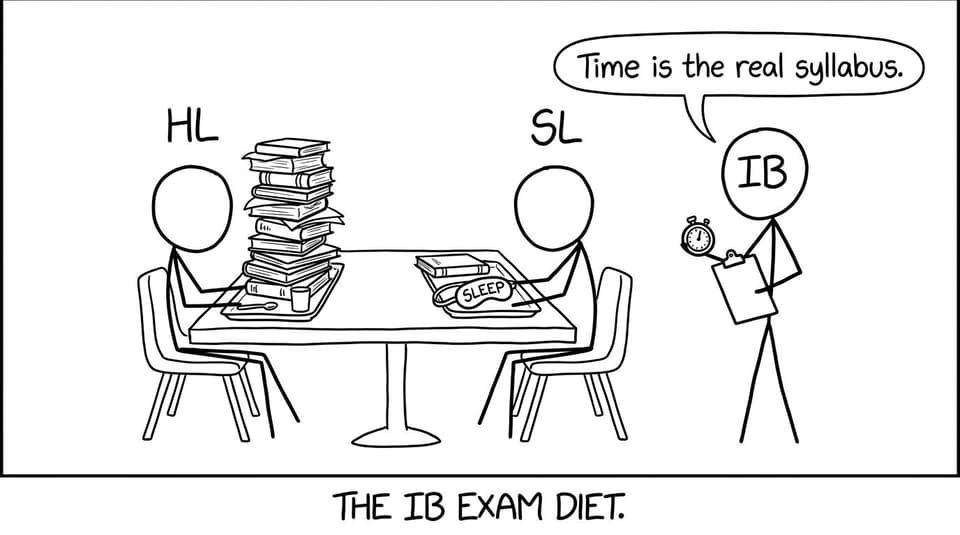
Quick checklist: when HL vs SL matters most in IB
Use this as your fast filter before you overthink everything.
- University prerequisites: Some programs genuinely require specific IB subjects at HL.
- Workload bandwidth: HL is usually more depth, longer papers, and more stamina under time.
- Grade strategy: A strong SL 7 can be worth more than a shaky HL 5.
- Exam technique differences: HL often adds extra components or higher-level question styles.
- Motivation and momentum: The level you can revise consistently tends to win.
If you want the broader baseline differences, RevisionDojo already breaks it down clearly in What's the Difference Between HL and SL in IB?.
HL vs SL in IB: what the difference really is (beyond the label)
Most students picture HL vs SL in IB as "same course, plus some extra chapters." Sometimes that is true. But the more important difference is what the extra chapters do to your thinking under pressure.
In many subjects, HL adds:
- More teaching time (often cited as ~240 hours vs ~150 hours)
- More content (extra units or extensions)
- More depth (harder applications, longer chains of reasoning)
- More exam time (longer papers, additional sections)
But the sneaky part is this: HL often increases the number of places you can lose marks.
A long response is rarely marked like a vibe check. The IB rewards specific steps, key terms, and command-term obedience. HL tasks can demand the same basics, plus one or two extra moves that separate "I know the topic" from "I can do it under exam conditions."
If you want to plan workload realistically, pair this article with How Many Hours Should IB Students Study?. It gives a grounded time model for HL vs SL.
Does HL vs SL matter for IB exams?
Yes, but mostly through timing and density.
In IB exams, many SL students lose marks because they did not practise under time. Many HL students lose marks because they practised under time but did not practise enough to make the extra depth automatic.
HL matters for exam prep because:
- Stamina becomes a topic. Your brain has to stay sharp longer.
- Mark allocation punishes vagueness. HL responses often require more precise structure.
- The margin for sloppy basics shrinks. The extra difficulty amplifies small weaknesses.
This is why revision systems beat revision motivation.
On RevisionDojo, the most reliable loop for IB exam preparation looks like:
- Learn fast with Notes + Flashcards + Question Bank (Free)
- Train exam accuracy with Questionbank
- Build timing and realism using How to Run Timed IB Mock Exams in RevisionDojo
That loop works for both HL and SL. HL students just need to run it longer and more consistently.
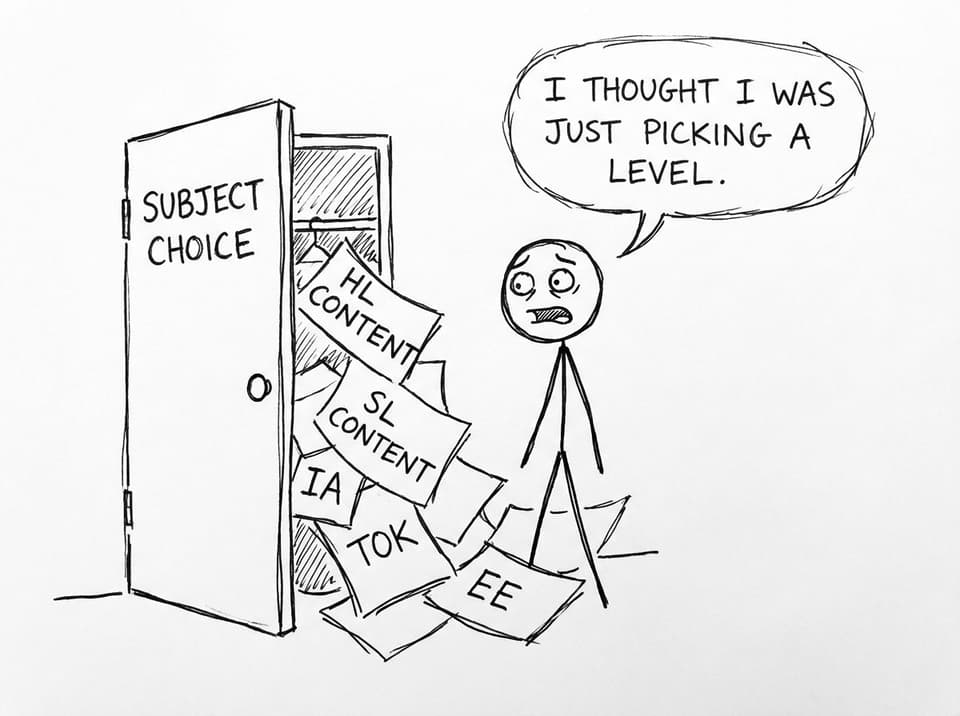
Does HL vs SL matter for universities?
It matters in a very specific way: prerequisites and signals.
Universities usually care about IB levels when:
- A program requires certain subjects at HL (common in engineering, medicine, some economics tracks)
- HL choices act as a signal of readiness (e.g., HL Math for quantitative degrees)
Universities usually care less about HL vs SL when:
- You meet prerequisites already
- Your overall IB score is strong
- Your HL choices are sensible for your direction
If you want a clean parent-friendly explanation (that also helps you), see Do Universities Care Whether My Child Took HL or SL in IB Subjects?.
But do not miss the deeper point: admissions is often a trade.
If HL pushes your grades down across the board, the "harder level" bragging rights are not a great consolation prize.
HL vs SL in IB: the real risk is not difficulty, it is misallocation
A quiet pattern repeats every exam session.
A student chooses HL because it "sounds better." They then revise like an SL student: occasional bursts, lots of rereading, too few timed sets, not enough feedback. HL punishes that.
Another student chooses SL and feels slightly embarrassed. They revise like a strategist: frequent retrieval, focused mistakes review, timed practice every week. SL rewards that.
Same student quality. Different outcomes.
HL vs SL in IB is less about intelligence and more about whether your schedule can hold the extra repetitions.
Decision rules: how to choose HL vs SL without regret
Choose HL when the subject is a door you actually need
If your likely university direction needs HL, you do not get to outsmart that requirement with optimism. You choose HL and build the system to survive it.
Use RevisionDojo's planning guide as a practical framework: IB HL vs SL Planner.
Choose HL when you can sustain the practice loop
HL success is boring.
It is small daily work, repeated until the exam questions start to feel predictable. If you cannot picture yourself running that routine for months, HL becomes expensive.
Choose SL when it protects your total points
In IB, points are points.
A stable SL subject where you can score a 6 or 7 may be the difference between meeting an offer and missing it. SL is not "less real." SL is often "more controllable."
Choose SL when you are already overloaded by the core
The Extended Essay, TOK, and Internal Assessments do not politely wait for a lighter week.
If coursework stress is already a fog, treat it like a budget. You cannot spend the same hour twice.
RevisionDojo's workflow helps you keep coursework contained: use the IB Coursework Grader to get criterion-based feedback quickly, then return to IB exam prep without carrying uncertainty for weeks.
How to revise for IB HL vs SL (the exam-prep playbook)
Use different definitions of "mastery"
For SL in IB, mastery often means: can you answer typical questions correctly and explain clearly under time?
For HL in IB, mastery often means: can you do that, plus handle unfamiliar twists and longer reasoning chains without freezing?
That changes your revision plan.
Build your revision around feedback, not effort
Effort feels good. Feedback changes grades.
RevisionDojo is designed around that:
- Study Notes to get clear on the syllabus without rewriting your life
- Flashcards to keep definitions and processes alive daily
- AI Chat (Jojo AI Chat) to get unstuck without losing momentum
- Grading tools to turn essays and coursework into actionable edits
- Mock Exams and Predicted Papers to pressure-test timing and stamina
If you want a single overview of this system, read RevisionDojo App: The Smarter Way to Prep for IB Exams.
Run a "two-week truth test" for any HL subject
If you are unsure about HL vs SL in IB, do this:
- Week 1: 3 focused Questionbank sessions + 1 timed section
- Week 2: Repeat, but increase difficulty and include HL-only components
Then ask one question: did your performance trend upward because your process worked, or downward because the load broke your week?
This is where a platform like RevisionDojo helps because you can drill with Questionbank, then simulate pressure through timed exam workflows like How to Run Timed IB Mock Exams in RevisionDojo.
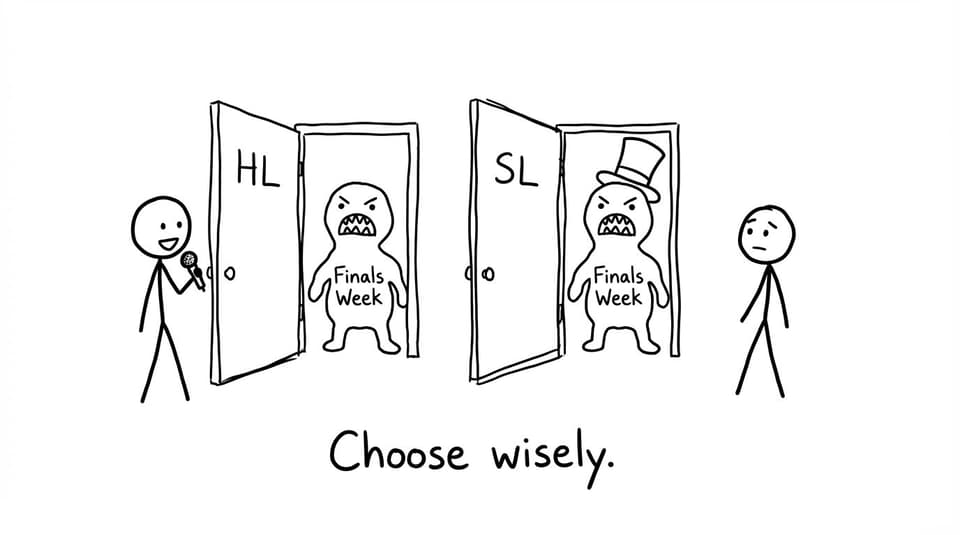
HL vs SL matters less than you think if you do this one thing
Treat revision like training, not like inspiration.
In IB, the students who look calm in May are rarely the students who "understood everything" early. They are the students who built predictable habits and kept them small enough to repeat.
A 20-minute daily routine compounds faster than a three-hour panic session.
That is also why RevisionDojo's design leans into short loops: quick Notes, fast Flashcards, targeted Questionbank sets, instant AI marking, then timed Mock Exams and Predicted Papers when you are ready to make it real.
Closing: in IB, your level matters less than your loop
HL vs SL in IB matters when it unlocks a prerequisite, matches your strengths, and fits your time budget. It matters less when it becomes a status symbol that steals your consistency.
The exam season does not reward the student who picked the "harder" label. It rewards the student who built the clearest routine: learn, recall, apply, get feedback, repeat.
If you want that routine to feel simpler, make RevisionDojo your home base for IB prep: drill weak topics with the Questionbank, tighten memory with Flashcards, clarify confusion with AI Chat, pressure-test timing with Mock Exams and Predicted Papers, and reduce coursework uncertainty with Grading tools and the Coursework Library. When you need a human push, use Tutors.
Choose the level that you can train consistently. Then train.