
Tested January 10, 2026
Product details reviewed August 21, 2026
Jojo AI vs Perplexity
Jojo AI and Perplexity are both generative AI tools that can help students learn. The conversations below preserve our January 10, 2026 side-by-side test: identical prompts, the model available on that date, and the responses each product returned. Jojo's main distinction is its direct connection to IB resources, exam workflows, and native interactive study tools.
Interactive Learning Tools
Quizzes
User message:
Quiz me on the pros and cons of supply side policies
 Perplexity
Here's a 10‑question text quiz on the pros and cons of supply-side policies.
-
Which of the following best describes the main aim of supply-side policies? A. Increase short-run aggregate demand only B. Shift long-run aggregate supply (LRAS) to the right C. Reduce the budget deficit in the short run D. Fix the exchange rate permanently
-
Which is a likely advantage of successful supply-side policies? A. Higher long-run economic growth without extra inflationary pressure B. A permanent fall in structural unemployment only if AD falls C. A one-off increase in the price level D. Reduced potential output
-
Which of these measures is most clearly a market-based supply-side policy? A. Large increase in government spending on state schools B. Cutting corporation tax to encourage investment C. Increasing public sector employment D. Raising the national minimum wage sharply
-
Which is a key disadvantage of many supply-side policies? A. They usually work immediately with no time lags B. They tend to reduce productivity in the long run C. They often have long implementation and impact time lags D. They can never fail because firms always respond as predicted
-
Which policy is most likely to reduce natural unemployment through the supply side? A. Higher unemployment benefits B. Stricter employment protection legislation C. Better-funded job‑matching and training schemes D. Higher import tariffs
-
Why might tax cuts as a supply-side policy fail to increase LRAS? A. Households may choose to save or work less rather than supply more labour B. Firms are legally forced to invest extra profits in R&D C. Consumers cannot respond to price signals D. LRAS cannot change in the long run
-
Which of the following is a likely distributional drawback of some supply-side reforms (e.g. labour market deregulation)? A. They always reduce income inequality B. They may increase wage and wealth inequality C. They guarantee higher real wages for low-skilled workers D. They fix all labour market imperfections
-
Which statement best explains why supply-side policies can help achieve non-inflationary growth? A. They shift AD right so prices rise faster than output B. They shift LRAS right, allowing higher output at a given price level C. They reduce both LRAS and AD D. They permanently fix nominal wages
-
Which is a typical fiscal cost problem with interventionist supply-side policies (e.g. education, infrastructure)? A. They always reduce the budget deficit in the short run B. They are free to implement C. They can require large government spending and raise public debt D. They automatically crowd in private investment with no risk
-
Evaluation: In which situation are supply-side policies least effective as a short-run stabilisation tool? A. Deep demand-deficient recession with lots of spare capacity B. Persistent low productivity growth limiting potential output C. High structural unemployment due to skills mismatch D. Chronic low investment and weak competition in product markets
If you want, answers can be shown after you attempt them, or turned into flashcards.**
 Jojo
JojoI'll create a quiz on the pros and cons of supply-side policies for you.



Great! I've created a quiz covering key aspects of supply-side policies. Here are the main pros and cons to keep in mind:
Pros:
- Increase long-term productive capacity
- Reduce inflationary pressures
- Improve international competitiveness
- Boost economic growth potential
Cons:
- Time lags - effects take years
- Can increase inequality
- May reduce worker protections
- Opportunity cost of government spending
How did you find the quiz? Would you like me to create flashcards on this topic or explore specific types of supply-side policies?
All chats are real chats created by the models stated above on January 10, 2026. Perplexity uses the Sonar model.
Jojo AI delivers fully interactive quizzes with navigable questions, immediate feedback, and real-time scoring - all within the chat. In this January 10, 2026 test, Perplexity returned a text-formatted quiz rather than a native scored quiz. Jojo turned passive reading into active practice.
Flashcards
User message:
Make flashcards for the cell division process
PerplexityCell Division Flashcards
Here is the content of the 10 flashcards on the cell division process. Each card presents a question followed by its answer.
Card 1 Q: What is the primary purpose of cell division in single-celled organisms? A: Reproduction to produce two identical daughter cells.
Card 2 Q: Name the two main types of cell division in eukaryotic cells. A: Mitosis (for growth and repair) and meiosis (for gamete production).
Card 3 Q: What phase precedes mitosis where DNA is replicated? A: Interphase, specifically the S (synthesis) subphase.
Card 4 Q: During which stage of mitosis do chromosomes condense and become visible? A: Prophase.
Card 5 Q: What happens in metaphase of mitosis? A: Chromosomes align at the cell's equatorial plate.
Card 6 Q: What structure pulls sister chromatids apart in anaphase? A: Spindle fibers.
Card 7 Q: In telophase of mitosis, what reforms around the separated chromosomes? A: Nuclear envelope.
Card 8 Q: How many daughter cells result from one round of mitosis, and how many chromosomes do they have compared to the parent? A: Two daughter cells, each with the same number of chromosomes as the parent (diploid).
Card 9 Q: What is the key difference between meiosis I and mitosis? A: Meiosis I involves homologous chromosome separation, reducing chromosome number by half.
Card 10 Q: What is cytokinesis? A: The division of the cytoplasm to complete cell division after nuclear division.
JojoI'll create a comprehensive set of flashcards for the cell division process, covering both mitosis and meiosis.
Great! I've created a comprehensive set of flashcards covering the cell division process. The deck includes:
Key topics covered:
- Mitosis phases (prophase, metaphase, anaphase, telophase)
- Meiosis I and II divisions
- Key differences between mitosis and meiosis
- Cell cycle phases and checkpoints
- Genetic variation mechanisms
- Cytokinesis in plant vs animal cells
Would you like me to create a quiz to test your understanding of these concepts?
All chats are real chats created by the models stated above on January 10, 2026. Perplexity uses the Sonar model.
Jojo AI creates interactive flashcard decks with flip animations and seamless navigation - study directly in the chat. In this January 10, 2026 test, Perplexity returned text-formatted cards rather than a native saved deck. With Jojo, the study tool is the conversation.
Graphs
User message:
Help me graph the function sin(x)
PerplexityThe sine function, sin(x), is a periodic trigonometric function that oscillates between -1 and 1 with a period of radians.
Graph
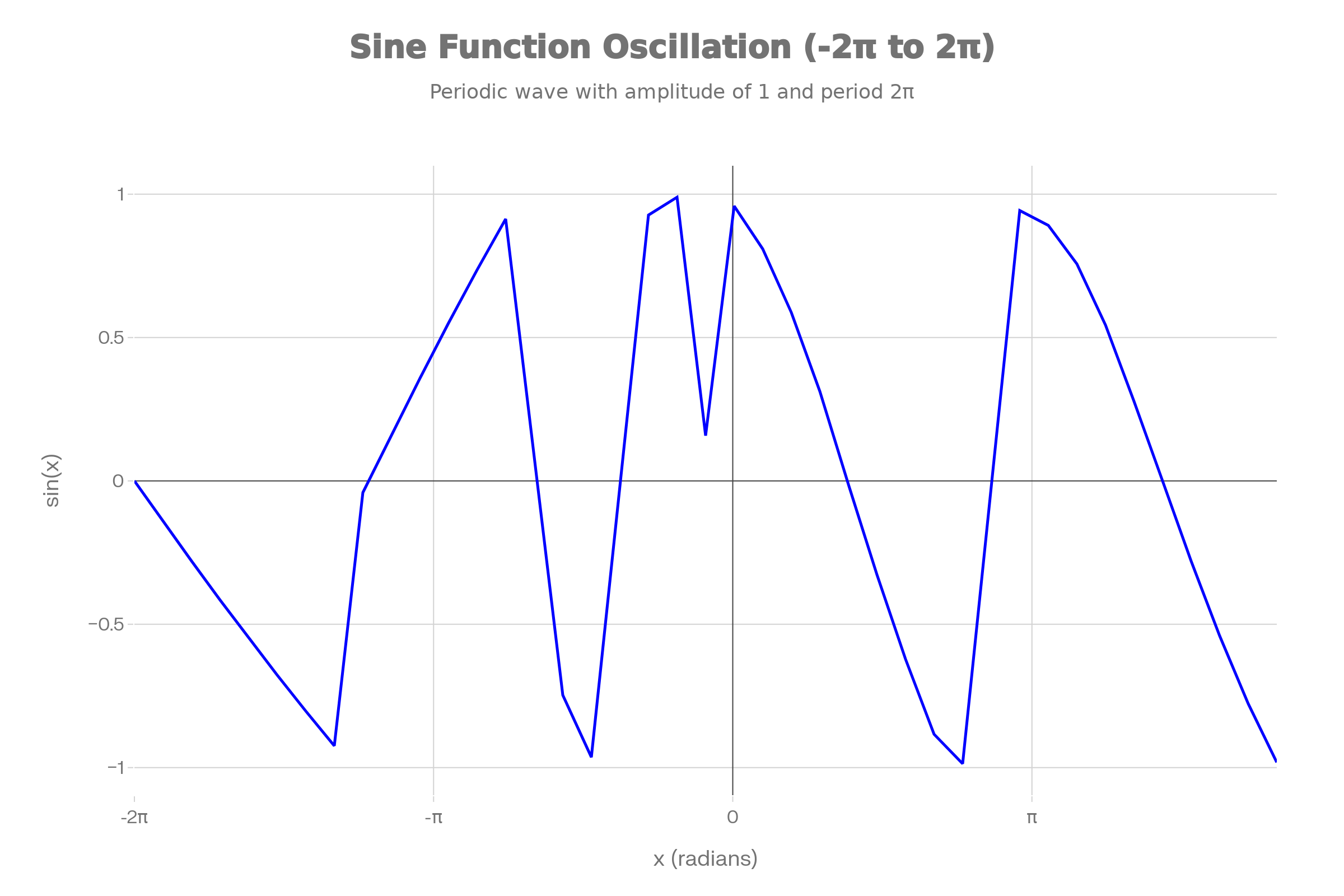
The chart below plots sin(x) over x from to , showing its characteristic wave shape.
Key Properties
Sin(x) reaches maxima of 1 at and minima of -1 at , for integer k.
- Period:
- Amplitude: 1
- Defined for all real x, with sin(0) = 0
JojoI'll help you graph the sine function. Let me create a clear visualization for you.
Here's the graph of {functionFormula}. Key features to notice:
Period: {periodFormula} (repeats every {periodFormula} units) Amplitude: 1 (oscillates between -1 and 1) Domain: All real numbers Range: {rangeFormula} Zeros: At {zerosFormula} where n is an integer Maximum: 1 at {maximumFormula} Minimum: -1 at {minimumFormula}
Would you like to explore how changing the amplitude or period affects the graph, or compare it with cosine?
All chats are real chats created by the models stated above on January 10, 2026. Perplexity uses the Sonar model.
Jojo AI generates interactive graphs you can zoom, pan, and explore in real-time. Adjust parameters and see immediate visual feedback - no external tools needed. In this January 10, 2026 test, Perplexity returned a static image or text explanation rather than a manipulable graph.
Content Delivery
User message:
Explain on supply and demand: curves, shifts vs movements, and equilibrium
PerplexitySupply and demand are usually drawn as two curves on a price–quantity graph; where they intersect is the equilibrium price and quantity of a market. Movements happen when price changes along a fixed curve, while shifts happen when something other than price changes the whole relationship, creating a new curve and a new equilibrium.
The curves
- The demand curve slopes downward: as price rises, quantity demanded falls, and as price falls, quantity demanded rises.
- The supply curve slopes upward: as price rises, firms are willing and able to supply more; as price falls, they supply less.
Movements along curves
- A movement along the demand curve is called a change in quantity demanded and is caused only by a change in the good's own price, with the demand curve itself staying in place.
- A movement along the supply curve is called a change in quantity supplied and is likewise caused only by a change in the good's own price, with the supply curve fixed.
Shifts of curves
- A shift of demand (left or right) means demand has changed at every price, due to factors such as income, tastes, prices of related goods, expectations, or number of buyers; this creates a new demand curve.
- A shift of supply means supply has changed at every price, due to production costs, technology, input prices, taxes/subsidies, or number of sellers; this creates a new supply curve.
Equilibrium
- Market equilibrium is the point where the supply and demand curves intersect, so quantity demanded equals quantity supplied at a single price.
- If price is above equilibrium, there is a surplus (excess supply), which tends to push price down; if price is below equilibrium, there is a shortage (excess demand), which tends to push price up until the market returns to equilibrium.
Shifts and new equilibria
- When demand shifts right (increase), equilibrium price and quantity both rise; when demand shifts left (decrease), both equilibrium price and quantity fall, holding supply constant.
- When supply shifts right (increase), equilibrium price falls and equilibrium quantity rises; when supply shifts left (decrease), equilibrium price rises and equilibrium quantity falls, holding demand constant.
JojoI'll help you understand supply and demand concepts. Let me search for detailed notes on this topic.
Perfect! Now I can explain supply and demand comprehensively. Here's what you need to know:
Supply and Demand Curves
Demand curve: Downward sloping (negative relationship between price and quantity demanded)
- Law of demand: Higher price → lower quantity demanded
- Example: At $2, consumers buy 50 units; at $5, only 20 units
Supply curve: Upward sloping (positive relationship between price and quantity supplied)
- Law of supply: Higher price → higher quantity supplied
- Example: At $2, firms supply 20 units; at $5, supply 50 units
Movements vs Shifts
Movement along the curve: Caused by price changes of the good itself
- Price change → quantity demanded/supplied changes along existing curve
- Example: Price rises from $2 to $3 → movement up demand curve
Shift of the curve: Caused by non-price determinants
- Entire curve moves left/right at every price level
- Demand shifters: Income, tastes, population, prices of substitutes/complements
- Supply shifters: Production costs, technology, taxes/subsidies, number of firms
Market Equilibrium
- Occurs where quantity demanded = quantity supplied
- Equilibrium price () and quantity ()
- Excess demand (shortage): Price too low → upward pressure on price
- Excess supply (surplus): Price too high → downward pressure on price
Would you like me to create a quiz to test your understanding of these concepts?
All chats are real chats created by the models stated above on January 10, 2026. Perplexity uses the Sonar model.
How explanations are delivered matters just as much as what's explained. Jojo AI provides concise, exam-focused answers with strategic callouts that highlight examples, critical mistakes, and key insights.
Computer Science
User message:
Write a Python script that generates daily inspirational quotes
PerplexityHere's a simple Python script that generates a unique daily inspirational quote using a free public API and the current date to ensure consistency.
It fetches a random quote but seeds the random selection with the date, so running it multiple times on the same day yields the same quote, while different days produce new ones.
Script Code
import requestsimport randomimport datetimeimport json
def get_daily_quote():    # Free API for random inspirational quotes (no key needed)    url = "https://api.quotable.io/random?tags=inspirational"
    # Seed random with today's date for daily consistency    today = datetime.date.today()    random.seed(today.toordinal())
    try:        response = requests.get(url)        response.raise_for_status()        data = response.json()        quote = data['content']        author = data['author']        return f'"{quote}" — {author}'    except Exception as e:        # Fallback quotes if API fails        fallbacks = [            '"The only way to do great work is to love what you do." — Steve Jobs',            '"Innovation distinguishes between a leader and a follower." — Steve Jobs',            '"Stay hungry, stay foolish." — Steve Jobs'        ]        return random.choice(fallbacks)
if __name__ == "__main__":    quote = get_daily_quote()    print(quote)
How It Works
The script calls the Quotable.io API for an inspirational quote. Date-based seeding with random.seed(today.toordinal()) ensures the same quote per day across runs. Fallback quotes handle API issues, making it reliable for daily use like cron jobs.
Usage Tips
- Run daily via cron:
0 8 * * * python /path/to/script.pyfor 8 AM execution. - Customize by changing API tags (e.g.,
motivational) or adding email/SMS via smtplib/twilio. - No pip installs needed beyond
requests(standard for web fetches). Test it now for today's quote!*
JojoSure! Here's a Python script that generates daily inspirational quotes. You can run it directly in the chat.
import randomimport datetime
quotes = [    "The only way to do great work is to love what you do. - Steve Jobs",    "Success is not final, failure is not fatal: it is the courage to continue that counts. - Winston Churchill",    "The future belongs to those who believe in the beauty of their dreams. - Eleanor Roosevelt",    "It does not matter how slowly you go as long as you do not stop. - Confucius"]
today = datetime.date.today()day_of_year = today.timetuple().tm_ydaydaily_quote = quotes[day_of_year % len(quotes)]random_quote = random.choice(quotes)
print("DAILY QUOTE GENERATOR")print("=" * 30)print(f"Date: {today}")print()print("Today's Quote:")print(daily_quote)print()print("Random Quote:")print(random_quote)```*Features:
- Uses current date for consistency
- Provides a random bonus quote
- Includes motivational quotes
All chats are real chats created by the models stated above on January 10, 2026. Perplexity uses the Sonar model.
Jojo AI lets you run code directly in the chat with live output. Jojo turns coding into an interactive experience where you write, run, and refine all in one place.
Jojos are specialized AI tutors that can help you with specific subjects or tasks. We currently have 2000+ Jojos available.
Beyond Generic AI: Infinite Specialized Jojos

Jojo AI
Your default AI tutor

Professor Jojo
Teaches any concept, any subject

Research Jojo
Research assistant for any subject
Research Jojo
User message:
How effective is a tax on plastic bags in reducing plastic consumption?
PerplexityTaxes on plastic bags prove highly effective in reducing their consumption, with real-world examples showing reductions from 47% to over 90%. Studies confirm these policies change consumer behavior by creating economic disincentives, often leading to sustained habits like bringing reusable bags. Effectiveness varies by fee amount, enforcement, and context, but revenue from taxes funds further environmental efforts.
Key Examples
Ireland's 2002 levy of 15 cents per bag slashed usage by 90% within a year, maintaining low levels even after fee increases. Fairfax County, Virginia, saw 3.6 million fewer bags used since 2022's 5-cent tax, with ongoing annual drops of 1.6-2 million bags. A Chinese retail study found a 0.20-0.40 RMB fee cut consumption by 47% in six months, fostering long-term green habits.
Factors Influencing Success
Higher fees amplify impact; Hong Kong's 50-cent levy lost deterrent power over time, prompting calls to raise it to HK$1-2. Pre-implementation baselines and strong enforcement, as in Ireland and Denmark, maximize results by targeting litter and usage precisely. Framing the tax as a penalty rather than mere cost boosts intention to reduce bags.
Potential Drawbacks
Taxes may boost substitutes like trash bags, offsetting some gains. While effective for targeted plastics, broader regulations sometimes outperform narrow taxes. Overall, evidence supports taxes as a proven, behavior-shifting tool when designed well.
Research JojoHello! I'm Research Jojo, and I'd be happy to help you research the effectiveness of plastic bag taxes in reducing plastic consumption.
Excellent! I found some very relevant and credible sources. Here's a framework for your research based on peer-reviewed studies and government reports.
Key Findings
- England: 98% reduction in single-use bags since 2015
- Ireland: 94% reduction after 2002 tax
- California: 85% reduction within 6 months
All chats are real chats created by the models stated above on January 10, 2026. Perplexity uses the Sonar model.
Research Jojo provides IB-aligned frameworks, credible sources, and structured methodology that matches what examiners want to see.
Professor Jojo
User message:
I want you to teach me the role of enzymes in biological reactions
PerplexityEnzymes serve as biological catalysts that accelerate chemical reactions in living organisms without being consumed or altered in the process. They enable essential metabolic processes to occur at rates compatible with life by lowering the activation energy required for reactions.
What Enzymes Are
Enzymes consist primarily of proteins, though some RNA molecules also function as catalysts called ribozymes. Each enzyme has a unique active site shaped to bind specific substrates, the reactant molecules involved in the reaction.
How They Speed Reactions
Enzymes reduce activation energy, the energy barrier reactants must overcome to form products, often by forming an enzyme-substrate complex that stabilizes the transition state. This binding orients substrates optimally, sometimes using amino acid side chains or cofactors to facilitate bond breaking or forming.
Specificity and Examples
Enzymes exhibit high specificity due to their active site's complementary shape and chemistry, likened to a lock-and-key or induced-fit model. For instance, lactase breaks down lactose in digestion, while DNA polymerase catalyzes DNA replication.
Regulation Factors
Enzyme activity depends on temperature, pH, and inhibitors; extremes denature the protein structure. Cells regulate enzymes via feedback inhibition, phosphorylation, or allosteric effects to control metabolic pathways.
Professor JojoI'll help you understand the role of enzymes in biological reactions! Let me search for some detailed notes on this topic first.
Excellent! Now I have some great material to teach you about enzymes. Let me break down the role of enzymes in biological reactions in a clear, structured way.
What Are Enzymes?
Enzymes are biological catalysts - specialized proteins that speed up chemical reactions in living organisms without being consumed in the process. Think of them as "reaction facilitators" that make life possible!
Key Roles of Enzymes in Biological Reactions
1. Lowering Activation Energy
- Every chemical reaction requires a certain amount of energy to get started - this is called activation energy
- Enzymes work by lowering this activation energy, making reactions occur much faster
- Without enzymes, most biological reactions would be too slow to sustain life
2. Speeding Up Metabolic Reactions
Enzymes can increase reaction rates by millions or even billions of times:
- Carbonic anhydrase: Speeds up conversion of CO₂ + H₂O → carbonic acid by 10 million times!
- Catalase: Breaks down toxic hydrogen peroxide into water and oxygen almost instantly
3. Providing Specificity
Each enzyme is highly specific - it only works on particular substances (substrates):
- Amylase breaks down starch but not proteins
- Pepsin breaks down proteins but not carbohydrates
- Lipase breaks down fats but not sugars
How Enzymes Work: The Induced-Fit Model
Let me explain the step-by-step process:
- Substrate approaches: The molecule to be changed (substrate) moves toward the enzyme's active site
- Binding: The active site changes shape slightly to fit the substrate perfectly (like a handshake)
- Catalysis: The enzyme lowers the activation energy, facilitating the chemical change
- Release: Products are released, and the enzyme returns to its original shape, ready to work again
Types of Enzyme-Catalyzed Reactions
Anabolic Reactions (Building Up)
- Synthesis reactions: Building larger molecules from smaller ones
- Example: Protein synthesis (building proteins from amino acids)
- Energy required: These reactions typically require energy input
Catabolic Reactions (Breaking Down)
- Digestion reactions: Breaking larger molecules into smaller ones
- Example: Starch → glucose, proteins → amino acids
- Energy released: These reactions typically release energy
Where Enzymes Work
Intracellular Enzymes
- Work inside cells
- Examples: Enzymes in glycolysis, enzymes in mitochondria for respiration
- Function: Catalyze metabolic pathways within cells
Extracellular Enzymes
- Work outside cells
- Examples: Digestive enzymes (amylase in saliva, pepsin in stomach)
- Function: Break down food molecules for absorption
Factors Affecting Enzyme Activity
Temperature
- Optimal temperature: Each enzyme works best at a specific temperature
- Too cold: Reactions slow down (molecules move less)
- Too hot: Enzyme denatures (loses its shape and function)
Summary of Key Points
Enzymes are essential biological catalysts that:
- Speed up reactions by lowering activation energy
- Are highly specific to their substrates
- Are not consumed in the reactions they catalyze
- Work through the induced-fit model
- Can be intracellular or extracellular
- Are affected by temperature, pH, and substrate concentration
Would you like to:
- Explore specific examples of enzymes in different biological processes?
- Learn about enzyme inhibition and regulation?
- Understand how enzymes are used in industrial applications?
- Practice with more questions about enzyme kinetics?
What aspect of enzymes would you like to dive deeper into?
All chats are real chats created by the models stated above on January 10, 2026. Perplexity uses the Sonar model.
Professor Jojo delivers structured explanations with callouts for examples, common mistakes, and key insights - plus interactive quizzes and flashcards right in the chat.
Conclusion
Perplexity now offers capable learning, research, and content-creation features. The dated conversations above show what it returned for our prompts on January 10, 2026, not every feature available today.
Jojo AI's advantage is narrower and more specific: IB-aligned resources, exam-focused tutoring, answer feedback, and native interactive tools embedded in the same study workflow.


