
A quiet IB problem nobody warns you about
The first time most IB students realize reflection is “a thing,” it feels harmless. A paragraph here. A quick comment there. Something you write when a teacher reminds you.
Then the year accelerates.
TOK wants you to reflect on knowledge and perspective. CAS wants reflection that proves growth. The Extended Essay wants reflections that show genuine engagement with inquiry. Three different formats, three different supervisors, three different vibes. And in the middle of that, you are also trying to revise content, drill exam questions, and keep your calendar from collapsing.
The problem is not reflection itself. Reflection is one of the best ideas in the IB.
The problem is fragmentation.
RevisionDojo solves that by making reflection feel like one connected system rather than three disconnected chores. Not by flattening TOK, CAS, and the EE into the same template, but by giving you shared structure, shared language, and shared visibility across the whole core.
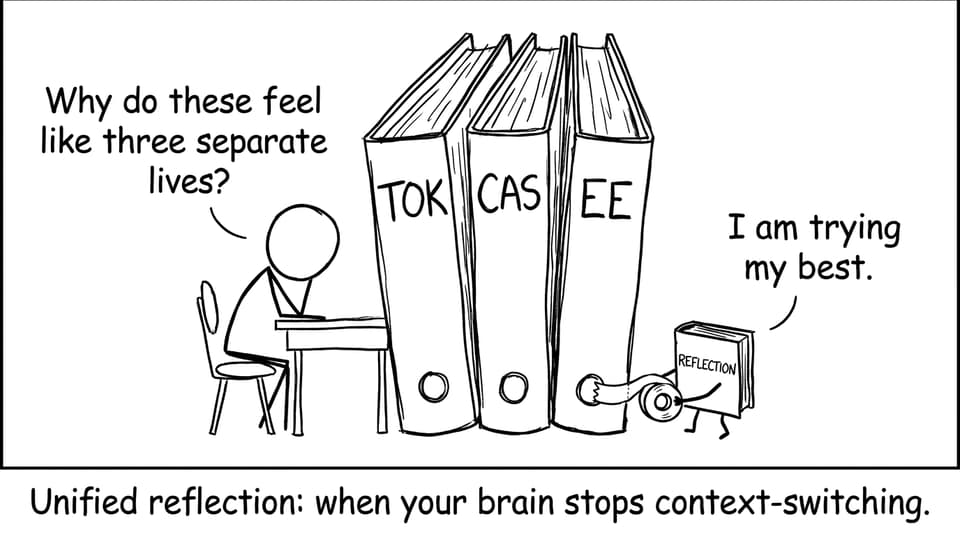
The unified reflection checklist (steal this)
If you want a simple way to unify your IB reflections across TOK, CAS, and the Extended Essay, start here. This is the smallest repeatable system that still produces high-quality evidence of growth.
-
One reflection framework you can reuse (same core questions, different context).
-
Component tags: TOK, CAS, EE (so nothing gets lost).
-
One Learner Profile trait per entry (so growth becomes visible over time).
-
One “decision point” (what you chose, and why).
-
One next step (so reflection turns into action).
-
One place to store it (so you can export, review, and improve).
RevisionDojo is built to keep this loop in one home base while you prepare for IB exams using the rest of the platform.
Why IB reflection works best when it’s connected
The IB core is often described like three separate mountains: TOK, CAS, and the EE. But in real student life, they overlap constantly.
-
TOK trains you to notice assumptions and limits.
-
CAS forces you to test values in the real world.
-
The EE rewards persistence through uncertainty.
Those aren’t separate skills. They’re the same skill wearing different clothing.
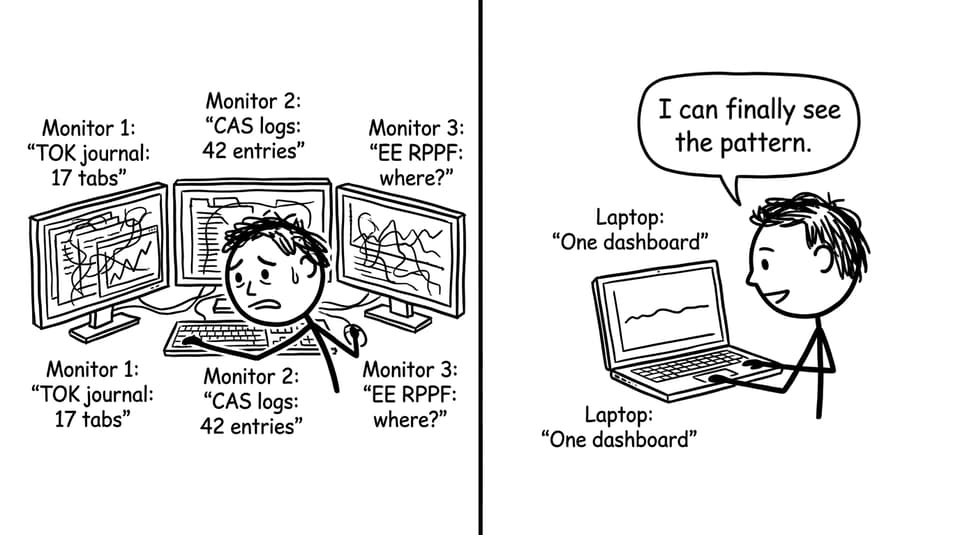
When you unify reflection, you stop context-switching. You also start seeing patterns: the same weakness (like vague claims or shallow evaluation) shows up in TOK writing, EE analysis, and even CAS reflections that describe events without meaning.
RevisionDojo’s approach is essentially: keep the differences of each component, but unify the engine underneath.
How RevisionDojo unifies IB reflection across TOK, CAS, and the Extended Essay
Shared templates that still respect each core component
A good reflection template is not a script. It’s a prompt that reliably produces insight.
RevisionDojo supports reflection prompts that can be shared across the IB core, while still allowing TOK-specific, CAS-specific, and EE-specific requirements.
A simple example of one shared spine:
-
What happened? (observation)
-
Why did it matter? (meaning)
-
What did you assume going in? (TOK lens)
-
What changed in you? (CAS lens)
-
What will you do differently in your process? (EE lens)
If you’re actively building TOK skills for essays and exhibitions, the IB Theory of Knowledge (TOK) hub pairs well with a unified reflection routine because it gives you the vocabulary to describe what you’re actually doing.
One reflection language that stops you from sounding random
Many IB students don’t struggle to reflect. They struggle to sound precise.
They write:
-
“I learned a lot.”
-
“It was challenging.”
-
“I grew as a person.”
Those sentences aren’t wrong. They’re just unmeasurable.
RevisionDojo pushes a shared reflective language across the core: inquiry, perspective, collaboration, ethics, self-management, and critical thinking. When you use the same language in TOK, CAS, and EE reflection, you start building a coherent story of yourself as a learner.
This becomes especially powerful when you’re trying to link your TOK thinking to your research writing. If that’s your goal, How to Use TOK to Enhance Your Extended Essay is a practical bridge.
Rubric alignment without turning reflection into performative writing
Here’s the subtle trap: when students hear “rubric,” they sometimes write reflections that sound like a sales pitch.
But the real goal of IB reflection is clarity: show what you did, what you noticed, and how your thinking evolved.
RevisionDojo supports consistent rubric-aligned feedback across core writing and documentation. For the EE and TOK especially, the IB Coursework Grader helps you see whether your writing actually matches the criteria, and it shortens the feedback loop between “draft” and “better draft.”
For EE structure and planning, the IB Extended Essay Guide hub makes it easier to reflect on process because you can name what stage you’re in (question, research, outline, analysis, revision) instead of writing vague updates.
Analytics that make growth visible (and therefore repeatable)
Most students don’t need motivation. They need proof.
If you can see that your reflections got deeper after you started using decision points, you keep doing it. If you can see that you reflect frequently in CAS but barely in TOK, you know exactly what to fix.
RevisionDojo’s unified approach means reflection becomes trackable across TOK, CAS, and EE. Not to turn you into a data point, but to give you a mirror.
The exam-season advantage: less admin, more marks
When exams approach, reflection tends to become the first thing students drop. That’s understandable. But in the IB, dropping reflection can create new stress later: missing CAS evidence, weaker EE engagement, and TOK writing that lacks personal insight.
RevisionDojo is designed as an all-in-one study loop, so reflection doesn’t sit in a separate app or folder you forget exists. Your revision can live alongside your core requirements:
-
Use the Questionbank to practice exam-style questions and convert mistakes into reflection prompts like “What assumption caused this error?”
-
Use Study Notes and Flashcards to keep memory stable when your schedule is uneven.
-
Use AI Chat to clarify concepts quickly when you feel stuck.
-
Use Grading tools and the Coursework Library to tighten coursework drafts.
-
Use Predicted Papers and Mock Exams to train calm under time pressure.
-
Use Tutors when you need a human explanation that cuts through the noise.
If you want the bigger exam-prep system, RevisionDojo App: The Smarter Way to Prep for IB Exams lays out how the pieces connect.
A realistic example: how unified reflection changes your week
Imagine an IB student who runs a CAS service project tutoring younger students. Meanwhile, they’re drafting an EE in History and preparing a TOK essay.
Without unification:
-
CAS reflection describes what happened.
-
EE reflections are rushed and procedural.
-
TOK journal entries feel abstract and detached.
With RevisionDojo’s unified approach, the student starts noticing overlap:
-
Their CAS tutoring reveals how language changes what counts as “understanding.”
-
That becomes a TOK insight about communication and knowledge.
-
That becomes an EE research habit: clearer definitions, better evaluation of sources, tighter argument claims.
Suddenly, reflection stops being “extra writing.” It becomes the glue that makes the IB core feel like one story.
The “10-minute reflection” pattern (so you actually do it)
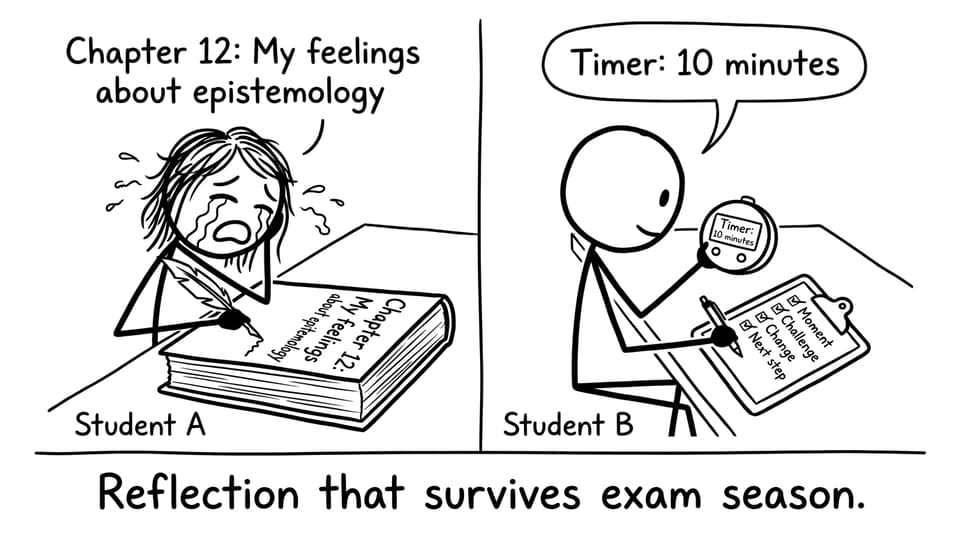
A reflection system only works if it survives tired days.
Try this format after TOK prep, CAS sessions, or EE work:
-
2 minutes: One moment that mattered.
-
2 minutes: One challenge or uncertainty.
-
3 minutes: One decision you made (and why).
-
2 minutes: One change in thinking or behavior.
-
1 minute: One next step.
If you want CAS-specific guidance for what “counts,” keep What is CAS? Unveiling the IBDP Creativity, Activity, Service nearby, and for deeper documentation habits use Using RevisionDojo to Strengthen IB CAS Reflection and Documentation.
Closing: the IB core becomes easier when it becomes one story
In the IB, reflection isn’t meant to be decorative writing you perform for separate folders. It’s meant to be the thread that connects what you think (TOK), what you do (CAS), and what you investigate (the Extended Essay).
RevisionDojo makes that thread stronger by unifying reflection across the core while also supporting the rest of your exam prep loop: Questionbank practice, Study Notes, Flashcards, AI Chat, Grading tools, Predicted Papers, Mock Exams, the Coursework Library, and Tutors.
If you want the IB to feel less like three separate lives and more like one coherent journey, build your reflection system in the same place you build your marks. Start with one template, run it for a week, and let the connections show up.
