




If you have ever watched a friend glide through their IB science while you are drowning in definitions, calculations, and lab write-ups, you have probably asked the same quiet question: Is there an easier option?
The honest answer is that “easy” in IB usually means aligned. Aligned with your strengths, your interests, your schedule, and your exam style. That is why Subject Selection matters so much. Done well, it can lower stress, protect your overall score, and make revision feel like progress instead of punishment.
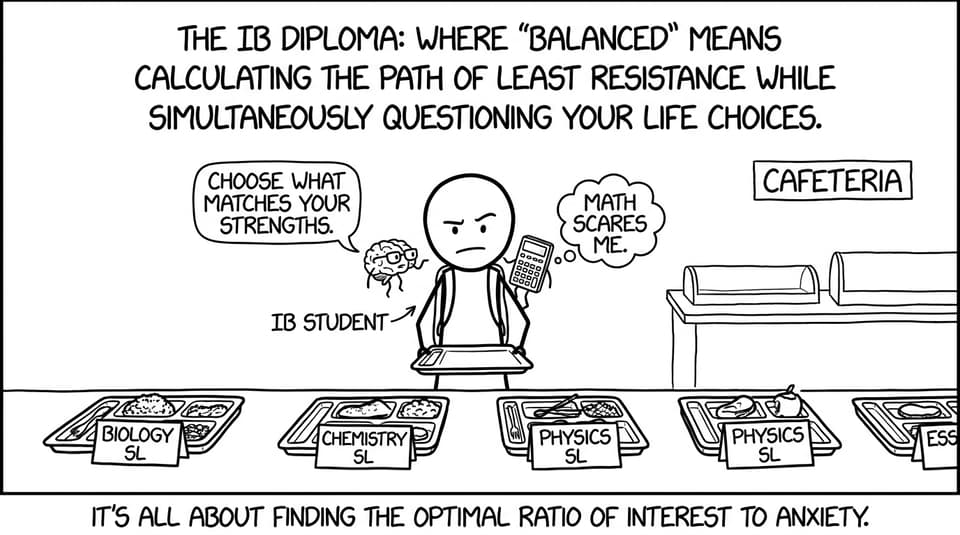
A quick Subject Selection checklist (before you pick “the easiest”)
Use this fast filter before committing to any “easy science”:
-
Math comfort: Do equations energize you or drain you?
-
Memory tolerance: Can you handle large content volume without burning out?
-
Writing vs problem-solving: Do you score better with explanations or calculations?
-
Lab workload: Do you like practical work, or would you rather analyze case studies?
-
University requirements: The “easiest” subject is irrelevant if it blocks your future options.
If you want a broad overview of what lives in Group 4, read What subjects are in Group 4 (science)?. It is a surprisingly calming starting point for Subject Selection.
What makes a science subject feel “easy” in IB?
Students usually call a subject easy when the difficulty sits in the same place they already have strength. In practice, “easy” tends to mean:
-
Fewer technically dense topics (or topics that feel intuitive)
-
Less math-heavy assessment
-
More predictable question styles
-
Clear study routines (flashcards, diagrams, short explanations)
-
Motivation: interest is an underrated multiplier
The key is not to hunt for a subject with zero effort. In IB, that does not exist. The goal is Subject Selection that makes your effort convert into marks efficiently.
Environmental Systems and Societies (ESS): “easy” for the right kind of thinker
ESS is often the first answer people give when asked about the easiest IB science. The reason is simple: it is interdisciplinary, usually lighter on complex calculations, and leans into real-world case studies.
But ESS is not a free ride. If you dislike evaluation, essay-style responses, and linking science to social decisions, ESS can feel strangely slippery. If you enjoy making arguments from data, connecting ideas, and thinking in systems, it can feel refreshingly manageable.
If you want a deeper reality check before committing, read Is ESS the easiest IB Science? and Is ESS Really the Easiest IB Subject?. Both are useful for smarter Subject Selection.
Biology SL: high content, lower math, very “learnable”
Biology SL is frequently described as accessible because it rewards consistent study habits. The concepts are often concrete (cells, body systems, ecosystems), and many questions ask you to explain processes clearly rather than solve multi-step calculations.
That said, Biology SL can become hard when students underestimate the content volume. It is “easy” when you build routines: short daily retrieval practice, diagram repetition, and keyword-accurate definitions.
A practical approach is to revise Biology SL with layered tools: use RevisionDojo Study Notes for the core explanations, then lock in recall with Flashcards, and finally pressure-test with the Questionbank. That workflow makes Biology SL feel like a subject you can steadily tame, which is exactly what good Subject Selection should do.

Chemistry SL: structured, mark-friendly, but only if you like patterns
Chemistry SL is often easier than Chemistry HL because the depth is reduced, and the math is more contained. Many students find Chem SL “doable” because it is structured: you learn a model, practice the model, and apply it to familiar question styles.
Chemistry SL tends to feel easiest for students who like:
-
Step-by-step methods
-
Equation practice
-
Topic-by-topic mastery
If you hate symbolic thinking or you avoid practice questions, Chemistry SL will not feel easy. But if you like tidy systems, it can become one of the most scoreable choices in your Subject Selection.
Physics SL: the “easier physics” is still physics
Physics SL is widely seen as more manageable than Physics HL because it avoids some of the heavier math and depth. Still, the subject has a personality: it rewards comfort with algebra, unit thinking, and problem-solving under time pressure.
Physics SL can be a strong “easier” choice if you:
-
Prefer solving to memorizing
-
Like getting a clean numeric answer
-
Can practice consistently without panic
If you are deciding between the big three sciences, this comparison guide helps frame Subject Selection clearly: Which science should I take in IB? Biology vs Chemistry vs Physics.
How to make Subject Selection without regret
A useful mental model: pick the subject whose difficulty matches your best habits.
-
If you can memorize steadily, Biology SL might feel easiest.
-
If you like structured practice, Chemistry SL can feel easiest.
-
If you like problem-solving, Physics SL can feel easiest.
-
If you like evaluation and real-world links, ESS can feel easiest.
For a fuller decision framework, keep How to choose the right Group 4 subject for you open while you plan. It is one of the clearest guides for Subject Selection.
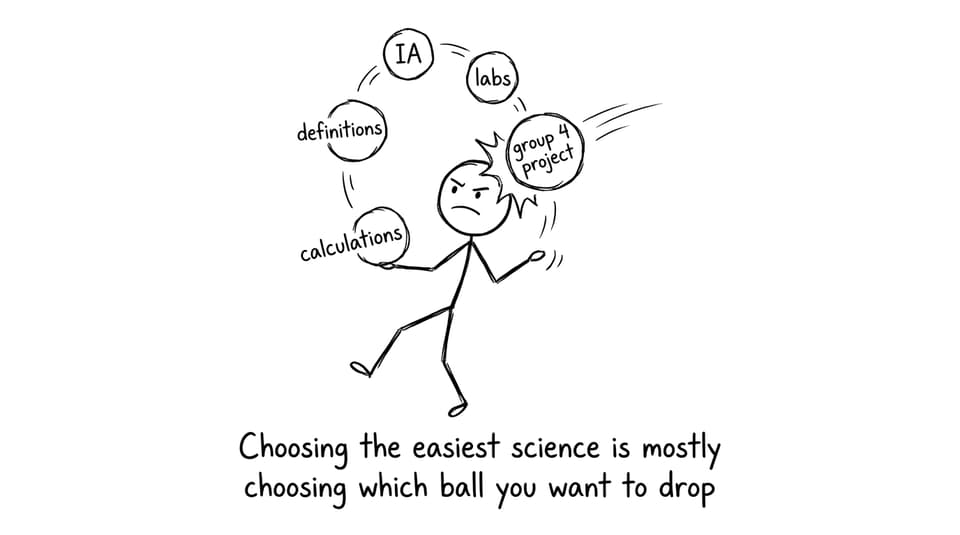
Closing: the easiest science is the one you can revise consistently
The best Subject Selection is not the one that sounds easiest in a hallway conversation. It is the one that lets you show up daily, revise without dread, and build confidence week by week.
If you want to keep researching your options, continue with Which IB Science is the easiest? and, for balance, Hardest Science Subjects in IB. Then use RevisionDojo to execute: the Questionbank for practice, Flashcards for recall, AI Chat for quick explanations, and Mock Exams plus Predicted Papers to sharpen exam timing. Good Subject Selection starts the journey. Great revision finishes it.