
TOK can feel like the only IB subject that grades your uncertainty.
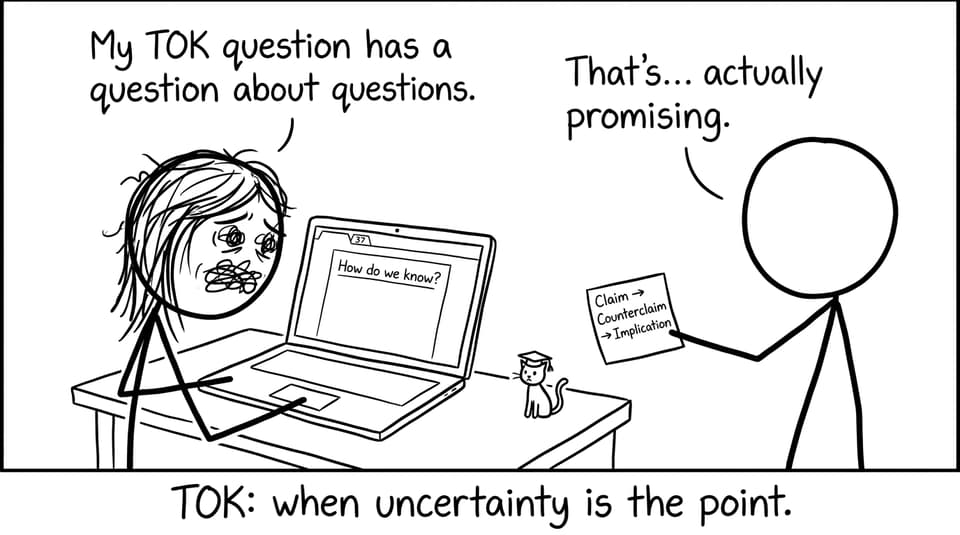
One minute you’re confident you have a solid point. The next, your teacher asks, “How do you know that?” and your argument suddenly feels like it was built from fog and good intentions.
That’s the hidden gift of TOK. It teaches you to build sturdy thinking in a world where information is cheap, confidence is loud, and certainty is often borrowed.
In this guide, you’ll learn the TOK thinking and writing skills that actually move marks: questioning assumptions without spiralling, using evidence without worshipping it, and turning examples into analysis. Along the way, you’ll see practical checklists you can use immediately for the essay and exhibition.
TOK success checklist (save this before you draft)
If your TOK work is drifting, this is the reset.
-
Can I state my knowledge question in one clean sentence?
-
Do I have a clear claim and a real counterclaim (not a weak “however”)?
-
Have I explained why my example matters, not just what happened?
-
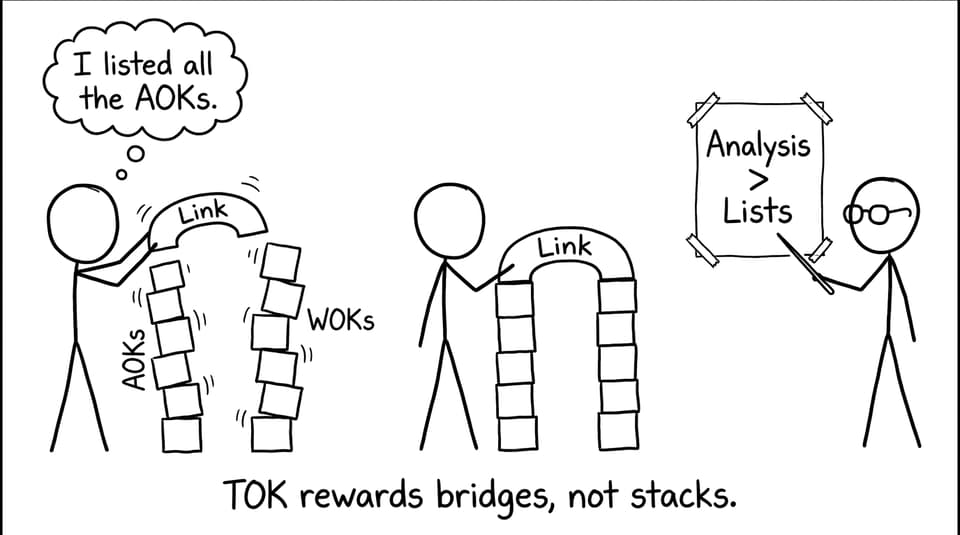
Did I link to an Area of Knowledge (AOK) and show how the method of knowing shapes the conclusion?
-
Is there a visible line from my paragraph back to the TOK title/prompt?
-
Did I reflect on implications: “So what changes if we accept this?”
When you need a bigger picture of how the course fits together, keep the IB Theory of Knowledge (TOK) hub open while you plan.
What TOK thinking really is (and what it isn’t)
Most subjects reward answers. TOK rewards judgement.
That doesn’t mean being vague. It means learning to hold two ideas at once: knowledge can be powerful and limited; methods can be reliable and biased; experts can be trustworthy and still wrong.
High-scoring TOK writing tends to do three quiet things:
-
It slows down a claim long enough to inspect the assumptions inside it.
-
It tests justification (how was this knowledge produced and validated?).
-
It keeps perspective visible (who benefits, who is excluded, what values are embedded?).
If you want course-aligned guidance for the essay itself, the TOK Essay notes are a useful reference point before you start drafting.
Core TOK thinking skills that raise your markband
Question assumptions without turning cynical
In TOK, assumptions are like the invisible rules of a game. You don’t notice them until someone challenges them.
Try this move: when you write a sentence that sounds “obviously true,” pause and ask what has to be true for that sentence to hold.
Example: “Science is objective.”
A TOK response doesn’t just agree or disagree. It asks: objective compared to what? objective under what conditions? objective for which communities of knowers? Then it explores how instruments, peer review, funding incentives, and interpretation shape what counts as “objective.”
Evaluate sources like a knower, not a collector
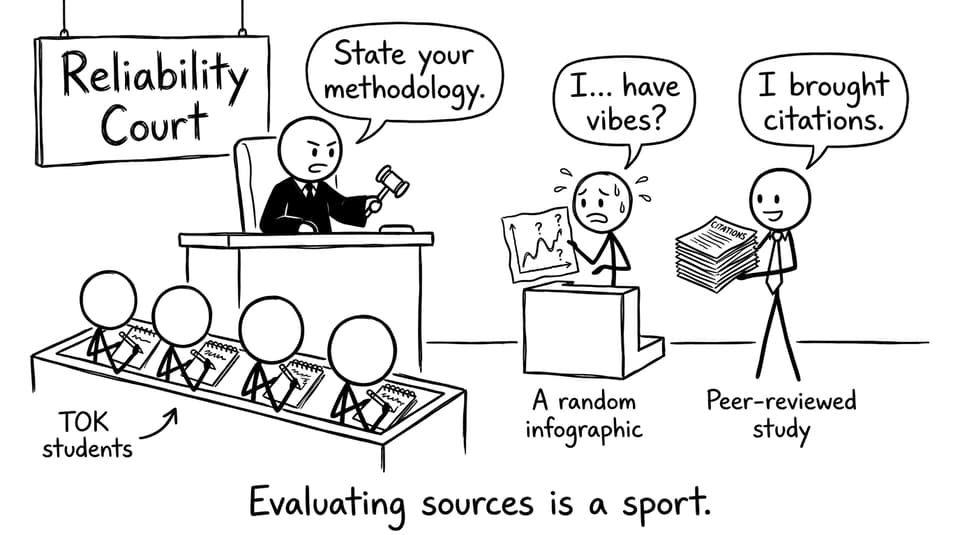
A common TOK trap is treating sources like trophies: the more you have, the smarter you look.
Examiners care more about whether you can evaluate reliability, bias, and method. Ask:
-
Who produced this knowledge, and what standards were used to validate it?
-
What evidence would change the conclusion?
-
Is the claim being repeated because it’s true, or because it’s socially convenient?
This kind of evaluation is easier when you study models. RevisionDojo’s TOK coursework exemplars show how top responses treat evidence as something to question, not worship.
Build perspectives that actually disagree
“On the other hand…” is not a counterclaim. It’s a signal you know one is required.
A strong TOK counterclaim changes the shape of the problem. It might challenge the standards of evidence, the role of language, or the ethics of knowledge production.
One practical method is to choose AOKs that genuinely clash in method (e.g., natural sciences vs history; mathematics vs the arts). If you need help turning prescribed titles into arguable questions, use TOK Essay titles and knowledge questions as a planning guide.
Reflect on implications (the step most students skip)
Reflection in TOK is not “I think this is interesting.” It’s explaining consequences.
Ask:
-
If we accept this claim, what changes about decision-making?
-
Who gains authority, and who loses it?
-
What risks appear when we treat this knowledge as certain?
This is where TOK becomes real life. Your argument stops being a school exercise and starts becoming a tool for navigating a messy world.
TOK essay skills: from “ideas” to a scoreable structure
The TOK essay rewards thinking that is visible. That means your structure should make your evaluation easy to spot.
A simple, examiner-friendly paragraph pattern:
-
Claim (a defensible answer to the title)
-
Justification (how we know, using an AOK lens)
-
Real-life example (specific, grounded)
-
Evaluation (limits, bias, alternative interpretation)
-
Counterclaim (genuine tension)
-
Implication (so what?)
If your essay is currently a set of interesting points with no spine, read Structuring for Success in IB TOK Essays and compare your draft against its structural expectations.
When you’re working with prescribed titles, it also helps to study how high-level plans look in action. RevisionDojo’s Ultimate TOK May 2026 Essay Guide is a useful model for turning a prompt into claims, counterclaims, and implications.
TOK exhibition skills: make the object do the thinking
The exhibition is where TOK becomes tangible: three objects, one prompt, one commentary that proves you understand knowledge in the wild.
A strong TOK exhibition object does two things at once:
-
It has real context (not just “a photo I found”).
-
It creates a knowledge tension (authority, bias, evidence, values, interpretation).
If you’re picking objects, don’t guess. Use Selecting the Right Objects for Your TOK Exhibition to avoid generic choices that lead to generic commentary.
Then, when you draft, focus on clarity and explicit links. The guide How to Create an Engaging TOK Exhibition Commentary is especially helpful for making sure every sentence earns its place.
For additional models, browse IB TOK Exhibition Examples and compare how successful commentaries keep the prompt in view.
How RevisionDojo helps you train TOK thinking (without losing your voice)
Most students don’t struggle with TOK because they lack intelligence. They struggle because they lack feedback loops.
RevisionDojo is built to make those loops fast.
-
Use the Study Notes and TOK hub to clarify what each task is really assessing: RevisionDojo Study Notes and IB Theory of Knowledge (TOK) hub.
-
Practise thinking with targeted prompts using Flashcards and Questionbank habits (short sessions, high frequency).
-
Draft faster with AI Chat when you’re stuck turning a real-life example into a knowledge issue.
-
Improve with rubric-aligned feedback using the Grading tools, including the IB TOK Essay Grader and IB TOK Exhibition Grader.
-
Learn what top work looks like through the Coursework Library, especially the TOK essay exemplars.
If you’re also preparing for timed performance across IB subjects, RevisionDojo’s Mock Exams and Predicted Papers (used as practice sets, not shortcuts) help you rehearse decision-making under pressure, which is also a hidden part of TOK.
Closing: TOK is a skill you can train
The students who do well in TOK aren’t the ones with the fanciest philosophy quotes. They’re the ones who learn a repeatable habit: make a claim, test it, challenge it, and reflect on what changes.
If you want to turn that habit into marks, build your workflow around RevisionDojo: start in the TOK notes, practise with Flashcards and Questionbank, draft with AI Chat, check alignment with the TOK graders, and learn patterns from the Coursework Library. TOK rewards visible thinking. RevisionDojo helps you make that thinking clearer, faster, and more confident.