RevisionDojo logoRevisionDojo logo
FeaturesSubjectsPricingSchools
Back to all posts
  1. Home
  2. /Blog
  3. /All 35 TOK Exhibition Prompts Explained

All 35 TOK Exhibition Prompts Explained

TOKIB
RevisionDojo Team
•Last updated: 21 Oct 2026•11 min read
ShareShare on XShare on WhatsAppShare on LinkedInShare on Facebook
Add as a preferred source on Google
All 35 TOK Exhibition Prompts Explained

Join 650k+ students breezing through the IBReady to breeze through the IB?

Footer

General

  • Download apps
  • For parents
  • For schools
  • Pricing
  • Gift RevisionDojo
  • Tutoring
  • IB syllabus
  • MYP syllabus
  • Blog
  • Student Questions

Features

  • Question Bank
  • Test Builder & Exam Mode
  • Predicted Papers
  • Past Papers
  • Study Notes
  • Interactive Lessons
  • Flashcards
  • Jojo AI Tutor
  • Coursework Studio
  • View all features

Research

  • All research
  • Jojo AI vs leading AI study tools
  • 2026 State of Learning Survey
  • 2025 State of Learning Survey
  • IB Moderation Analysis
  • Jojo AI vs ChatGPT
  • Jojo AI vs Gemini
  • Jojo AI vs Perplexity
  • Jojo AI vs Claude
  • Jojo AI vs Poe

Platform

  • About RevisionDojo
  • RevisionDojo vs Others
  • Content philosophy
  • Trustpilot
  • Join usWe're hiring
  • Student Ambassador
  • Help center
  • Contact us
  • Terms of Service
  • Data & privacy
  • Privacy policy
  • Cookie policy
  • Trust Center

IB Subjects

  • Arabic A
  • Arabic A Lit
  • Arabic ab initio
  • Arabic B
  • Biology
  • Business Management
  • Chemistry
  • Chinese A Lang & Lit
  • Chinese B
  • Computer Science (CS)
  • Computer Science (First Exam 2027)
  • Design Technology (DT)
  • Design Technology (First Exam 2027)
  • Digital Society (DS)
  • Economics
  • English A Lang & Lit
  • English A Lit
  • English B
  • Environmental systems and societies (ESS)
  • French A
  • French A Lit
  • French ab initio
  • French B
  • Geography
  • German A
  • German A Lit
  • German ab initio
  • German B
  • Global Politics
  • History
  • History (First Exam 2028)
  • Mathematics Analysis and Approaches (AA)
  • Mathematics Applications & Interpretation (AI)
  • Philosophy
  • Physics
  • Psychology
  • Psychology (First Exam 2027)
  • Spanish A
  • Spanish A Lit
  • Spanish ab initio
  • Spanish B
  • Sports, exercise and health science (SEHS)
  • Theory of Knowledge (TOK)
  • World Religions

MYP Subjects

  • MYP Biology
  • MYP Chemistry
  • MYP Design
  • MYP English Lang & Lit
  • MYP Extended Mathematics
  • MYP History
  • MYP Individuals & Societies
  • MYP Integrated Sciences
  • MYP Physics
  • MYP Standard Mathematics
  • MYP Biology
  • MYP Chemistry
  • MYP Design
  • MYP English Lang & Lit
  • MYP Extended Mathematics
  • MYP History
  • MYP Individuals & Societies
  • MYP Integrated Sciences
  • MYP Physics
  • MYP Standard Mathematics
RevisionDojo logo

© 2022 - 2026 RevisionDojo (MyDojo Inc)

RevisionDojo was developed independently of the IBO and as such is not endorsed by it in any way.

Download on the App StoreGet it on Google Play
GDPR compliant

Related Articles

DP1 Reassurance & Mindset · Oct 21, 2026 · 11 min read

What I Wish I Knew: IB DP1 Lessons That Matter

What I wish I knew IB students understood sooner: a reassuring DP1 guide to study systems, deadlines, feedback, CAS, rest, and starting this week.

DP1 Reassurance & Mindset · Oct 21, 2026 · 11 min read

Switch From IB Diploma to Courses: Is It Failure?

Switch from IB Diploma to courses without shame. Compare credentials, university implications, warning signs, and practical next steps for DP1 students.

DP1 Reassurance & Mindset · Oct 21, 2026 · 11

Straight-A Student Struggling in IB? A DP1 Reset

Straight-A student struggling in IB? Learn why DP1 feels different, reset your study system, and take practical steps to regain confidence this week.

DP1 Reassurance & Mindset · Oct 21, 2026 · 12

Why IB Teachers Grade Harsh in DP1, and What to Do

IB teachers grade harsh in DP1 for several reasons. Learn how marking works, check whether feedback is fair, and build a practical study plan this week.

DP1 Reassurance & Mindset · Oct 21, 2026 · 12

IB October Burnout: Why DP1 Feels the Worst

IB October burnout can make DP1 feel unmanageable. Learn why the dip happens and use a realistic one-week reset to regain energy, focus, and control.

DP1 Reassurance & Mindset · Oct 21, 2026 · 10

Good First Semester IB: What Progress Looks Like

Good first semester IB progress is not perfection. Learn what DP1 students should understand, organize, practise, and improve during their first term.

Starting TOK can feel like being handed familiar words that suddenly refuse to stay simple. You know what evidence is. You know what an expert is. Then Theory of Knowledge asks what makes evidence adequate or why experts deserve trust.

The TOK exhibition prompts are 35 prescribed knowledge questions. You choose one prompt, select three specific objects, and write a commentary of no more than 950 words explaining how those objects illuminate the question. The exhibition contributes 33% of the TOK assessment, while the externally assessed 1,600-word essay contributes 67%.

Below, every prompt is translated into a practical line of inquiry, with an object direction to help you begin. These are starting points, not ready-made choices. The best objects usually come from contexts you understand personally.

TOK exhibition requirements at a glance

Before comparing prompts, remember the essentials:

  • Select one prescribed prompt and reproduce it exactly.
  • Choose three specific objects, or images of objects, with real-world contexts.
  • Explain why each particular object belongs in the exhibition.
  • Connect every object directly to the same prompt.
  • Develop distinct insights instead of repeating one argument.
  • Keep the complete commentary within 950 words.

Specificity matters. Instead of choosing "a newspaper," identify one front page from a particular date. Instead of "a calculator," use a particular calculator and explain how its functions shape what its user can know.

For the wider assessment context, read the current TOK requirements explained.

Prompts about knowledge, evidence, and certainty

1. What counts as knowledge?

Ask where knowledge ends and belief, opinion, or skill begins. A weather warning could test whether a justified prediction is already knowledge.

2. Are some types of knowledge more useful than others?

Define usefulness within a situation. A first-aid card and medical textbook could show how purpose and urgency change what knowledge is useful.

min read
min read
min read
min read

3. What features of knowledge have an impact on its reliability?

Consider evidence, reproducibility, expertise, transparency, and review. A medicine label could connect standardized testing with dependable claims.

4. On what grounds might we doubt a claim?

Explore reasonable doubt, not automatic suspicion. An edited social media post raises questions about sources, motives, evidence, and missing context.

5. What counts as good evidence for a claim?

A customer review may be relevant, but independently verified reviews may support a broader conclusion more strongly. Quality depends on the claim.

6. How does the way that we organize or classify knowledge affect what we know?

Categories reveal patterns while hiding exceptions. A library classification label can show how systems shape discovery and perceived relationships.

7. What are the implications of having, or not having, knowledge?

A food allergen label could connect access to knowledge with safety, responsibility, and the consequences of remaining uninformed.

8. To what extent is certainty attainable?

Compare degrees of certainty rather than answering yes or no. A mathematical proof and medical scan could reveal different standards.

9. Are some types of knowledge less open to interpretation than others?

A speedometer appears less interpretive than a poem, yet its meaning still depends on calibration, units, and context.

10. What challenges are raised by the dissemination and/or communication of knowledge?

A translated instruction manual could reveal how language, simplification, audience, authority, and access alter knowledge as it travels.

RevisionDojo's complete guide to TOK exhibition prompts offers further help connecting questions to objects.

Prompts about values, ethics, and power

11. Can new knowledge change established values or beliefs?

A revised museum label could expose tension between new historical research, established narratives, and cultural identity.

12. Is bias inevitable in the production of knowledge?

A questionnaire can show how wording and selection introduce assumptions before researchers even collect answers.

13. How can we know that current knowledge is an improvement upon past knowledge?

Two map editions could test whether improvement means greater accuracy, detail, accessibility, or usefulness. Newer does not automatically mean better.

14. Does some knowledge belong only to particular communities of knowers?

A ceremonial object displayed with permission could raise questions about cultural ownership, access, authority, and understanding.

15. What constraints are there on the pursuit of knowledge?

A rejected research proposal could demonstrate how ethical, financial, technological, political, or institutional limits shape investigation.

16. Should some knowledge not be sought on ethical grounds?

A research consent form could help examine when possible benefits fail to justify risks to participants.

17. Why do we seek knowledge?

A family genealogy record might reveal overlapping motives such as curiosity, identity, care, status, or control.

18. Are some things unknowable?

Distinguish what is temporarily unknown from what may be impossible to know. A destroyed diary could represent permanently inaccessible historical perspectives.

19. What counts as a good justification for a claim?

A product certification mark could test whether institutional authority, standardized testing, or direct experience provides sufficient support.

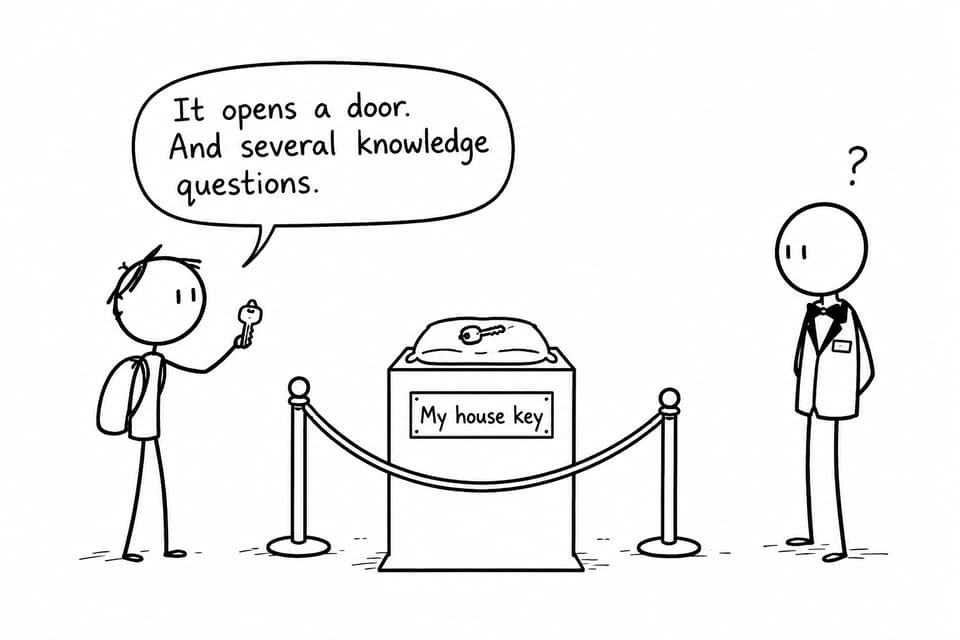
A student presents an ordinary house key as a profound museum exhibit while an attendant looks puzzled

An ordinary object becomes philosophically useful when its specific context supports a precise knowledge question.

Prompts about knowers, culture, and expertise

20. What is the relationship between personal experience and knowledge?

A travel journal could show how experience produces insight while remaining limited by one person's perspective.

21. What is the relationship between knowledge and culture?

A bilingual family recipe might connect practical knowledge with language, identity, preservation, and cultural transmission.

22. What role do experts play in influencing our consumption or acquisition of knowledge?

A doctor's annotated test result could show how expertise enables understanding while requiring non-specialists to extend trust.

23. How important are material tools in the production or acquisition of knowledge?

A school microscope can show how tools extend perception while limiting observations through their design and resolution.

24. How might the context in which knowledge is presented influence whether it is accepted or rejected?

A health claim on product packaging could reveal how setting, authority, audience, and commercial purpose affect acceptance.

25. How can we distinguish between knowledge, belief and opinion?

A handwritten prediction beside an official result could help examine truth, evidence, confidence, and justification.

26. Does our knowledge depend on our interactions with other knowers?

A document containing teacher feedback could demonstrate how criticism, explanation, and collaboration change individual understanding.

27. Does all knowledge impose ethical obligations on those who know it?

A confidentiality agreement could explore whether possessing privileged information creates responsibilities that ordinary knowledge does not.

RevisionDojo's TOK Exhibition Coursework Library shows how effective commentaries stay focused on their prompts. Study structure, but never copy objects or arguments.

Prompts about objectivity, ownership, and production

28. To what extent is objectivity possible in the production or acquisition of knowledge?

A laboratory protocol might show how transparent procedures reduce individual influence, even when perfect neutrality remains difficult.

29. Who owns knowledge?

A patented design could reveal tension between rewarding creators, protecting cultural knowledge, and allowing society to benefit from discoveries.

30. What role does imagination play in producing knowledge about the world?

A scientific model can show how researchers imagine unseen structures before testing whether those models explain observations.

31. How can we judge when evidence is adequate?

A smoke alarm test record could demonstrate why high-stakes conclusions require stronger evidence than everyday decisions.

32. What makes a good explanation?

Two instruction manuals for one device could test whether clarity, accuracy, scope, simplicity, and usefulness outweigh sheer detail.

33. How is current knowledge shaped by its historical development?

An older science textbook could show how present knowledge emerged through inherited concepts, disputes, corrections, and continuities.

34. In what ways do our values affect our acquisition of knowledge?

A personalized news feed can demonstrate how existing interests and values influence what information someone encounters or accepts.

35. In what ways do values affect the production of knowledge?

A research funding announcement could show how institutional and social priorities determine which questions receive resources.

How to choose your prompt and objects

Do not choose the prompt that sounds most sophisticated. Choose the one that gives you three specific, defensible objects with genuinely different contributions.

Use this quick test:

  • Can I explain the prompt in ordinary language?
  • Can I identify three existing objects with precise contexts?
  • Does each object reveal something different?
  • Can I explain why each particular object is necessary?
  • Can I address complications without forcing an absolute answer?

A useful planning sentence is: This object shows that... because... If the sentence works equally well for hundreds of unrelated objects, the connection is probably too generic. Strong analysis depends on what makes this object, in this context, uniquely helpful.

RevisionDojo's guides to choosing a strong exhibition prompt, selecting TOK exhibition objects, and understanding exhibition grading can move you from an initial idea to a focused commentary. Study Notes and AI Chat can clarify terminology, while grading tools and Tutors can help test whether your reasoning is explicit.

Turn a question into an exhibition

The exhibition becomes manageable when you stop hunting for three impressive objects. Its real task is smaller and more interesting: noticing how knowledge already operates in the world around you.

Begin with a prompt you can explain without TOK jargon. Find three objects with identifiable histories and contexts. Then make every paragraph prove why that particular object changes, complicates, or deepens your response.

RevisionDojo lets you bring that planning together with Questionbank practice, Flashcards, Predicted Papers, Mock Exams, the Coursework Library, grading tools, Tutors, and subject Study Notes. As the ultimate IB resource, it helps ensure that TOK remains connected to the wider work of DP1 rather than becoming one isolated deadline.
How helpful was this article?
Add as a preferred source on Google

Frequently Asked Questions