Join 650k+ students breezing through the IBReady to breeze through the IB?
A calmer way to face TOK May 2026
The night you first read the TOK May 2026 prompts, they can feel less like questions and more like mirrors. Each title reflects your habits: how quickly you jump to certainty, how often you hide behind examples, how tempted you are to sound smart instead of think clearly.
Here’s the quiet truth that changes everything: a top TOK essay isn’t written by someone with the most knowledge. It’s written by someone who can manage uncertainty on purpose. That’s what examiners reward: controlled argument, precise examples, and honest evaluation.
This RevisionDojo guide walks you through all 6 May 2026 prompts with practical angles, AOK pairings, and the kind of planning structure that keeps your TOK essay from turning into 1,600 words of polite panic.
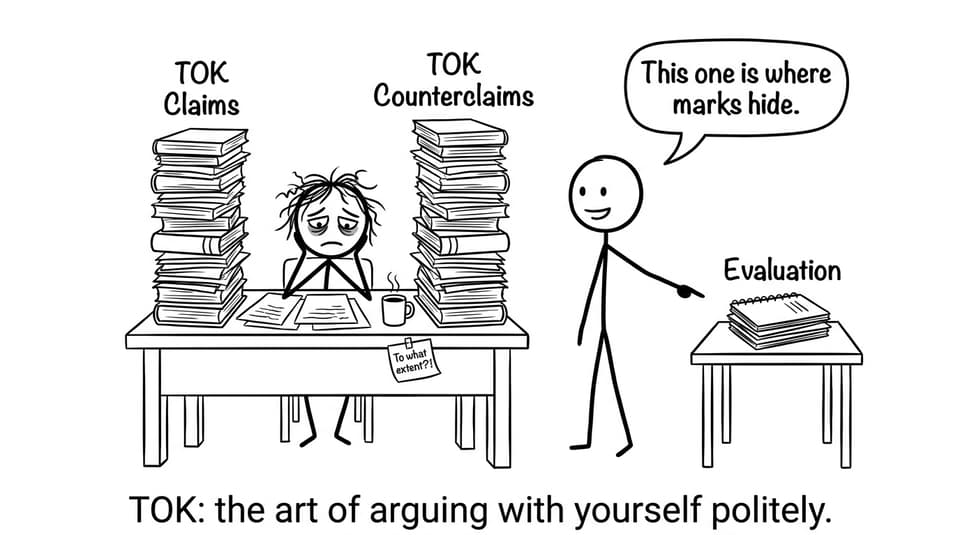
TOK claims vs counterclaims comic
TOK May 2026 in one checklist (save this)
Before you write anything, run this TOK checklist:
Choose one title and rewrite it in your own words.
Define 2-3 key terms as you’ll use them (not dictionary definitions).
Write one clean knowledge question (KQ) behind the title.
min read
min read
min read
min read
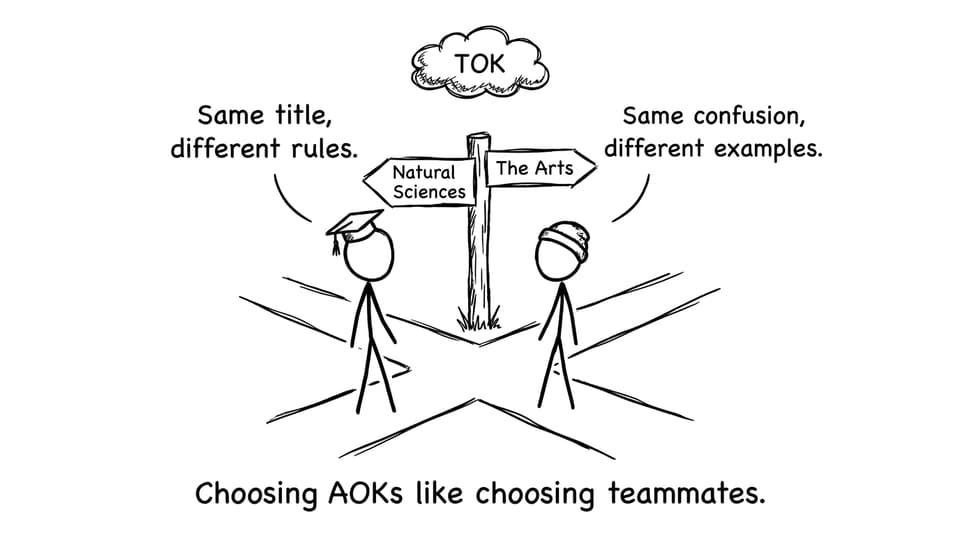
Pick two contrasting Areas of Knowledge (AOKs) and commit to them.
For each AOK: build a claim, counterclaim, and evaluation.
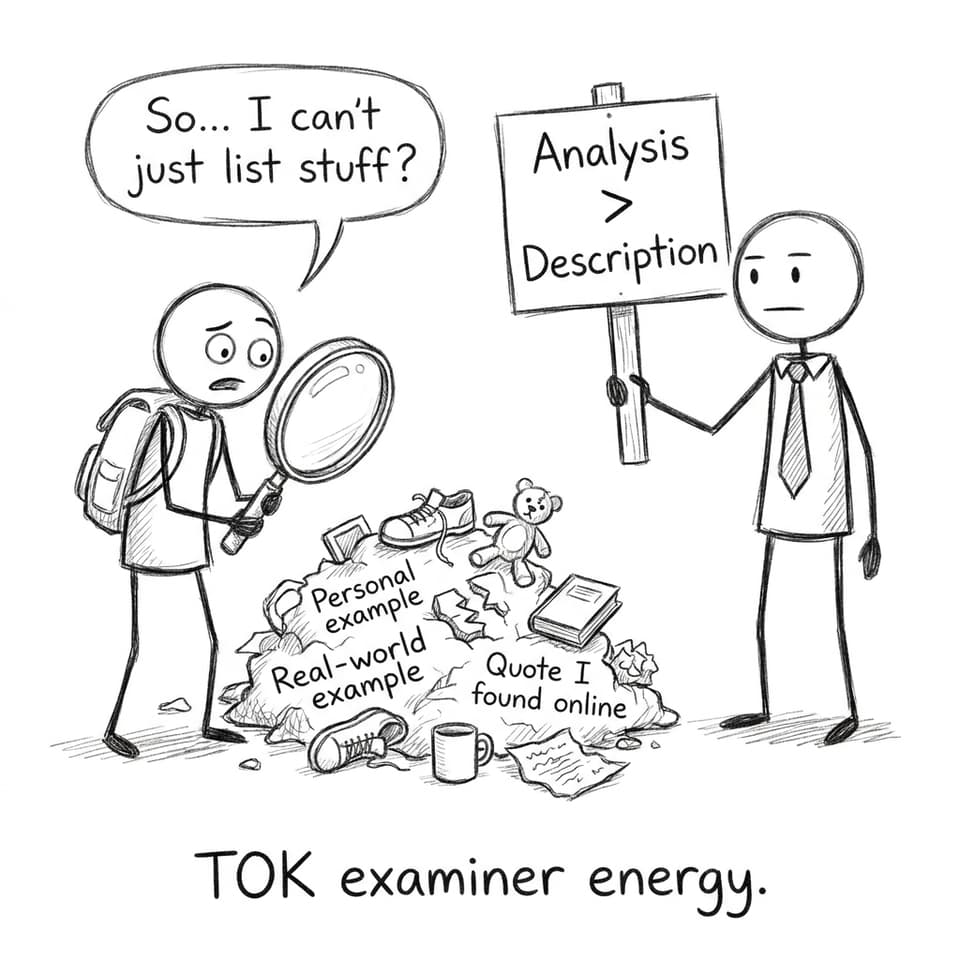
Use real-world examples that are specific (named study, event, artwork, policy, discovery).
Keep looping back to the exact wording: to what extent, reliable, power, context.
The title is asking whether the flaws of observation change its value in the production of knowledge. In TOK, “essential” doesn’t mean “perfect.” It means “hard to replace.”
Strong angles for TOK
In the natural sciences, observation is filtered through instruments, protocols, and peer review. That can reduce individual bias, but it also means we often observe through a theory (what we measure is shaped by what we expect).
In the arts or human sciences, observation can be intimate and meaningful while still being subjective. The point isn’t to eliminate interpretation, but to control for it.
This is a classic TOK trap: students treat doubt like a personality trait. Examiners want something sharper: doubt as a method.
Productive TOK contrasts
In the natural sciences, doubt is institutionalized: hypotheses are designed to be tested and possibly rejected.
In religious knowledge systems, doubt can be framed as destabilizing, yet traditions of interpretation and debate often use doubt to deepen commitment or clarify belief.
What “to what extent” really means here
A high-scoring stance is usually conditional:
Doubt is central when the methods of an AOK allow revision (science, history).
Doubt is less central when the knowledge goal is coherence, identity, or meaning (some religious contexts), though doubt can still exist.
Prompt 3: Is the power of knowledge determined by how it’s conveyed?
This prompt rewards students who separate two ideas:
The validity of knowledge (is it justified?)
The power of knowledge (does it influence decisions, beliefs, behavior?)
Clean TOK comparisons
In mathematics, a proof doesn’t become true because it’s persuasive. Conveyance matters for access, but not for validity.
In language and literature (and public discourse), conveyance can become the power: metaphor, narrative, framing, and repetition change what people accept.
Evaluation you can actually defend
Argue that conveyance often determines power in public life (policy, media, propaganda), while in formal systems (math, parts of science) power is constrained by method and verification.
Prompt 4: Do we only understand something through its context?
This is a TOK question about the limits of interpretation. Context can illuminate meaning, but it can also become an excuse to never commit to a judgement.
Where context feels unavoidable
History: sources, perspectives, and power relations shift what an event “means.” A document is never just a document.
Natural sciences: even “objective” results depend on context like experimental design, background assumptions, and the questions we choose to ask.
Where context seems less dominant
Mathematics: some truths appear context-independent once axioms are set.
Basic sensory knowledge: you can recognize pain or color without a history lesson, though language and culture shape how you interpret it.
A strong conclusion here usually says: context is essential for rich understanding, but some knowledge remains stable across contexts due to shared methods or formal constraints.
Prompt 5: “All things are numbers” (Pythagoras)
This title tempts students to write a tribute to math. In TOK, you score higher by asking what numbers can’t capture, and when quantification changes what we value.
Arguments that feel balanced
In natural sciences and economics, numbers enable prediction, comparison, and control. Measurement is a kind of power.
In the arts (music, architecture, design), ratios and patterns matter, but meaning also comes from culture, intention, and interpretation.
The evaluation hinge
A nuanced stance might be:
Many aspects of reality are describable numerically.
But not all aspects are reducible to numbers without loss (ethics, aesthetic judgement, lived experience).
Prompt 6: Is interpretation a reliable tool in producing knowledge?
This prompt is about when interpretation is a strength versus when it becomes distortion. In TOK, reliability is usually conditional, not absolute.
Strong AOK pairings
History: interpretation is necessary because evidence is incomplete and perspectives differ. Reliability improves through corroboration, transparency, and methodological care.
Ethics: interpretation is unavoidable because principles collide and contexts vary, but reliability is contested because standards of justification differ.
A high-scoring move
Don’t just say “interpretation is subjective.” Show how communities try to make it more reliable: peer critique, shared frameworks, and explicit criteria.
A good TOK draft is fragile. It can collapse under vague examples, rushed definitions, or missing evaluation. RevisionDojo is designed to steady that process.
Use the Coursework Library to study high-quality TOK exemplars and see what top-band analysis looks like.
Use Study Notes and Flashcards to lock in TOK language (justification, reliability, perspectives, methods, ethics) without overstuffing your essay.
Use AI Chat to test your knowledge question, stress-test a counterclaim, or ask, “What would an examiner think I’m missing?”
Use Grading tools to check whether your paragraphs actually evaluate.
When exam season hits, keep your wider IB workload stable with Mock Exams and Predicted Papers for other subjects, so TOK doesn’t get squeezed by panic revision. Explore IB Predicted Papers when you need realistic rehearsal.
If you want human feedback, RevisionDojo Tutors can help you refine examples and clarity without rewriting your voice.
Closing: TOK is training for uncertainty
What makes TOK hard isn’t the writing. It’s the honesty. You’re asked to argue for a position while keeping the strongest alternative view alive, then decide what you trust and why. That’s not just an IB skill. It’s a life skill.
If you want your May 2026 TOK essay to feel controlled instead of chaotic, build your loop inside RevisionDojo: plan with structured guidance, learn the language with Flashcards, test ideas with AI Chat, polish with Grading tools, and study exemplars in the Coursework Library. Your job isn’t to sound certain. Your job is to think clearly and show it.