
For M28 students: IB exams in May 2028, started DP1 in August 2026.
Yes, feeling lost after your first TOK class is completely normal. A confusing first class does not mean you are bad at Theory of Knowledge; it usually means you have entered a course that asks different questions from most school subjects.
In Biology, you might learn a process. In Mathematics, you might apply a method. TOK steps back and asks how those methods produce knowledge, what their limits are, and why we trust some conclusions more than others.
That shift can feel vague at first. It becomes clearer once you stop searching for the hidden correct answer and start examining how answers are built.
TOK confusing first class: the short explanation
Here is what new DP1 students need to know:
- TOK is about how knowledge is produced, justified, interpreted and challenged.
- You are not expected to arrive with a background in philosophy.
- A strong response makes a clear claim, supports it with a specific example and considers a meaningful limitation.
- Uncertainty is often part of the discussion, not evidence that the lesson failed.
- Two habits make TOK easier: collecting real examples and testing every claim from more than one perspective.
TOK is part of the IB Diploma Programme core. It is assessed through an exhibition and a 1,600-word essay, but your earliest classes are usually about developing the thinking that those tasks eventually require. You can see the wider course structure in the RevisionDojo IB Theory of Knowledge hub.
What is TOK about in plain language?
TOK asks a deceptively simple question: how do we know?
Consider a weather forecast. Its conclusion depends on measurements, models, assumptions and interpretation. Consider a historical account. It depends on surviving evidence, selection, context and the historian's perspective. Both can produce knowledge, but they do not produce or justify it in exactly the same way.
TOK gives you language for examining those differences. You may discuss evidence, certainty, interpretation, objectivity, values, culture, power and responsibility. The purpose is not to become suspicious of every fact. It is to become more precise about why a claim deserves confidence.
A useful TOK response therefore moves beyond saying, “Everyone has a different opinion.” It asks sharper questions:
- What evidence supports the claim?
- Which assumptions shape the conclusion?
- Does the method suit the question?
- Whose perspective is represented or missing?
- Under what conditions might the claim change?
This is why TOK thinking skills matter more than memorising a dictionary of impressive terms.
Why TOK feels unusually confusing in DP1
Most students become good at school by learning what an answer should contain. TOK changes the rhythm. The teacher may respond to your answer with another question, and a discussion may end without one position defeating every alternative.
That can feel like a lack of structure. In reality, the structure is simply less visible.
A productive TOK discussion often follows this pattern:
- Someone makes a knowledge claim.
- The class identifies the evidence or assumptions behind it.
- Another perspective reveals a limitation.
- The original claim becomes narrower and more defensible.
The goal is rarely to prove that nothing can be known. It is to judge what can reasonably be known, how confidently it can be claimed and what might restrict that confidence.
You are also learning unfamiliar vocabulary while trying to use it in live discussion. Words such as justification, perspective and interpretation may sound abstract until you connect them to actual situations. The guide to developing TOK thinking through real-life situations can help make that connection concrete.
Two habits that make TOK click
Keep a small bank of real examples
TOK becomes difficult when every discussion remains hypothetical. Start collecting situations in which knowledge was created, disputed, corrected or communicated.
Your examples might come from a scientific model, a disputed historical source, an artwork interpreted differently by two audiences or a decision made by an algorithm. The event itself is only the starting point. Add three short notes:
- What knowledge claim was being made?
- How was it justified?
- What limitation or alternative perspective matters?
Specific examples give your thinking something solid to push against. They also prepare you for the exhibition and essay without forcing you to write either task prematurely.
RevisionDojo's Coursework Library and TOK exhibition exemplars can show you how effective work uses concrete objects and situations. Treat exemplars as models to analyse, not scripts to imitate.
Use the “because, but, so” test
Whenever you make a TOK claim, complete three moves:
- Because: give your reason or evidence.
- But: identify a serious limitation, exception or competing perspective.
- So: produce a more careful conclusion.
For example, you might argue that numerical data can strengthen a claim because it enables comparison. But the way information is measured and selected may embed assumptions. So numerical evidence can increase confidence when its collection method and context are also examined.
This is not a magic essay template. It is a training habit that stops your answer from becoming either an unsupported opinion or an empty list of perspectives.
A manageable weekly TOK routine
You do not need to spend hours trying to solve every philosophical problem. After each class, take ten minutes to record:
| Record | What to write |
|---|---|
| One question | The question that remained genuinely difficult |
| One claim | Your current answer in a single sentence |
| One example | A specific situation that tests the claim |
| One challenge | A limitation or different perspective |
| One revision | A narrower, more defensible conclusion |
Over several weeks, this creates a visible record of your thinking. You begin to notice that progress in TOK is not always acquiring more information. Sometimes it is learning to make a smaller, clearer claim.
When terminology blocks you, RevisionDojo's Study Notes and Flashcards can help you review concepts. AI Chat can question your reasoning, while Grading tools can provide feedback once you begin drafting assessed work. The best TOK resources for the exhibition and essay explain how these forms of support fit together.
RevisionDojo also brings Questionbank practice, Predicted Papers, Mock Exams and Tutors together for your academic subjects. Those tools serve a different purpose from TOK, but stronger subject knowledge gives you richer material to examine. You cannot discuss how scientific or mathematical knowledge works if the underlying example is inaccurate.
What progress should feel like
TOK may not suddenly become easy. More often, it becomes navigable.
You start recognising the difference between a claim and an example. You ask what justifies a conclusion instead of merely agreeing with it. You notice when a counterargument genuinely changes your position. Most importantly, you become comfortable reaching a qualified conclusion rather than forcing absolute certainty.
Assessment will matter later. When that time comes, learn the requirements directly and use focused guidance such as writing exhibition commentary beyond description. In your first weeks, however, the best preparation is learning to think slowly, support claims precisely and revise your position honestly.
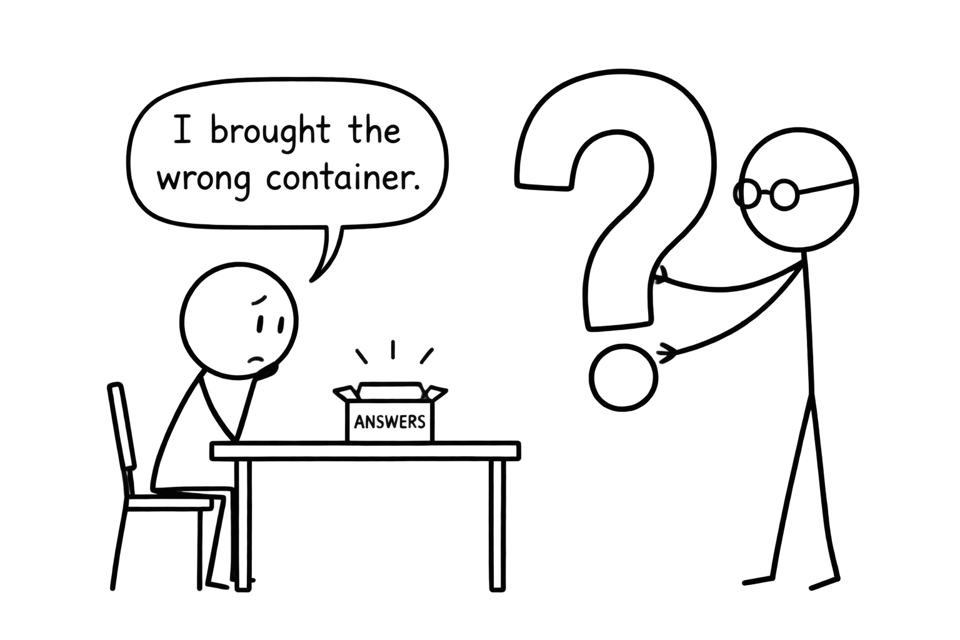
Feeling confused at the beginning is not a verdict on your ability. It is often the first sign that TOK has interrupted an old habit: expecting every worthwhile question to come with a neat answer box.
Your next step: open the RevisionDojo IB Theory of Knowledge hub and choose one introductory Study Notes topic to review before your next class.