


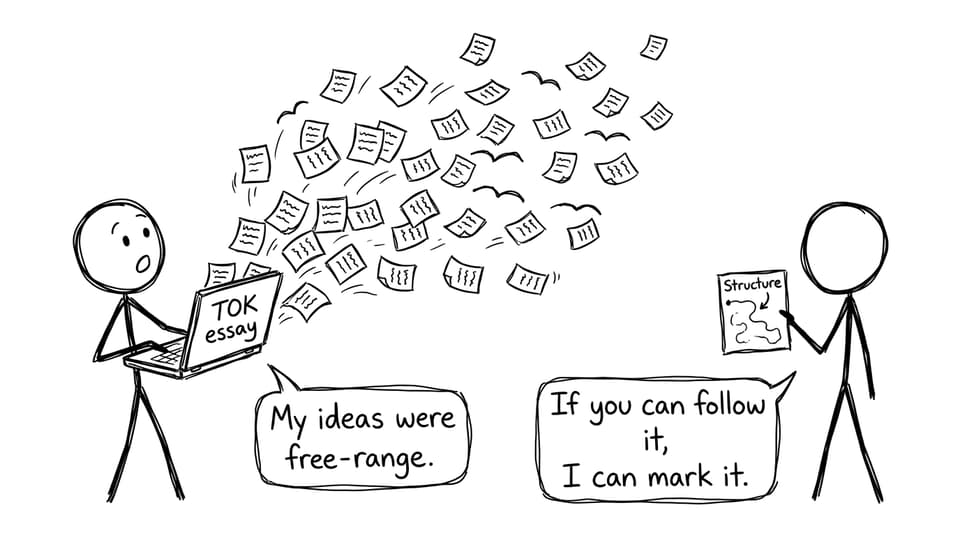
Writing a TOK essay often starts with a strange feeling: you have too many thoughts.
Not empty-minded. Overfull.
You read the prescribed title and suddenly everything connects to it: a documentary you watched at 1 a.m., a lab you rushed through, a headline you argued about with your parents, a quote you half-remember from class. The problem is that none of it lines up yet.
And in TOK, ideas don’t get rewarded for being interesting. They get rewarded for being controlled.
That’s why TOK structure matters. A strong TOK structure doesn’t make your essay less thoughtful; it makes your thinking visible. It’s the difference between a conversation that wanders and an argument that earns trust.
If you want a quick home base for the assessment and requirements, start with IB Theory of Knowledge (TOK) Resources. For a targeted breakdown of the essay unit itself, use TOK Essay study notes.
TOK essay structure checklist (steal this before you draft)
Use this TOK checklist to build a structure that can actually carry your ideas:
-
Interpret the prescribed title and define key terms in your context
-
Convert the title into one focused knowledge question (KQ)
-
Choose two Areas of Knowledge (AOKs) you can compare meaningfully
-
For each AOK: build a claim, a counterclaim, and an evaluation
-
Use real-life examples (RLEs) that you can explain (not just mention)
-
Keep linking back to the prescribed title in every paragraph
-
End with a conclusion that answers the KQ with nuance, not slogans
If you need current title-specific scaffolding, TOK essay planning templates are built to force balanced claims and counterclaims in a clean TOK structure.
What “good TOK structure” really means
A TOK essay isn’t a museum tour of impressive thoughts. It’s closer to a courtroom argument, except you’re also the judge.
TOK structure exists to do three quiet jobs:
It proves relevance
TOK examiners reward focus. Structure stops you from drifting into a general essay about “bias” or “truth” that never quite answers the prescribed title.
It creates comparison
TOK is strongest when it compares how knowledge works in different places. AOK comparison is where your TOK essay becomes distinctively TOK.
It forces evaluation (the part many students skip)
Many TOK drafts have claims and examples, then jump straight to another claim. But TOK marks live in evaluation: so what, how reliable, under what conditions, with what limits?
For a wider set of core support articles that connect TOK to the rest of the diploma mindset, browse IB Core posts.
Step one: decode the prescribed title like it’s a set of instructions
Your TOK essay structure begins before you write a single sentence. You’re not trying to sound philosophical; you’re trying to be precise.
Here’s a practical way to unpack a TOK title:
Circle the “pressure words”
These are words like reliable, justified, certain, objective, matter, extent, value, knowledge, truth. In TOK, these words are never neutral.
Decide what the title is forcing you to do
Most TOK titles quietly demand one of these:
-
Compare two ways knowledge is produced
-
Explore a tension (certainty vs doubt, interpretation vs evidence)
-
Evaluate a method (observation, language, technology, models)
-
Decide whether a condition “matters” for knowledge
If your class is working with the current session, you can see how RevisionDojo frames each prompt in May 2026 TOK essay prompts explained and the deeper walkthrough in the Ultimate TOK May 2026 essay guide.
Write a “boring” paraphrase
If you can paraphrase the title in plain language without changing its meaning, you understand it.
A strong TOK essay structure starts with a title you can restate without poetry.
Step two: turn the title into one focused knowledge question (KQ)
The easiest way to lose control of a TOK draft is to chase multiple KQs at once.
A focused KQ does three things:
-
It uses TOK language (knowledge, justification, interpretation, reliability, perspective)
-
It invites a genuine debate (not a factual answer)
-
It sets up a comparison between AOKs
Try these KQ stems (choose one and commit):
-
To what extent do we need ______ to justify knowledge claims?
-
How do ______ and ______ shape what counts as evidence?
-
When, if ever, does ______ reduce the reliability of knowledge?
Then test it: if you can’t answer your KQ differently in two AOKs, your TOK structure will become repetitive.
Step three: choose two AOKs that create real contrast
AOK choice is a structural decision, not a decoration. Your TOK structure should make comparison unavoidable.
Good AOK pairings usually look like one of these:
-
Natural Sciences vs Human Sciences (controlled experiments vs messy humans)
-
History vs Natural Sciences (interpretation of sources vs repeatability)
-
The Arts vs Natural Sciences (meaning-making vs measurement)
-
Mathematics vs Human Sciences (certainty vs context)
A simple test: can you imagine different kinds of disagreement in each AOK?
If you want to borrow examples with intellectual honesty, build them from subjects you actually study. For instance, a political RLE becomes more precise when you can lean on conceptual clarity from IB Global Politics notes. A psychology example becomes more careful when you can anchor it in research thinking from IB Psychology resources. A history example becomes less vague when you understand interpretation and source limits from IB History resources.
A reliable TOK essay structure (that still feels like you)
Here is a TOK structure that consistently works, because it matches how the rubric rewards thinking.
Introduction (150-250 words)
Your introduction is not a TED Talk. It’s an agreement with the examiner about what you will do.
Include:
-
A clear paraphrase of the prescribed title
-
Definitions of 1-2 key terms (only if they affect your argument)
-
Your knowledge question
-
A thesis that answers the title and signals nuance
-
The two AOKs you will use
A strong TOK thesis often has this shape:
Although ______ can strengthen knowledge by ______, it can also weaken knowledge when ______, especially in ______ compared to ______.
This thesis is structural. It tells your reader what to look for.
Body section for AOK 1 (about 500-650 words)
Use a repeatable TOK paragraph pattern:
Claim
One clear claim that answers the title in this AOK.
Real-life example (RLE)
Choose one example you can explain with control.
Link to TOK
Explain why this example supports the claim about knowledge.
Counterclaim
A serious objection or limitation.
Evaluation
Weigh the claim against the counterclaim. State conditions: when does each hold?
Body section for AOK 2 (about 500-650 words)
Repeat the same structure. The repetition is not boring; it’s how the examiner can compare your thinking.
Conclusion (200-300 words)
The TOK conclusion is not a summary. It’s a judgement.
-
Answer the KQ directly
-
Show what your comparison taught you
-
Acknowledge limits (without collapsing into “it depends”)
-
End by returning to the prescribed title language
If you want to see how strong essays manage this balance, the TOK coursework exemplars library is the fastest way to internalize what “controlled nuance” looks like in TOK.
The TOK engine: claim, counterclaim, evaluation (in that order)
Many students write TOK as:
claim -> example -> new claim -> new example
That’s not TOK. That’s a list.
TOK is:
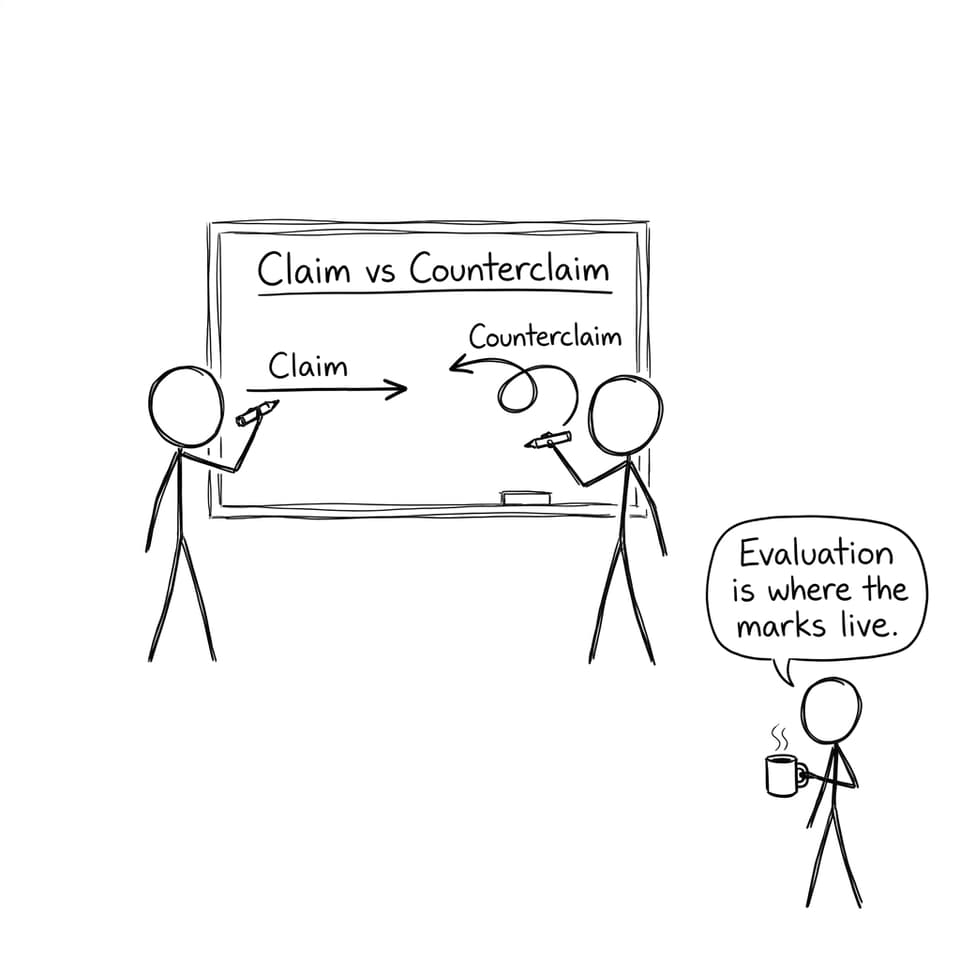
claim -> example -> counterclaim -> evaluation -> implication
The evaluation is where you show you can think like a knower, not just a reporter of ideas.
How to write evaluation that earns marks
Use these sentence starters (they sound simple because they work):
-
This claim holds more strongly when…
-
A limitation is… because…
-
The counterclaim is persuasive if…
-
However, it fails to account for…
-
This suggests that in this AOK, knowledge is more dependent on…
TOK evaluation is basically conditional reasoning. Your structure should make those conditions visible.
Real-life examples in TOK: fewer, sharper, explained
A TOK essay is not improved by adding more examples. It’s improved by explaining one example more clearly.
Pick RLEs that allow you to discuss:
-
What counts as evidence
-
How bias enters (or is controlled)
-
How disagreement is resolved (or not)
-
The role of methods, models, language, or technology
If you find yourself writing three sentences of “what happened” and one sentence of “so what,” your TOK structure is upside down.
A helpful rule:
-
20% describing the example
-
80% analyzing how it supports your knowledge claim
Depth over breadth: the quiet strategy behind strong TOK
TOK rewards depth because depth reveals your thinking. Breadth often hides it.
Two well-developed AOK sections with honest counterclaims almost always outperform a shallow tour of four AOKs.
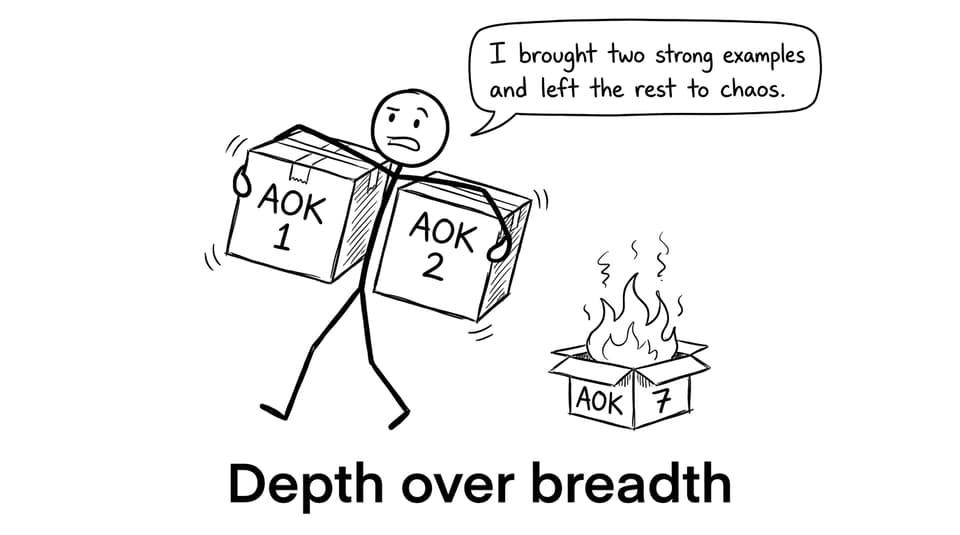
If your outline is getting crowded, the fix is rarely “add more.” The fix is “cut until each paragraph has room to evaluate.”
Common TOK structure mistakes (and the clean fixes)
Mistake: writing a “philosophy vibe” intro
Fix: treat the intro like a contract. Define, focus, commit.
Mistake: using an example but not linking it to knowledge
Fix: add the missing middle sentence: what does this show about justification/reliability/perspective?
Mistake: counterclaims that don’t challenge the claim
Fix: make the counterclaim threaten the claim’s logic, not just mention a limitation.
Mistake: ending with “therefore it depends”
Fix: decide what it depends on and which side is stronger under which conditions.
Mistake: forgetting the prescribed title for a whole paragraph
Fix: end each paragraph with one sentence that reuses key words from the title.
To strengthen writing control across your IB essays generally, it helps to train structured expression in other subjects too. For example, clear analytical routines from IB English Language and Literature study strategies can make your TOK paragraphs tighter.
How RevisionDojo turns TOK structure into a repeatable system
TOK writing improves fastest when you can cycle through: plan, draft, check, revise.
RevisionDojo is built around that loop:
-
Study Notes to clarify TOK concepts and essay expectations quickly
-
Flashcards to keep key TOK terms, AOK differences, and evaluation language active
-
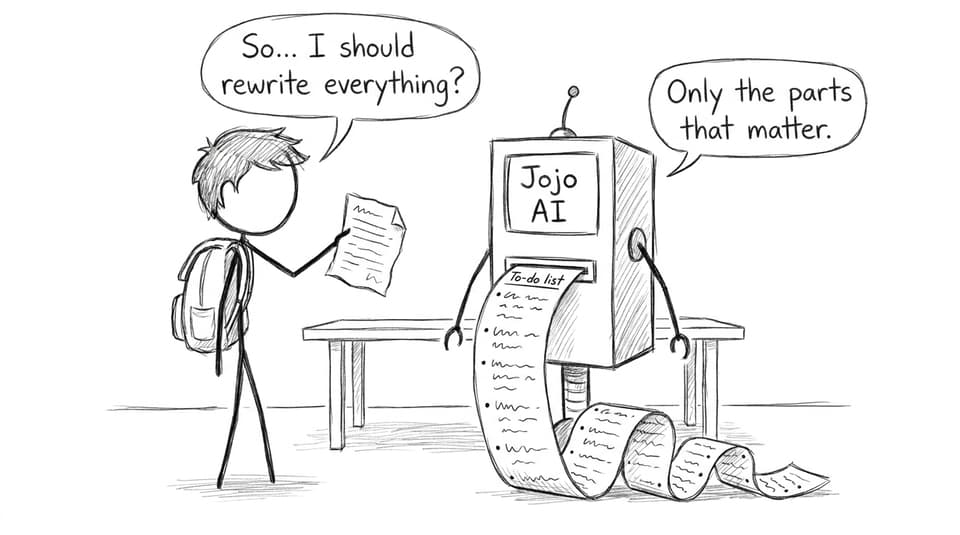
AI Chat (Jojo) to test whether your claim/counterclaim genuinely disagree and to generate sharper KQs
-
Grading tools to align your draft with how marks are actually awarded
-
Coursework Library to study high-quality TOK exemplars and notice what “good” looks like
-
Tutors when you want human feedback on argument strategy, not just proofreading
-
For your other IB subjects feeding your TOK examples: Questionbank, Mock Exams, and Predicted Papers to build real understanding you can later use as RLE material
Start with the core hub: IB Theory of Knowledge (TOK) Resources, then build title-specific confidence with TOK essay prompts guides.
Closing: a TOK essay is a map, not a diary
The best TOK essays don’t read like someone thinking out loud. They read like someone who thought deeply first, then guided the reader through the thinking with care.
That’s what TOK structure is: a map drawn after the journey, so someone else can follow it.
If you want to build that map faster, use RevisionDojo as your TOK workshop: plan with the templates, study the exemplars, refine with AI Chat, and tighten your draft with rubric-aligned grading tools. Then practice the thinking that powers your examples across subjects using Study Notes, Flashcards, Questionbank, Mock Exams, and Predicted Papers.
Your next step is simple: pick your TOK prescribed title, write one focused KQ, and outline two AOK sections with claim, counterclaim, and evaluation before you draft a single paragraph. Structure first. Then let the ideas breathe inside it.