

The moment your TOK exhibition gets real
At some point, every IB student hits the same wall: you’ve chosen a TOK prompt that sounds interesting, but your “objects” are still just… stuff. A photo you found. A screenshot you saved. Something on your desk that seemed symbolic at 1 a.m.
The calm truth is that TOK doesn’t reward symbolism by itself. TOK rewards specific real-world objects that create a genuine knowledge problem: How do we justify a claim? Who gets to decide what counts as evidence? What changes when knowledge moves from personal to shared? If your objects can’t spark those questions, the writing becomes description, and description rarely scores.
A TOK object selection checklist (save this)
Before you commit, run each object through this quick TOK checklist:
-
Is it clearly linked to the TOK prompt? (Not just thematically related.)
-
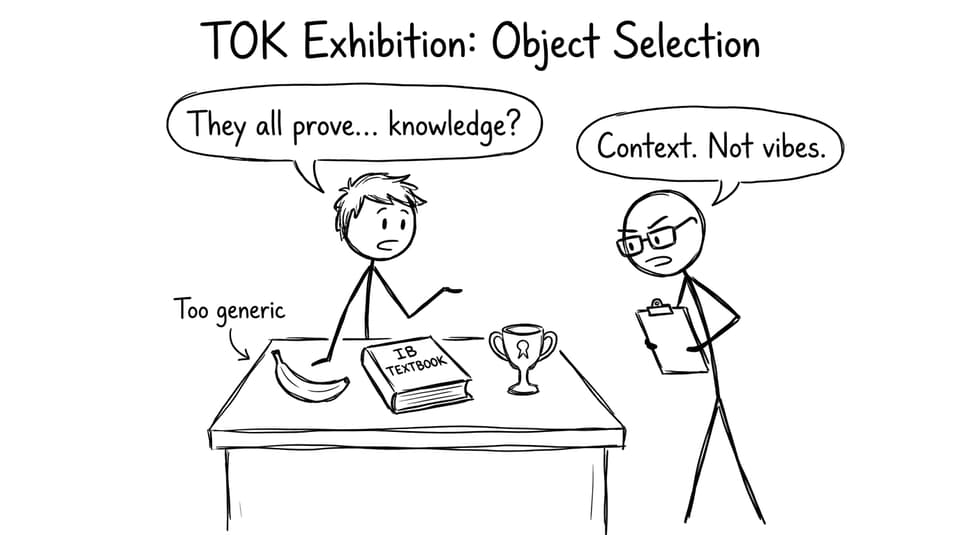
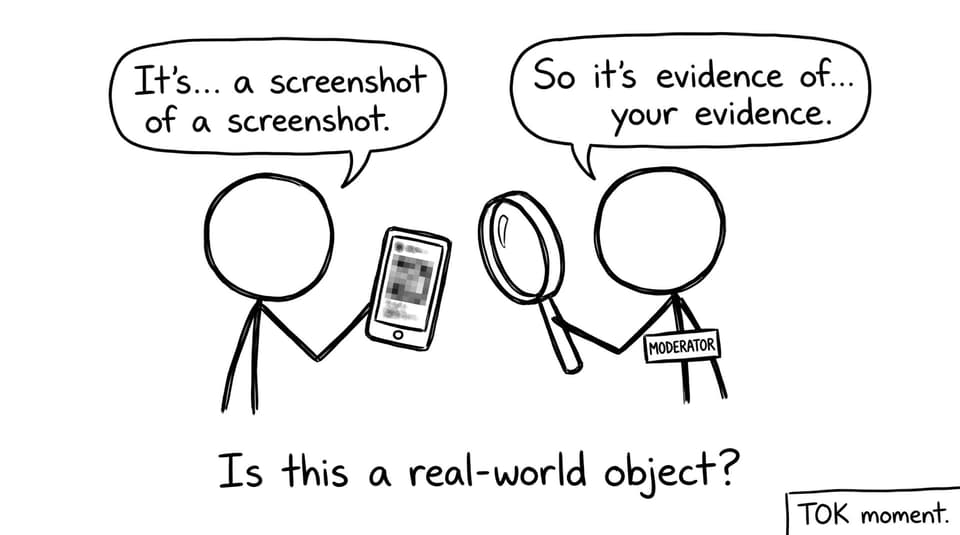
Is it specific and real? (Not a vague category like “a newspaper” or “a painting.”)
-
Does it bring a distinct perspective? (So your three objects don’t repeat each other.)
-
Can you name the knowledge concept it raises? (Evidence, reliability, bias, authority, interpretation, certainty.)
-
Can you explain its context in one sentence? (Where it came from and why it matters.)
For the full requirements and the 950-word limit, keep this guide open: IB TOK Exhibition: Your Complete Guide to Success.
Start with a prompt that can “hold” three objects
A strong TOK prompt is like a coat hook: it should be sturdy enough to hold three different objects without collapsing into a single point. If your prompt only allows one obvious angle, you’ll end up with three similar objects and three similar paragraphs.
If you’re still deciding, use What are the TOK Exhibition Prompts? to interpret prompts as lenses (not topics). Then check how your prompt connects to the bigger TOK course in IB Theory of Knowledge Resources.
What makes an object “good” in TOK (and what makes it weak)
Good TOK objects are specific, contextual, and arguable
A high-impact TOK object is usually:
-
Traceable: you can explain its origin (who made it, where it appeared, what it was used for).
-
Debatable: a reasonable person could interpret its knowledge value differently.
-
Method-revealing: it shows how knowledge is produced, filtered, trusted, or challenged.
If you want a bank of realistic ideas that actually work, use Best TOK Exhibition Object Ideas as a starting point, then personalize.
Weak TOK objects are generic or purely decorative
Watch out for:
-
Objects that only “represent” an idea but don’t do anything epistemically
-
Three objects from the same medium (three screenshots, three quotes, three photos)
-
Objects that force you to explain the world, not the knowledge issue
If you’re unsure what examiners are actually assessing, read How Is the TOK Exhibition Graded? before you write another sentence.
Build a set: three TOK objects that “argue” with each other
The best TOK exhibitions feel like one conversation in three voices.
Try this simple pattern:
-
Object 1 (everyday credibility): something personal or common that people trust quickly
-
Object 2 (institutional credibility): something with authority (a study, policy, official statement)
-
Object 3 (challenge or disruption): something that exposes limits, bias, or uncertainty
This structure naturally creates claims and counterclaims, which is exactly the TOK skillset you practise in TOK Thinking and Skills: How to Succeed in IB TOK.
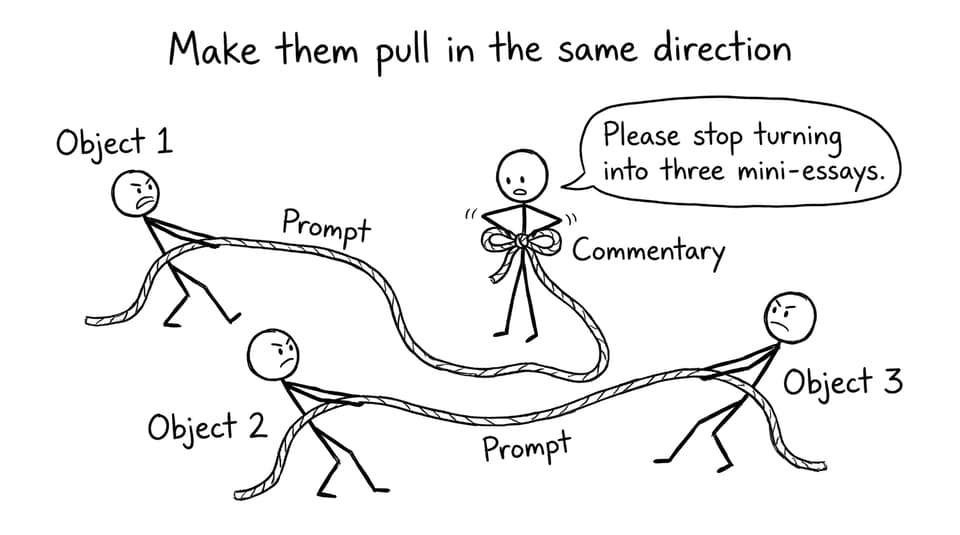
How to write commentary that stays TOK (not storytelling)
For each object, use a tight TOK mini-arc:
-
Context (1-2 sentences): what it is and where it comes from
-
Link (1 sentence): how it connects to the prompt
-
TOK insight (3-5 sentences): the knowledge issue (justification, bias, reliability, methods)
-
Contrast (1-2 sentences): how it adds something your other objects don’t
To keep the full task coherent, it helps to align it with your broader TOK planning: Mastering the TOK Essay and Exhibition.
Final thought: choose objects that make TOK unavoidable
A strong TOK exhibition doesn’t come from finding “the perfect object.” It comes from choosing three objects that make a knowledge tension unavoidable, then writing commentary that stays analytical, specific, and connected to the prompt.
When you want that structure fast, RevisionDojo is built for it: use Study Notes to clarify concepts, Flashcards to sharpen vocabulary, AI Chat to generate tighter knowledge questions, the TOK Exhibition Grader to self-check against the rubric, and the Coursework Library for exemplars. Add Questionbank practice and Mock Exams for your wider IB exam prep, and you’re not just finishing TOK; you’re learning how to think under pressure, on purpose.