Join 650k+ students breezing through the IBReady to breeze through the IB?
For IB students sitting exams in May 2028, the best preparation begins with two priorities: complete the exhibition using specific, well-justified objects, then approach the essay as a careful evaluation of an exact prescribed title. Build the necessary skills now, but do not choose an essay title yet because the May 2028 titles have not been officially published.
TOK often feels abstract until you replace philosophical vocabulary with a practical question: Why should someone accept this knowledge claim, and under what conditions might they reject it?
That question connects both assessments. The exhibition investigates how knowledge operates in the world around you. The essay develops a sustained argument about knowledge across areas of knowledge.
TOK requirements currently confirmed for May 2028
As of October 2026, the publicly available IB Theory of Knowledge subject brief identifies the current course as first assessed in 2022. No replacement syllabus specifically for first assessment in May 2028 has been publicly confirmed in the official material reviewed for this article.
Under the current course:
The exhibition contributes 33% of the TOK result.
Students select one of 35 official IA prompts.
The exhibition uses three specific objects or images of objects.
Its written commentary has a maximum of 950 words.
The exhibition is internally assessed and externally moderated.
The essay contributes 67% of the TOK result.
Students answer one of six prescribed titles for their examination session.
The essay has a maximum of 1,600 words and is externally assessed.
The official IB TOK overview continues to describe assessment through the exhibition and essay. Your coordinator and TOK teacher remain the final sources for the documents, procedures and internal deadlines applying at your school.
The May 2028 prescribed titles are not officially published as of October 2026. Titles for May sessions have historically become available to schools during the preceding September. September 2027 is therefore a sensible planning assumption, not a guaranteed publication date.
min read
min read
min read
min read
A practical checklist for this cohort
By the end of DP1, aim to have:
understood the exhibition assessment instrument;
selected one official prompt without changing its wording;
tested several objects for specificity and relevance;
completed the exhibition according to your school calendar;
built a bank of examples from different areas of knowledge;
practised evaluating rather than merely describing claims; and
learned to acknowledge sources consistently.
During DP2, you can concentrate on interpreting the official titles, choosing the strongest fit for your thinking and refining the essay before your school’s deadline.
TOK exhibition advice for May 2028
Begin with the prompt
An impressive object cannot rescue a weak connection to the prompt. Compare several official IA prompts and identify which one allows you to discuss three genuinely different manifestations of knowledge.
The strongest prompt is often not the one that sounds most philosophical. It is the one you can connect convincingly to specific objects. RevisionDojo’s guide to choosing a TOK exhibition prompt suggests a useful test: can you find three objects with distinct contexts and analytical roles?
Once selected, reproduce the prompt exactly. Do not paraphrase or narrow its wording in the submitted exhibition.
Choose objects with real contexts
A generic dictionary, smartphone or photograph provides little analytical leverage. A particular dictionary involved in a documented translation dispute, or a particular photograph whose meaning changed when removed from context, gives you more to examine.
For each proposed object, record what it is, where and when it was used, who interacted with it, why that context matters and what it reveals that the other objects do not. Use the guide to selecting TOK exhibition objects before committing to your final three. The goal is not novelty. It is to make a knowledge issue visible through real circumstances.
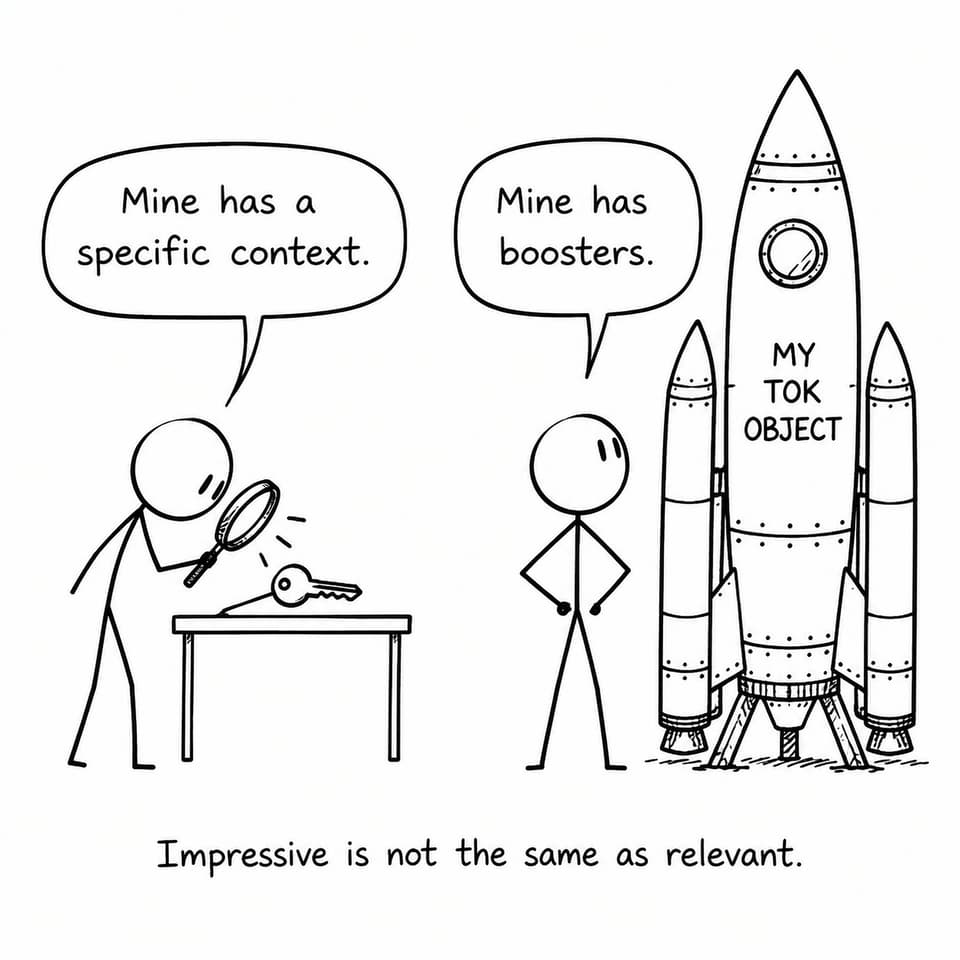
One student examines a contextualised key while another presents an oversized rocket as a TOK object
A student compares a carefully contextualised object with an impressive but less relevant alternative.
Justify every object
Description tells the reader what an object is. Analysis explains what it reveals about the prompt. Justification shows why this particular object belongs in the exhibition.
A useful planning sequence is to establish the object’s context, identify the knowledge issue, connect it explicitly to the prompt, explain its distinct contribution and consider a limitation or alternative interpretation. This is a planning tool, not a compulsory paragraph formula.
You can prepare now, but you cannot responsibly select your May 2028 title until the authenticated set reaches your school. Unofficial websites or shared documents claiming to provide confirmed titles should not determine your work.
Instead, keep an example journal organised around history, the human sciences, the natural sciences, the arts and mathematics. Record the situation, the knowledge problem it raises and what the example can or cannot demonstrate. The purpose is not to collect famous anecdotes. It is to develop examples you understand well enough to analyse accurately.
Interpret every important word
When the six titles arrive, compare all of them before choosing. Underline command terms, assumptions, absolute language and required areas of knowledge. Preserve the title exactly during planning and submission.
For each candidate, ask what it requires you to evaluate, which terms allow reasonable interpretation, whether particular areas of knowledge are required, and whether you can develop contrasting perspectives supported by specific examples.
The RevisionDojo guide to TOK knowledge questions can help uncover the underlying problem. Your essay must still answer the prescribed title rather than replacing it with an easier, broader question.
Build arguments, not alternating claims
A claim followed by a counterclaim is not automatically evaluation. Effective evaluation identifies the conditions under which each position becomes more or less convincing.
If you argue that a method produces reliable knowledge, examine what reliability means in that area, which assumptions the method depends on, how errors are identified and whether another method offers a meaningful comparison. Keep the title as the thread connecting every section.
The TOK essay structure framework can organise your reasoning, but no universal template can replace close attention to the chosen title.
Make examples serve the reasoning
An example earns its place by testing an argument. Introduce only the necessary context, connect it to a precise claim and explain what follows. Avoid spending most of a paragraph retelling an event or naming philosophers and discoveries without analysing their relevance.
Learn course vocabulary through application. Read the exhibition instrument, explore prompts and notice objects with specific personal, academic or public contexts. Follow your school’s schedule if it has already been issued.
January to June 2027
Develop and complete the exhibition when directed. Leave time to replace an object if its connection remains generic. Check the 950-word maximum, source acknowledgement, image details and object identification before submission.
June to August 2027
Build your example journal without predicting titles. Practise explaining how evidence, interpretation, models, authority and perspective influence knowledge production.
September to October 2027
Ask whether the official titles have reached your school. Once your teacher provides them, compare all six and create short plans for your strongest two or three.
November 2027 to February 2028
Select a title, refine your interpretation and draft according to your school’s feedback process. Internal deadlines may be considerably earlier than final IB procedures. Reserve one revision for argument quality, followed by separate checks for title wording, citations, word count, coherence and academic integrity.
Use AI without surrendering authorship
The IB’s guidance on artificial intelligence and assessment places AI use within its academic integrity expectations. AI-generated work is not automatically your own, and tools should never replace your reasoning or conceal the origin of ideas and language.
AI can ask diagnostic questions, identify ambiguity or test whether a paragraph addresses the title. Keep the argument, example selection and prose authentically yours, while following school rules for disclosure and acknowledgement.
RevisionDojo supports the wider process. Its Coursework Library, Study Notes and TOK resources clarify expectations, while AI Chat and Tutors can question unclear reasoning. Questionbank, Flashcards, Grading tools, Predicted Papers and Mock Exams provide connected support across the Diploma Programme.
Make steady thinking your advantage
TOK improves quietly. One precise object choice, one qualified claim and one carefully examined example may feel small. Across two years, those decisions compound into focused, specific work.
Your immediate task is not to guess the essay titles. It is to recognise how knowledge is produced, justified, challenged and communicated. RevisionDojo brings together exhibition guidance, exemplars, essay support, AI Chat, the Coursework Library and Tutors to help turn that habit into a disciplined submission.
Upload one practice paragraph to the RevisionDojo Coursework Grader, identify its weakest rubric-linked issue and rewrite it today.