

A knowledge question in TOK is an open, contestable question about how knowledge is produced, justified, interpreted, shared, or limited. Instead of asking only what is true, it asks how we know, whose standards matter, and what might change the answer.
That distinction can feel slippery in DP1. You may understand a topic perfectly well and still struggle to turn it into Theory of Knowledge. TOK asks you to examine the machinery behind the facts.
A useful knowledge question TOK students might ask is: How can we judge whether evidence is sufficient to justify a claim? A medical study, historical document, or courtroom photograph could help you explore it. The situation changes; the underlying problem about evidence remains.
The quick knowledge question checklist
A strong knowledge question usually:
- focuses on knowledge rather than merely requesting information
- allows more than one defensible answer
- examines concepts such as evidence, certainty, interpretation, perspective, justification, or responsibility
- can be explored through specific real-world situations
- has boundaries without deciding the answer in advance
- encourages evaluation, not just description
Try the consequence test. If one date, definition, calculation, or search result settles the question, it is probably not yet a knowledge question. If answering requires comparing standards, examining assumptions, and weighing limitations, you are much closer.
What makes a question about knowledge?
Compare these questions:
- When was a particular photograph taken?
- To what extent can photographs provide reliable knowledge about historical events?
The first asks for a fact. The second asks how evidence works. A photograph preserves visual detail, but framing, captions, editing, and missing context influence what viewers believe it shows.
Similarly, What did this clinical trial conclude? concerns one study's result. How should uncertainty affect our confidence in scientific conclusions? opens discussion about measurement, replication, statistical uncertainty, and changing evidence.
The useful move is from the claim to the grounds supporting it. RevisionDojo's guide to breaking down TOK knowledge questions develops this distinction further.
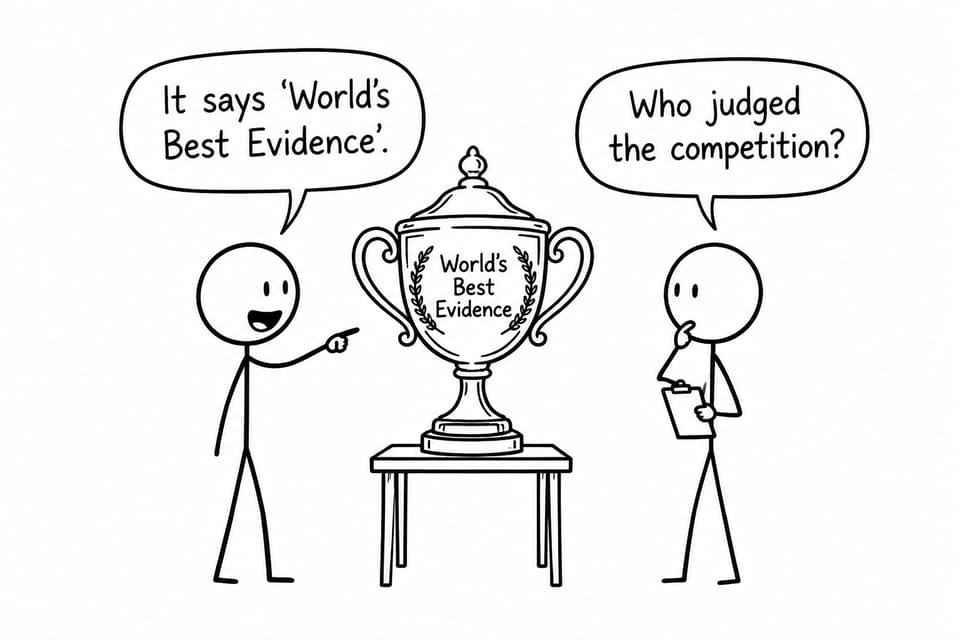
Two students discover that an impressive label can create another question about authority.
Four features of a strong TOK knowledge question
It is open but focused
Can we know anything? is open, but almost any idea could enter the discussion. How does the method used to collect evidence affect the reliability of knowledge in the human sciences? gives you a clearer path.
Terms such as how, to what extent, and under what conditions can help establish boundaries. However, wording alone cannot turn a vague question into an analytical one.
It is contestable
Consider: Does expert agreement justify accepting a knowledge claim?
Expertise matters because specialists have relevant training and methods. However, experts can disagree or work within shared assumptions. Your answer might conclude that agreement strengthens justification under certain conditions without removing the need to examine evidence.
Contestability does not make every opinion equally persuasive. You still need to judge which position is better justified.
It uses TOK concepts purposefully
Words such as evidence, objectivity, interpretation, and perspective help only when their meaning is clear in context.
Is evidence important? is too loose. Why might the same evidence justify different conclusions in history? identifies a problem involving source selection, corroboration, and interpretation. Explore these sample TOK questions and topics for further models.
It connects to something real
Consider: How do classification systems influence what we know? A biological classification guide could show how categories help researchers identify patterns. A museum label might reveal how categories reflect cultural choices.
The example should expose a tension or implication, not decorate the paragraph. RevisionDojo's guide to developing TOK thinking through real-life situations explains that connection.
How to turn a topic into a knowledge question
Start with something specific, then work backwards to the knowledge problem behind it. Imagine two news outlets describing the same protest differently:
- Topic: reporting on a protest
- Claim: one report emphasizes peaceful gathering, another disorder
- Knowledge issue: selection and framing affect what audiences accept
- Concepts: evidence, perspective, language, interpretation
- Knowledge question: How does the language used to present an event influence whether a claim about it is accepted?
A family recipe provides another route. Learning through demonstration raises questions about experience and communication. You might ask: To what extent can practical knowledge be communicated without direct experience?
A useful starting template is:
How does [a concept or process] influence [the production, justification, interpretation, or communication of knowledge] in [a defined context]?
Treat this as scaffolding, not a formula. Keep the final wording natural and relevant to your example.
Knowledge questions in the TOK exhibition
The exhibition uses one of the 35 prescribed IA prompts. You connect your chosen prompt to three objects through a written commentary with a maximum of 950 words. Your school assesses it internally, subject to IB moderation.
The prompts are already knowledge questions. Use your chosen prompt exactly as provided rather than rewriting it. Your creative work lies in selecting specific objects and explaining their significance.
Suppose you choose: What counts as good evidence for a claim? A generic “newspaper” lacks definite context. A specific front page reporting a named event on a particular date lets you examine its producer, evidence, omissions, and audience.
Each object should contribute something distinct. One might demonstrate disciplinary standards, another the influence of authority, and a third differences between communities. Three objects making essentially the same point leave less room for analysis.
Explore RevisionDojo's TOK exhibition exemplars, then use its guide to linking examples with knowledge questions to strengthen the explanation connecting each object to your prompt.
Knowledge questions in the TOK essay
The externally assessed TOK essay has a maximum length of 1,600 words. Students choose one of six prescribed titles issued for their examination session.
A title functions as a knowledge question. Do not replace it with your own broader version. Unpack its terms and assumptions, then answer it through the areas of knowledge specified or permitted by its instructions.
A title about doubt, for example, requires more than stories about uncertain people. You might distinguish productive doubt from indiscriminate scepticism and compare their consequences in different areas of knowledge.
A useful paragraph pattern is:
- make a claim addressing the title
- introduce a precise real-world example
- explain how it supports your claim
- examine a limitation or alternative interpretation
- judge what follows for the title
That final step turns examples into evaluation. RevisionDojo's overview of TOK essay and exhibition requirements helps distinguish the assessments. Its guide to linking the TOK essay and exhibition explores connections without treating them as identical tasks.
Common mistakes and practical fixes
Asking only what happened. Ask how we can know what happened and what would count as adequate justification.
Discussing a social issue without examining knowledge. Climate policy or artificial intelligence is a topic, not automatically TOK analysis. Identify the problem involving evidence, authority, interpretation, or values.
Using an example without context. Name the actual document, event, object, or method. Context supplies material for analysis.
Treating balance as the goal. You need not declare competing positions equally convincing. Compare their reasoning and reach a qualified judgment.
Displaying vocabulary instead of explaining. Choose concepts that clarify the problem rather than forcing every TOK term into one paragraph.
Before keeping a question, explain its central disagreement aloud. If none emerges, refine it. If almost anything could count as an answer, narrow its scope.
Build a habit of noticing knowledge questions
Starting TOK in DP1 gives you time to collect objects and situations before assessment deadlines approach. A correction notice, marked laboratory report, or translated poem may become useful because each reveals something about how knowledge works. Record the source, context, and question it raises while those details are available.
RevisionDojo brings that process together with Study Notes, AI Chat for testing interpretations, Grading tools for feedback, and a Coursework Library for examining structure. Across the Diploma Programme, its Questionbank, Flashcards, Predicted Papers, Mock Exams, and Tutors support wider study routines.
Use those resources to test your reasoning, not replace it. The strongest question is not the one that sounds most philosophical. It is the one that helps you explain precisely why a claim deserves confidence, where its limits lie, and what could change your mind.