

A study group can look productive while achieving very little. Four students sit together, open the same notes, and leave an hour later with the comforting feeling that revision happened. But comfort is not the same as learning.
So, what study group strategies work for MYP students? The strongest groups set one criterion-based goal, give every member an active role, require explanations from memory, practise applying ideas, and finish with individual questions. The group creates support, but each student must leave able to perform independently.
That distinction matters because MYP assessment is criterion-based. Productive group revision must develop the analysis, investigation, communication, application, or evaluation required by the current task.
The quick study group checklist
Before starting, check that your group can answer yes to these questions:
- Do we have three to five active members?
- Have we chosen one subject, concept, and assessment criterion?
- Does everyone know what to prepare?
- Will each person explain or solve something without notes?
- Have we included an unfamiliar question or context?
- Will everyone complete an individual check?
- Have we agreed when to stop?
A group without a defined finish line usually drifts into conversation. A group with a visible outcome has something to work toward.
What study group strategies work for MYP students?
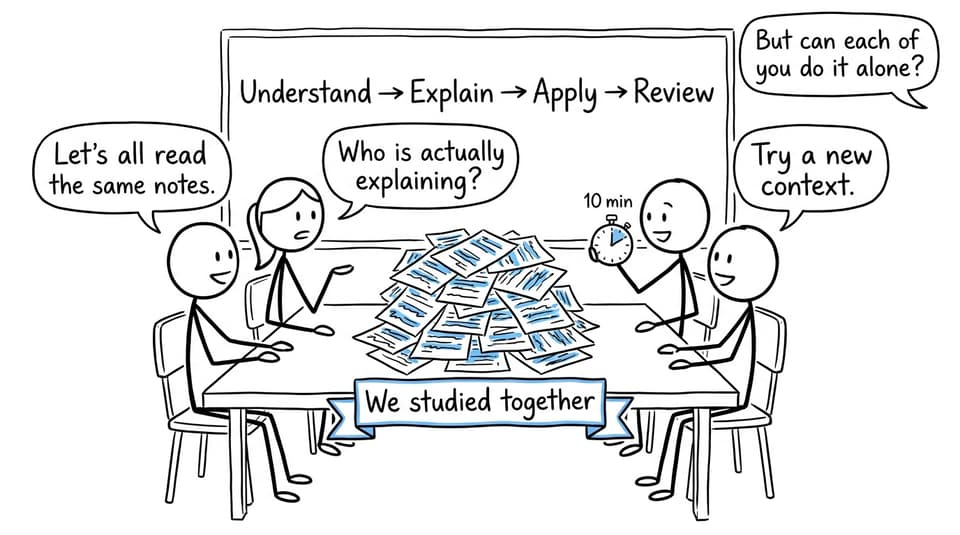
The most reliable strategy is a cycle of understand, explain, apply, and review. It reflects the MYP emphasis on inquiry, communication, reflection, and self-management while keeping the session practical.
Set one criterion-based target
Do not begin with “revise science.” Choose a target small enough to test by the end:
- Analyse how a writer creates tension in an unseen extract.
- Generalise a mathematical pattern and justify the rule.
- Evaluate two historical sources using origin, purpose, and content.
Open the task sheet or teacher-provided rubric and identify the relevant criterion. Translate it into ordinary language. “Evaluate the validity of a hypothesis” might become: “Use the results and limitations to decide whether the evidence supports the hypothesis.”
This keeps the group aligned with what teachers assess. RevisionDojo’s guide to understanding MYP assessment criteria can help students turn rubric language into visible actions.
Give everyone a role that requires thinking
Roles prevent one confident student from doing all the intellectual work. For a group of four, use:
- Facilitator: states the goal and keeps discussion on task.
- Explainer: teaches the first concept without reading a script.
- Questioner: asks “why?”, “how do you know?”, and “what changes if...?”
- Checker: compares the work with the criterion and records errors.
Rotate roles every 10 to 15 minutes. The quietest member should not automatically take notes, and the strongest student should not remain the permanent teacher. Every role should involve retrieval, reasoning, or evaluation.
Explain from memory before opening notes
One of the best MYP revision techniques is simple: close the materials and explain the idea first. The explainer gets 60 to 90 seconds. Other members listen for missing steps, unclear vocabulary, or unsupported claims.
Only afterward should the group check a textbook or concise resource. RevisionDojo Study Notes, Flashcards, and supported MYP subjects can provide a reference point. Looking first can create familiarity; attempting first reveals what the student can retrieve.
Use prompts such as:
- What is the central concept?
- Why does this process happen?
- What evidence supports that interpretation?
- Which part of the criterion does this demonstrate?
For science, adapt the recall-and-application loop in RevisionDojo’s MYP Sciences revision guide. Mathematics groups can use these MYP Mathematics study techniques.
Make questions, not presentations
Long presentations leave one student active and everyone else passive. Replace them with short question rounds.
Each member prepares two questions: one retrieval question checking essential knowledge and one application question placing that knowledge in a different situation. After an answer, another student must improve, challenge, or justify it.
In Language and Literature, that could mean offering a different interpretation of an authorial choice. In mathematics, it could mean explaining why a method works. In sciences, it might involve predicting what happens when one variable changes.
Students can borrow the “what, why, so what” sequence from these MYP Language and Literature revision strategies. The aim is to reveal where an answer stops being precise.
End with individual performance
The final test of group learning happens alone. Give everyone the same short question, requiring a silent, independent answer within five to ten minutes.
Compare responses against the task requirements. Check whether each answer addressed the command term, included evidence or working, and avoided the misconceptions identified earlier.
RevisionDojo’s Questionbank can supply targeted practice, while Grading tools can help students inspect written responses. AI Chat is most useful after an attempt, when the group has a precise misconception to investigate. Flashcards can preserve corrected definitions. Mock Exams and Predicted Papers can later add timed conditions. The Coursework Library can clarify how strong work is structured, while Tutors provide human support when a difficulty remains hard to diagnose.
For students approaching optional external assessment, the MYP eAssessment preparation guide offers guidance on command terms, unfamiliar contexts, and timing.
A 45-minute method you can use today
Message two to four classmates, choose one current topic, and use this sequence.
Before the session
Each member brings the relevant rubric and writes two questions. Agree on the criterion, meeting length, and shared goal in advance. Use the broader MYP revision checklist if the topic feels too broad.
During the session
Minutes 0-5: Define success. Write what everyone should be able to do. Identify the command term and criterion.
Minutes 5-15: Retrieval round. Each person explains one part from memory. List gaps without interrupting every mistake.
Minutes 15-25: Repair and question. Check Study Notes or class materials, correct misconceptions, and answer the prepared questions.
Minutes 25-35: Apply. Complete one unfamiliar problem, source, extract, scenario, or data set together. Ask for reasons, not just answers.
Minutes 35-42: Work alone. Everyone completes a short response independently under time pressure.
Minutes 42-45: Record the next move. Each student writes one error rule: “Next time, I will...” Schedule another session only if it has a specific target.
This approach fits the MYP inquiry cycle: students begin with a question, investigate it, apply what they find, and reflect. RevisionDojo’s guide to inquiry-based learning in the MYP explains how to use that cycle productively.
Common study group mistakes to avoid
A study group becomes less effective when it is too large, broad, or dependent on one person. Three focused participants will usually achieve more than eight distracted ones.
Do not spend the session making beautiful shared notes or divide a topic so completely that each member understands only one section. Never accept “I understand” as evidence. Ask for an explanation, example, justification, or independent response.
Keep academic integrity boundaries clear. Discuss concepts, compare methods, and give feedback, but produce assessed work according to your school’s rules. Collaboration should increase independence, not disguise dependence.
Build a group that needs itself less
The best study group is not one that meets endlessly. It helps each member notice weaknesses sooner, explain ideas clearly, and practise independently with greater precision.
Start small: one criterion, one concept, 45 minutes. Use roles to distribute the thinking, RevisionDojo to supply focused explanations and practice, and an individual final task to verify what changed. A productive meeting does not end with everyone saying, “That made sense.” It ends with everyone proving, alone, that it now does.