


A student can know every fact in a unit and still lose marks because the task asked for analysis, not description. That is one of the MYP's most important lessons: knowledge matters, but the evidence you produce matters too.
So, does RevisionDojo cover MYP assessment criteria? Yes. RevisionDojo provides MYP resources designed to support criteria-aware preparation, including subject content, practice questions, exam building, feedback, and guidance on command terms. Its materials can help students practise the knowledge and skills represented by Criteria A-D. However, students should still use the task-specific rubric supplied by their teacher because strand wording can vary by subject, MYP year, language-acquisition phase, and assessment.
The sensible way to understand RevisionDojo MYP assessment criteria coverage is not as a digital copy of one universal rubric. No such universal rubric exists across all subjects. It is better understood as a learning system that connects content knowledge with the actions an MYP response must demonstrate.
RevisionDojo MYP criteria coverage at a glance
Use this checklist before beginning a revision session:
- Select the correct course through the RevisionDojo MYP hub.
- Check your teacher's current task sheet and criterion strands.
- Identify the assessed Criteria A-D rather than assuming every criterion applies.
- Highlight command terms such as identify, explain, analyse, justify, and evaluate.
- Review the relevant concept with Study Notes or Lessons.
- Practise producing the evidence required by the criterion.
- Use feedback to locate the missing strand, not merely the wrong fact.
- Retry the task under a realistic time limit.
RevisionDojo supports this process through its Questionbank, Study Notes, Flashcards, AI Chat, Grading tools, Predicted Papers, Mock Exams, Coursework Library, and Tutors. The precise resources available can differ between courses, so students should check their subject page rather than assuming every tool appears in every MYP subject.
How MYP assessment criteria actually work
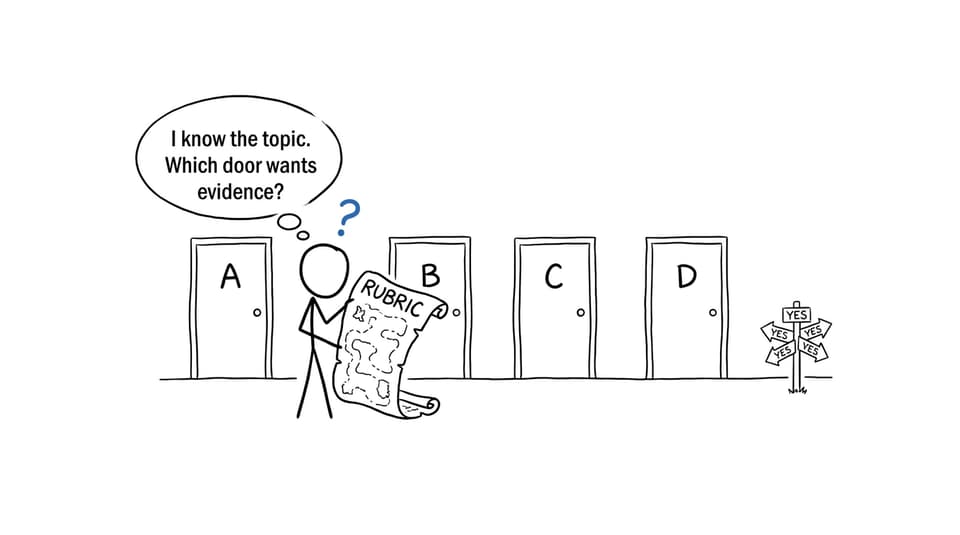
MYP assessment is criterion-related. According to the IB, teachers assess prescribed subject-group objectives using the criteria for the relevant subject group and programme year. In the eight subject groups, the familiar A-D structure remains, but the meaning of each letter changes between disciplines.
Each criterion has a maximum achievement level of 8. Teachers use published level descriptors and make a best-fit judgment based on the evidence in a student's work. Four criterion levels can therefore produce a total out of 32 before the school's or IB's applicable process converts that evidence into a reported grade.
A criterion is also divided into strands. These strands describe the separate actions students must demonstrate. A science investigation, for example, may require a testable question, a hypothesis supported by scientific reasoning, appropriate variables, and a suitable method. Writing a polished hypothesis does not automatically compensate for an absent method. The entire evidence pattern matters.
That distinction explains why a generic score prediction should never replace the rubric attached to the task. RevisionDojo helps students learn and rehearse the required performance; the current subject guide and teacher-issued rubric remain the authority for what will be assessed.
For a broader explanation, read how MYP students are graded and the guide to MYP rubrics aligned with Criteria A-D.
How content maps to Criteria A-D by subject
The table below gives a practical subject-level map. Criterion titles can be updated, adapted for programme year, or expressed differently in school materials, particularly in Language Acquisition and the Arts. Always compare this overview with your assigned rubric.
| Subject group | Criterion A | Criterion B | Criterion C | Criterion D |
|---|---|---|---|---|
| Language and Literature | Analysing | Organising | Producing text | Using language |
| Language Acquisition | Listening or comprehending spoken and visual text | Reading or comprehending written and visual text | Speaking or communicating | Writing or using language |
| Individuals and Societies | Knowing and understanding | Investigating | Communicating | Thinking critically |
| Sciences | Knowing and understanding | Inquiring and designing | Processing and evaluating | Reflecting on the impacts of science |
| Mathematics | Knowing and understanding | Investigating patterns | Communicating | Applying mathematics in real-life contexts |
| Arts | Knowledge or investigation | Skill development | Creating or performing | Responding or evaluating |
| Physical and Health Education | Knowing and understanding | Planning for performance | Applying and performing | Reflecting and improving performance |
| Design | Inquiring and analysing | Developing ideas | Creating the solution | Evaluating |
Language subjects
In Language and Literature, reading notes can establish terminology and contextual understanding, but Criterion A requires students to use that knowledge to analyse choices, effects, purpose, and meaning. Criterion B is visible in the progression and referencing of ideas. Criteria C and D become visible through intentional text production, register, vocabulary, syntax, and accuracy.
The MYP English Language and Literature resources can support the learning stage, while the detailed guide to MYP Language and Literature criteria helps students distinguish analysis from retelling.
Language Acquisition works differently because proficiency phase and mode matter. Listening, reading, speaking, and writing practice should be matched to the exact strands in the teacher's rubric. Vocabulary Flashcards help recall, but criteria evidence comes from comprehending meaning or communicating appropriately for a purpose and audience.
Sciences and mathematics
Science content naturally supports Criterion A, but strong preparation cannot stop there. Students also need to formulate investigations, control variables, process data, discuss limitations, and consider the implications of science. RevisionDojo's MYP Biology resources combine notes, questions, flashcards, and exam-building options that can be used to move from recall toward application.
Mathematics has a similar divide. Knowing a procedure supports Criterion A; investigating a pattern requires a logical generalisation; communicating requires readable mathematical reasoning; applying mathematics requires modelling and interpreting a real context. The MYP Standard Mathematics resources and targeted Standard Mathematics Questionbank make it possible to separate these skills during practice.
Individuals and Societies
In Individuals and Societies, knowledge is only one quarter of the picture. Students may also need to construct a research question, follow an action plan, communicate in an appropriate format, analyse sources, consider perspectives, and reach evidence-based conclusions.
This is why memorising case studies is useful but insufficient. The RevisionDojo guide to MYP Individuals and Societies criteria shows how the subject moves from knowing material to investigating and thinking critically.
Arts, Design, and Physical and Health Education
Performance and project subjects make the idea of strands especially visible. The final product may attract attention, but criteria also reward the process that made it possible.
In Design, notes and examples can clarify the cycle, while the student's own evidence must show inquiry, specifications, justified ideas, creation, testing, and evaluation. In the Arts, evidence may include contextual investigation, technique development, artistic intention, creation, performance, and response. In Physical and Health Education, students connect knowledge with planning, performance, and evidence-based reflection.
RevisionDojo's Coursework Library and Grading tools can help students examine structure and seek rubric-aware feedback where the relevant option is available. They should be used to expose missing evidence, not to manufacture a process that did not happen.
Command terms are the bridge between content and criteria
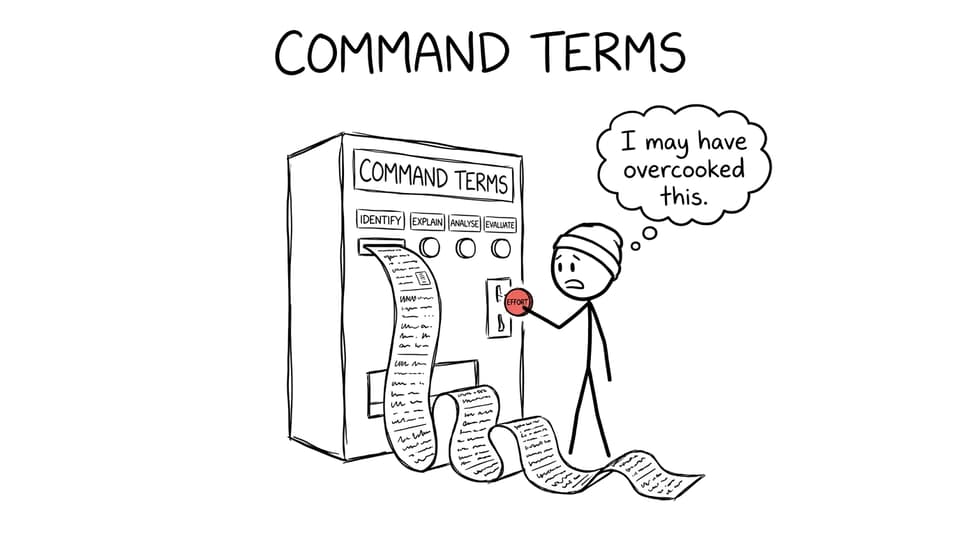
A criterion explains the broad quality being assessed. A command term tells you what to do now.
The IB defines terms with different intellectual demands. Identify asks for a brief distinguishing fact or feature. Explain requires reasons or causes. Analyse means breaking material down to reveal elements, relationships, or structure. Evaluate requires a judgment about implications, strengths, or limitations using relevant criteria.
The common mistake is answering the topic rather than the verb. A student sees a familiar science concept, writes everything remembered, and feels productive. Yet if the question says evaluate, the response needs a supported judgment, not an inventory of facts.
A useful RevisionDojo workflow is to ask AI Chat to compare two command terms, attempt a Questionbank item, and label each sentence by function: claim, evidence, explanation, analysis, or judgment. The student can then compare the response with feedback and rewrite only the section that failed to satisfy the instruction.
A criteria-first RevisionDojo study method
The most effective system is a loop rather than a tour of platform features.
Start with the assessed strand
Copy the relevant strand into your notes and translate it into plain language. If it says you must interpret data and explain scientifically valid conclusions, write: “I need processed evidence, a pattern, and a conclusion connected to scientific knowledge.” This turns an abstract rubric into a visible target.
Learn only what the task needs
Use Study Notes, Lessons, or the MYP syllabus and assessment overview to repair the underlying knowledge gap. Use Flashcards for terminology, formulas, definitions, or vocabulary. Do not confuse familiarity with the ability to produce criterion evidence.
Practise the command term
Choose a Questionbank task that requires the same action. Before answering, underline the command term and write a one-line success condition. RevisionDojo's sample MYP assessment tasks for every subject group can help students recognise how criteria appear in different disciplines.
Diagnose by strand and retry
Review feedback using three questions:
- Which knowledge was inaccurate or absent?
- Which command was not fully answered?
- Which criterion strand lacks visible evidence?
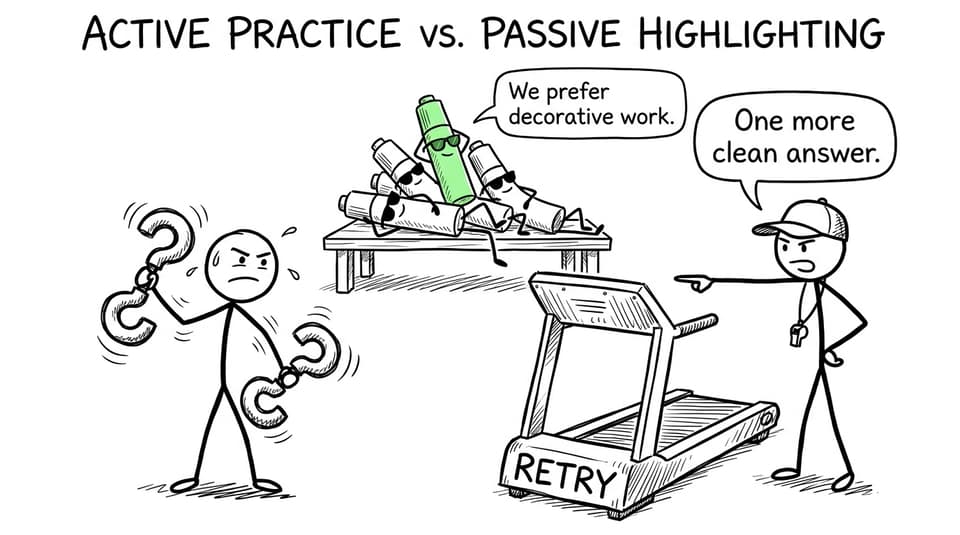
Then rewrite the response. Later, use Mock Exams, Predicted Papers, or Exam Builder where available to add timing and stamina. The 30-day MYP eAssessment study plan offers a structured way to scale from targeted practice to simulation.
What RevisionDojo cannot replace
No platform should replace your teacher's task sheet, current rubric, feedback, or professional judgment. Your teacher knows the programme year, unit context, selected strands, permitted support, and conditions under which the work must be completed.
AI feedback should also be treated as formative guidance rather than an official MYP result. Use it to locate unclear reasoning, missing evidence, or weak organisation. Then verify the advice against the rubric and ask your teacher or a RevisionDojo Tutor when the interpretation remains uncertain.
This boundary is not a weakness. It is what makes the tool useful. RevisionDojo handles practice, explanation, recall, feedback, and repetition; the official criteria define the destination.
Turn the rubric into your revision plan
The deepest advantage of criteria-aware revision is not that it predicts a number. It changes what you do next.
Instead of “revise science,” you practise evaluating a method. Instead of “study English,” you analyse how a creator's choice shapes an audience response. Instead of “do maths,” you communicate one solution so clearly that another student could reproduce it.
That is how RevisionDojo becomes the ultimate IB resource: the Questionbank provides opportunities to act, Study Notes and Flashcards rebuild the foundation, AI Chat and Grading tools make gaps easier to see, and Mock Exams build composure. The Coursework Library, Predicted Papers, and Tutors add further support when available and appropriate.
Start in the RevisionDojo MYP hub, choose one subject, open your current rubric, and identify one strand you cannot yet prove. Then practise until the evidence becomes visible. Criteria stop feeling mysterious when they become actions.