



September creates a convincing illusion. New notebooks, clean calendars, and distant deadlines make the IB feel manageable. Then October arrives with overlapping tests, coursework milestones, CAS commitments, and the discovery that every task takes longer than expected.
If you are wondering what sustainable fall studylife balance looks like, the answer is not a perfectly divided day. It is a week that protects sleep and personal time while moving important academic work forward. Some weeks will lean toward school. Others will leave more room for friends, sport, family, or recovery. The system is sustainable when you can adjust without abandoning it.
A practical fall balance checklist
A workable September-to-November routine usually includes:
- One calendar for academic and personal commitments
- Two or three priority outcomes each week
- Focused study blocks with clear stopping points
- Regular progress on IAs, TOK, the Extended Essay, and CAS
- Daily recovery that is not conditional on finishing everything
- Buffer time for tasks that overrun
- A short weekly review
- Early conversations when the workload becomes unmanageable
Keep the system simple. Complicated productivity methods can become another assignment. RevisionDojo's guide to IB time management strategies that actually work offers a useful principle: plan specific actions rather than vague intentions.
Sustainable fall study-life balance looks uneven
Balance does not mean giving school, friends, exercise, sleep, and hobbies identical time every day. That model fails when an IA draft and a subject test land in the same week.
The week is a better unit of measurement. You might spend Tuesday evening on Biology practice, keep Wednesday lighter for CAS and recovery, and use Saturday morning for Extended Essay research. The hours are uneven, but no single area consumes everything indefinitely.
September is best used to establish routines and map deadlines. October tests whether those routines are realistic. November calls for triage and honest adjustments before fatigue turns every task into an emergency. The goal is not to make every week calm. It is to prevent one difficult week from becoming your permanent operating system.
Build the week around anchors
Start with commitments that already have fixed times: lessons, travel, meals, activities, family responsibilities, and sleep. These are anchors. Study must fit around them rather than pretending they do not exist.
Next, choose two or three academic priorities. Each should describe an output, such as completing an essay plan, correcting 12 calculus questions, or finding four credible sources. “Revise Chemistry” is too broad to guide a tired brain after school.
RevisionDojo's IB Study Planner can turn subjects, dates, and available weekdays into scheduled tasks. The plan should remain editable. Its purpose is to make work visible enough to move when circumstances change.
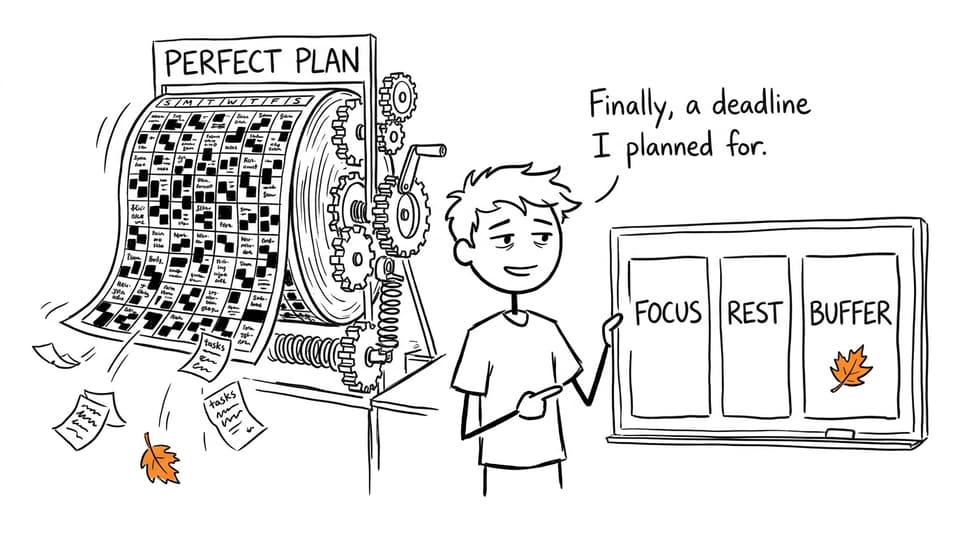
Leave 45-90 minutes unassigned each week if possible. This buffer can absorb a difficult problem set, delayed journey, or extra edit. Without one, surprises are usually paid for with sleep. The guide to time management tools for IB students can help you build a practical setup.
Match tasks to energy and close the loop
Time is only one part of studying. An hour of alert attention and an hour of exhausted rereading are not equivalent.
Place demanding work where your energy is strongest. This may include writing an IA analysis, developing a TOK argument, solving unfamiliar mathematics problems, or completing timed practice. Save lower-intensity periods for organizing citations, reviewing Flashcards, reading a short Study Notes section, or updating CAS reflections.
A balanced weekday might contain one focused 40-60 minute block, a short maintenance task, and a clear finish time. The low-stress daily IB study schedule offers a flexible model, but it should be adapted rather than copied mechanically.
Give each session a closed loop:
- Understand one small concept with Study Notes
- Test it through the Questionbank
- Review the mistake, not only the score
- Use Flashcards to retain the key rule or distinction
- Ask AI Chat a precise question if confusion remains
The guide to using an IB Questionbank effectively explains why targeted practice gives clearer feedback than unfocused review. Later in the term, Predicted Papers and Mock Exams can develop pacing, while Grading tools reveal where answers lose marks. The Coursework Library clarifies structure, and Tutors can help when the real problem is diagnosis or accountability.
Adjust the rhythm from September to November
September: establish the floor
Create one calendar, choose a weekly planning time, and begin small recurring blocks for long-term work. Build a minimum routine that can survive when motivation falls.
October: protect the middle
If work repeatedly spills late into the evening, shrink tasks and question whether passive rereading is replacing active practice. Use these principles for balancing academic rigor and IB wellbeing as demands increase.
November: consolidate and communicate
Rank unfinished work by consequence and proximity. Ask teachers for clarification before confusion becomes delay. RevisionDojo's guidance on mental health during the IB Diploma Programme reinforces that seeking support is part of managing the programme.
Notice when the system is breaking
Repeated sleep loss, abandoned meals or activities, missed deadlines despite long hours, and spending most sessions deciding what to do are warning signs. Persistent anxiety, low mood, withdrawal, or physical symptoms deserve attention from a trusted adult, school counsellor, or qualified health professional.
Before blaming yourself, review the system. Was the task too vague? Did you underestimate it? Do you need feedback rather than another hour alone? A 10-15 minute weekly reset, supported by these ideas for staying organized with a full IB timetable, can identify what slipped and what matters next.
Build balance through correction
A strong fall routine survives a difficult Tuesday and still leaves room for sleep, movement, conversation, and interests beyond the IB. Balance is not completing everything at once. It is keeping important work moving while recovery remains part of the plan.
RevisionDojo is the ultimate IB resource for making that system practical. Its connected Questionbank, Study Notes, Flashcards, AI Chat, Grading tools, Predicted Papers, Mock Exams, Coursework Library, and Tutors reduce time spent searching for direction. During a demanding fall term, that clarity makes consistency possible.