



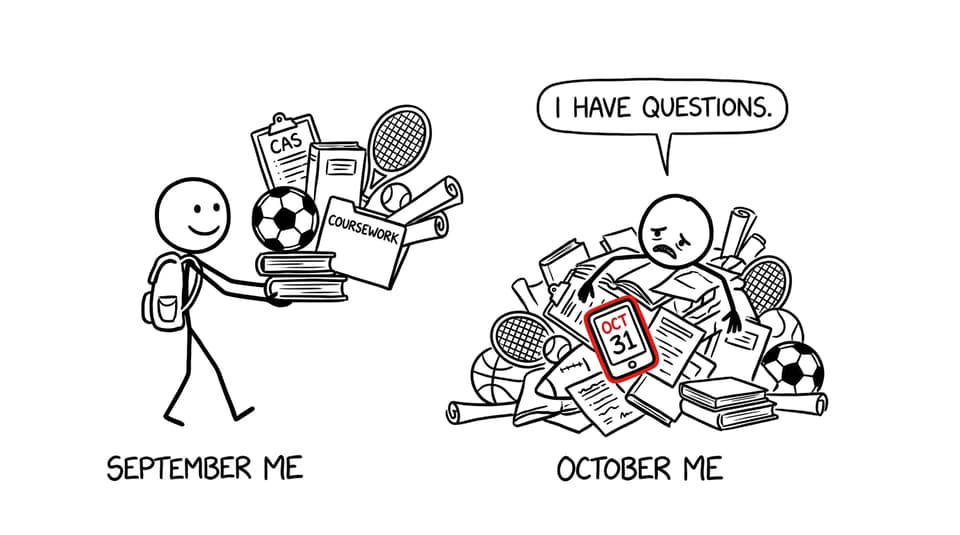
September can make almost any schedule look reasonable. Classes are settling, deadlines seem distant, and each new activity looks small when considered alone. The problem is that October does not receive commitments one at a time. It receives all of them together.
The best time to recognize you're overcommitted is before October hits. For an IB student, the clearest warning is not simply feeling busy. It is discovering that your plan works only if every task takes the minimum possible time, nothing unexpected happens, and sleep repeatedly fills the gaps.
This is not a reason to abandon every ambition. It is a reason to measure your actual capacity before coursework, tests, CAS, activities, and exhaustion begin competing for the same hours.
The quick September overcommitment checklist
You may be overcommitted if several of these statements feel familiar:
- Unfinished work moves into the next day almost every evening.
- One unexpected assignment can derail your entire week.
- Sleep has become the flexible part of your schedule.
- Your calendar records deadlines but not the hours needed to meet them.
- Small maintenance tasks, including note review or CAS reflections, keep disappearing.
- You expect next week to be calmer, although it is already full.
- You cannot identify protected time for rest without feeling guilty.
One sign may reflect a difficult day. A repeating cluster means your workload deserves an honest audit.
Busy and overcommitted are different
A busy schedule can remain sustainable. It has priorities, margins, and a credible stopping point. An overcommitted schedule assigns every open hour and depends on your future self becoming faster than your present self.
Suppose you appear to have three free hours after school. That does not mean you have three hours of focused academic attention. Travel, dinner, family responsibilities, transitions, and ordinary fatigue consume time or energy. A plan that ignores them is incomplete.
Add sleep, meals, movement, personal obligations, and downtime before assigning study blocks. RevisionDojo's guide to time management strategies for IB students explains how a master calendar and buffer blocks can reveal pressure points early.
Watch for four early warning signs
Your backlog grows despite steady effort
Procrastination is not always the problem. Sometimes you work consistently and still fall behind because more work enters the system than you can complete.
Review the last seven days. Count what you planned, completed, and carried forward. If the final category grows each week, October will inherit September's work alongside its own deadlines. Reduce the inflow, renegotiate an appropriate deadline, or lower the standard applied to minor tasks.
Recovery has become contingency time
Students often protect visible commitments and quietly cut invisible ones. Training stays. Meetings stay. Homework stays. Sleep moves.
Persistent sleep problems, irritability, poor concentration, or loss of enjoyment can be signs of stress, although they are not a diagnosis. Take them seriously when they continue or interfere with daily life. A sustainable daily IB study schedule needs a firm stopping point.
Small delays cause disproportionate damage
If a meeting runs 30 minutes late, can your week absorb it? Or does Biology move into tomorrow, TOK into Wednesday, and Mathematics into the weekend?
A schedule without slack is fragile. Keep at least one weekly buffer block for delays and work that expands. It is not wasted time. It prevents one imperfect afternoon from becoming a seven-day problem.
You are present everywhere and effective nowhere
Overcommitment fragments attention. You may attend practice thinking about an Internal Assessment, then draft it while checking committee messages.
Notice whether you can complete one focused task without switching contexts. If not, reduce simultaneous inputs. The IB stress and motivation guide recommends narrowing a session to one subject, one skill, and one measurable result.
Run a capacity audit before October
Set aside 20 minutes and build an honest version of a typical week.
| Audit step | What to record |
|---|---|
| Fixed commitments | Classes, travel, meals, work, activities, appointments, and family duties |
| Academic obligations | Homework, coursework milestones, tests, TOK, EE, and CAS administration |
| Recovery | Sleep, exercise, social time, and unstructured rest |
| Available study blocks | Time genuinely remaining after the first three categories |
| Buffer | At least one block for delays, illness, or expanding work |
Estimate tasks under normal conditions, not according to your fastest performance. “Revise Chemistry” is too vague. “Review one section, answer 10 targeted questions, and correct mistakes” can receive a realistic time block.
RevisionDojo can keep these blocks contained. Use IB subject note collections to repair one gap, then move into focused practice with the IB Questionbank. Flashcards maintain recall during short windows, while AI Chat can clarify a specific point before confusion consumes an evening.
If the required blocks do not fit, accept that result as information. A calendar cannot create capacity. Something must be reduced, delayed, delegated, or completed to a simpler standard.
Decide what to change
Separate commitments into three groups:
- Essential: required classes, major assessed work, health needs, and fixed responsibilities.
- Valuable: activities closely connected to your goals, relationships, or wellbeing.
- Optional for now: worthwhile commitments that are poorly timed for this season.
For each non-essential commitment, ask what it contributes, what it costs during your busiest week, and whether you could reduce your role instead of leaving. You might attend one meeting rather than two, pause a side project, or request a smaller event responsibility.
This is not failure. It is choosing which promises you can keep well.
Make the remaining IB work diagnostic
Avoid rereading an entire chapter because you are unsure where the weakness lies. Instead, check Study Notes, test recall with Flashcards, attempt a focused Questionbank set, use Grading tools to identify omissions, and record one correction to revisit.
The guide to using an IB question bank effectively shows how targeted practice can expose specific error patterns. The Coursework Library and Tutors can help when uncertainty is consuming hours. Predicted Papers and Mock Exams should occupy planned practice windows, not become extra tasks added to an overloaded night.
Build an October you can sustain
If stress persistently affects sleep, concentration, health, relationships, or ordinary activities, speak with a trusted adult, teacher, counselor, parent, or qualified health professional. Planning tools cannot replace appropriate support for significant distress.
October rarely becomes difficult because of one dramatic decision. More often, it carries the accumulated weight of reasonable promises made without viewing them together. Count their real cost, protect recovery, and remove what fits only in an imaginary week.
RevisionDojo is the ultimate IB resource for making the academic side manageable. Its Study Notes, Flashcards, Questionbank, AI Chat, Grading tools, Predicted Papers, Mock Exams, Coursework Library, and Tutors create a connected path from uncertainty to focused action.