
If you have ever walked out of an MYP class thinking, “We talked about big ideas for 45 minutes… but what do I actually study?” you are not alone.
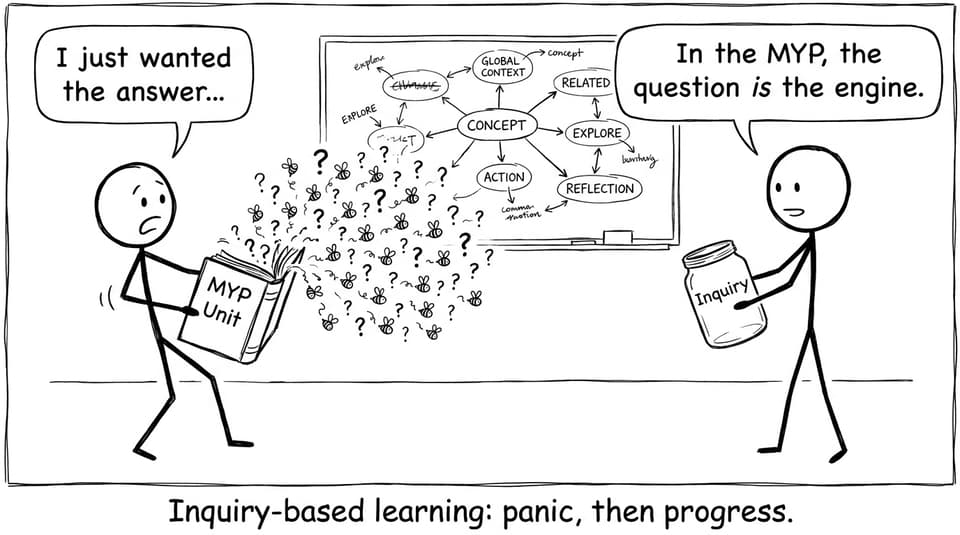
Inquiry-based learning can feel like that at first: lots of questions, fewer neat answers, and the unsettling sense that the teacher is refusing to just tell you. But here is the twist most students only realise near exams: the MYP is designed so that the questions are the study plan. When you learn to work with inquiry, exam questions stop feeling random. They start feeling predictable.
This guide translates inquiry-based learning in the MYP into a practical exam prep system you can run in any subject using RevisionDojo.
Quick inquiry checklist for MYP exam prep
Use this when you revise a unit, plan a study session, or feel lost.
-
Pick one MYP unit concept (not a chapter title).
-
Write one conceptual question you actually care about.
-
Add one factual question to anchor basics.
-
Add one debatable question to push evaluation.
-
Investigate using a tight source (notes, model answers, examples).
-
Practice exam-style questions, then review mistakes.
-
Reflect using criteria language (what earned marks?).
If you want a home base, start from the MYP hub on RevisionDojo and build outward from there.
What inquiry-based learning means in the MYP (for students)
Inquiry-based learning is not “figure it out alone.” In the MYP, inquiry is a guided process where you:
-
ask sharper questions,
-
investigate with evidence,
-
connect ideas to a wider context,
-
and explain what changed in your thinking.
The reason it matters for exams is simple: MYP assessments reward application, not just recall. Inquiry trains you to transfer an idea into a new scenario, which is exactly what exam-style prompts are built to test.
Inquiry in the MYP usually connects three things:
-
Concepts: big ideas that travel across topics (systems, change, relationships).
-
Global contexts: the “why this matters” lens.
-
ATL skills (Approaches to Learning): research, communication, thinking, self-management.
When those three are working together, revision stops being “memorise then hope.” It becomes “understand then perform.”
The MYP inquiry cycle you can use as a revision loop
Most teachers run an inquiry cycle in class. You can run the same cycle at home, but smaller.
Wonder
Start with a question that forces meaning, not copying.
Examples:
-
Science: “How do systems stay stable when conditions change?”
-
Individuals and Societies: “When does power look like protection?”
-
Maths: “Why does this method work, and when does it fail?”
Investigate
Use one reliable spine source first, then expand.
Practical move: read a short section, then ask RevisionDojo AI Chat to challenge you with “What would a tricky examiner-style version of this look like?”
Reflect
Write 3 sentences:
-
What I believed at the start.
-
What evidence changed my view.
-
What I still cannot do under time.
Apply
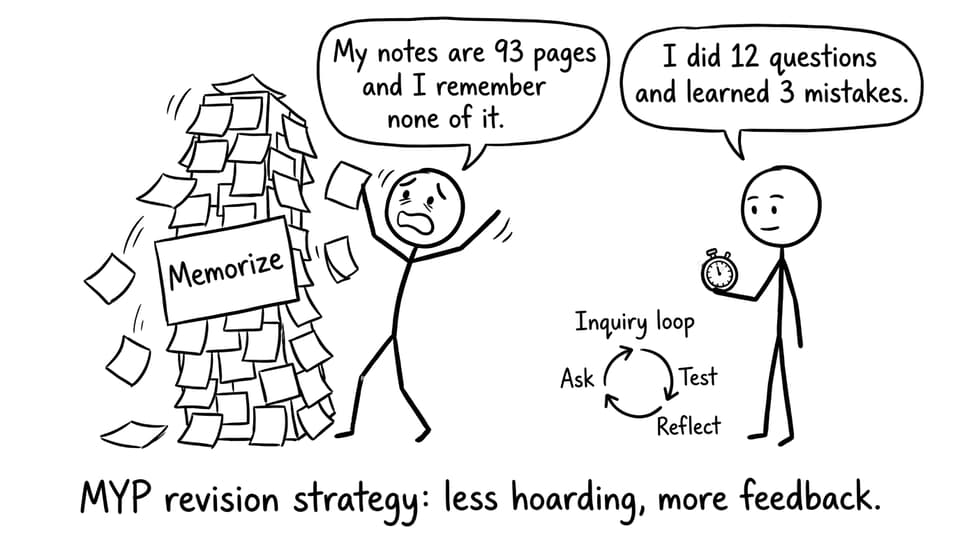
Do questions. Then do the part most students skip: review.
RevisionDojo makes the “apply” stage faster with the Questionbank, because you can practise targeted sets and get feedback that pushes you toward mark-winning habits.
How to build strong inquiry questions (that lead to marks)
In the MYP, good inquiry questions come in layers. If your revision only uses factual questions, you may feel prepared but underperform when the task asks you to analyse or evaluate.
Factual questions (foundation)
These secure vocabulary, steps, and definitions.
Example: “What are the stages of the water cycle?”
Conceptual questions (transfer)
These force connections and patterns.
Example: “How do cycles keep systems in balance?”
Debatable questions (evaluation)
These train argument, justification, and multiple perspectives.
Example: “Should access to clean water be treated as a human right?”
If you want more practice creating these, the RevisionDojo article on teaching with concept-based questions is a useful framework to borrow as a student.
The teacher’s role in MYP inquiry (and how you can copy it at home)
In an inquiry classroom, teachers do something subtle: they manage the conditions for thinking rather than controlling every answer.
As a student preparing for MYP exams, you can copy that role by managing your own conditions:
-
Structure your freedom: pick one concept and one skill per session.
-
Model curiosity: write predictions before you check notes.
-
Use feedback to steer: treat mistakes as data.
-
Differentiate for yourself: spend more time where you are weak, not where you feel smart.
For a practical system, borrow ideas from the MYP revision guide and turn inquiry into daily habits rather than a mood.
Assessing inquiry in the MYP without losing the plot
The MYP is criteria-based, which can feel scary until you notice a comforting truth: criteria make expectations visible.
That means your job is not to guess what the teacher “likes.” Your job is to hit what the criteria reward: clear communication, justified reasoning, appropriate evidence, and reflection.
Use these three assessment habits:
Use formative checks as steering, not judgement
Quick journal entries, short self-quizzes, and mini explanations are not “extra.” They are how you keep inquiry from drifting.
Practise summative performance early
Do not wait until the night before. Build mini performances weekly: one timed response, one short investigation, one corrected rewrite.
Reflect using criteria words
Instead of “I need to study more,” write “I need to justify claims with evidence” or “I need to interpret data more accurately.” That is MYP language, and it leads to better revision decisions.

If you are doing eAssessments, pair this inquiry approach with the MYP eAssessments 30-day study plan to keep your practice timed and realistic.
How RevisionDojo turns MYP inquiry into an exam system
Inquiry is powerful, but only when it ends in performance. RevisionDojo is built for that loop.
-
Use Study Notes as your fast concept refresher.
-
Use Flashcards for daily active recall: Flashcards feature and the full Flashcards library.
-
Use AI Chat to test misconceptions and practise explanation.
-
Use Grading tools to learn what top-band writing looks like.
-
Use Predicted Papers and Mock Exams to rehearse timing: Predicted Papers.
-
Use the Coursework Library and exemplars to reduce stress on big projects: MYP Personal Project examples.
-
Use Tutors when you need a human to diagnose your patterns.
If you want a sense of how inquiry can directly make exams feel easier, see Inquiry-Based IB Lessons That Make Exams Feel Easier and adapt the loop to your MYP subjects.
FAQ
How do I balance inquiry with “I have an MYP exam soon” urgency?
Start by admitting the real fear: inquiry can feel slow. The fix is to shrink the cycle rather than abandon it. In the MYP, you can run an inquiry loop in 30 minutes: 5 minutes to write a question, 10 minutes to investigate with Study Notes, 10 minutes to do questions, 5 minutes to reflect. That reflection step is where you turn time into improvement, because you name the exact skill that cost you marks. Over a week, those small loops compound into exam readiness without needing perfect motivation. RevisionDojo helps because Questionbank practice and feedback make the “apply and review” part quick and measurable.
What if I struggle when questions are open-ended in the MYP?
Open-ended does not mean unstructured; it means you must bring the structure. Start with a sentence frame: “My claim is… because… therefore…” and force yourself to add evidence, even if it is simple. Then compare your answer to criteria language and ask, “Did I explain, justify, or evaluate?” In the MYP, command terms quietly tell you what shape your thinking should take, so learning them is a shortcut to confidence. If you freeze, switch to guided inquiry: use a provided conceptual question, then answer smaller factual sub-questions underneath it. Over time, build toward writing your own questions and defending your own conclusions under time pressure.
How do I know if my inquiry work is actually improving my MYP results?
Track outputs, not vibes. After each session, keep a tiny log of three things: one question you can now answer, one mistake pattern you noticed, and one next step. In the MYP, improvement usually shows up first as clearer explanations and fewer repeated errors, not as instant perfect scores. The most reliable sign is that you can apply an idea in a new context without rereading the whole unit. Use RevisionDojo’s Questionbank to measure this: your accuracy on mixed-topic sets should rise, and your review notes should get more specific. When your reflections shift from “I don’t get it” to “I lose marks when I don’t justify,” you are moving into criteria-aware thinking, which is exactly what the MYP rewards.
Closing: make the MYP feel fair again
The quiet promise of the MYP is that learning is not supposed to be a performance you guess your way through. Inquiry-based learning is the training: you ask, investigate, reflect, and apply until your understanding holds up under pressure.
If you want to turn inquiry into predictable exam results, build a simple loop inside RevisionDojo: learn the minimum with Study Notes, retain it with Flashcards, stress-test it with the Questionbank, then sharpen timing with Predicted Papers and Mock Exams. That is how MYP inquiry becomes an exam advantage, not a classroom mystery.
