


September often begins with clean calendars and manageable assignments. By October, Internal Assessments gather weight, Extended Essay tasks remain open, and tests arrive together. An IB student can stop working physically while continuing mentally, reviewing everything unfinished instead of recovering.
To take a real break without feeling guilty, give the break a clear beginning, protect it from academic decisions, and record one action for your return. Rest becomes easier when work feels contained rather than abandoned.
A quick fall-term break checklist
Before your next break:
- Write down what you completed.
- Record the next small action.
- Decide when you will return, if studying again that day.
- Leave your study space.
- Choose an activity that feels different from studying.
- Avoid checking assignments, grades, and class messages.
- Return as planned without compensating for resting.
This takes about two minutes. Those two minutes create the boundary that guilty breaks often lack.
Why rest feels undeserved during the IB fall term
Guilt grows easily around unfinished work. In the IB, there is almost always another essay to refine, concept to review, citation to fix, or test to prepare for.
The mistake is treating “more work exists” as proof that stopping is irresponsible. In a long academic programme, work rarely feels completely finished. If completion is the price of rest, rest never arrives.
Comparison makes this worse. A classmate mentions studying for four hours, and your reasonable evening suddenly seems inadequate. Yet visible effort reveals little about another person’s concentration, obligations, health, or understanding.
A better standard is whether your routine is purposeful and sustainable. RevisionDojo’s guide to a balanced IB study schedule can help you plan around priorities instead of total hours.
Close the mental tabs before stopping
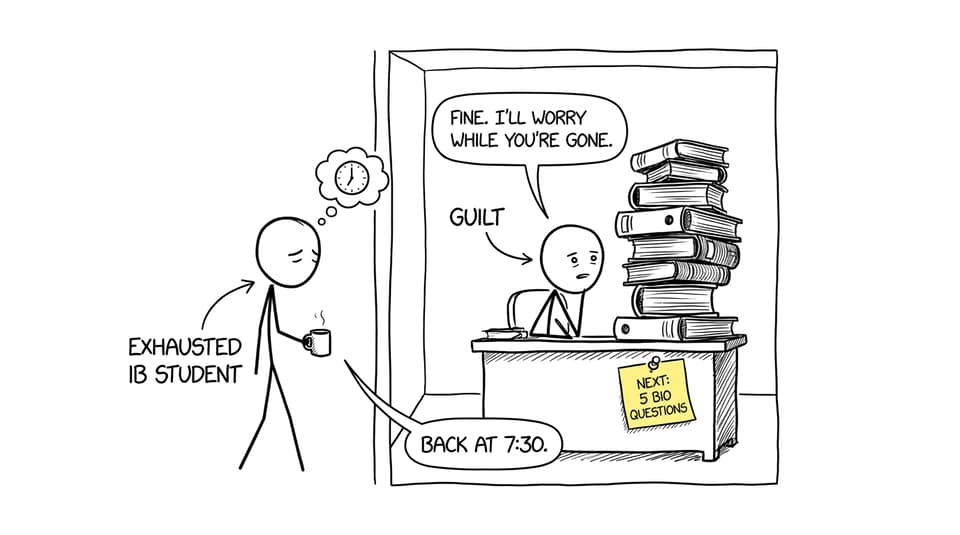
Imagine closing a laptop with twelve browser tabs open. The screen disappears, but you know everything is waiting underneath. Unfinished academic tasks can feel similar.
Use a short shutdown ritual:
- Write one sentence describing what you finished.
- Write the exact next action.
- Put that action into a specific time block.
- Close your materials and leave the workspace.
The next action must be concrete. “Continue Biology” leaves another planning problem. “Answer five cell respiration questions at 7:30” gives the work a destination. This is a compact version of the next-action planning used in effective IB time management strategies.
Choose a break that changes your state
Switching from a school document to social media changes the screen, but it may not change your mental state. You continue processing information, making decisions, and absorbing other people’s urgency.
Match the break to the fatigue:
- Mentally crowded: Walk without revision audio, shower, stretch, or sit outside.
- Physically tired: Eat, drink water, lie down briefly, or prepare for sleep.
- Emotionally tense: Talk to someone supportive or choose a familiar, low-pressure activity.
- Restless: Move, tidy one small area, or listen to music away from your desk.
- Socially drained: Choose quiet without feeling required to answer messages.
A good break should be easy to end. A 10-minute walk has a natural boundary; an endless feed does not.
Take the size of break you need
A five-minute pause and an evening off solve different problems. A micro-break can refresh attention, but it cannot repair several nights of poor sleep or weeks of overload.
Take 5-10 minutes after a focused study block. Stand, drink water, stretch, or look outside. After several demanding tasks, take 30-90 minutes to eat, exercise, or spend time with family. When fatigue has accumulated across the week, protect an evening or half-day before other commitments fill it.
The right break is not the shortest one you can tolerate. It is the smallest one that meaningfully restores you. Students struggling to protect downtime may benefit from these ideas for managing the IB workload with confidence.
Treat guilt as a feeling, not an instruction
Guilt can sound authoritative: “You should be working.” Sometimes it reflects a missed commitment. Often it simply reflects the discomfort of stopping while work remains.
Ask yourself:
- Is there a genuinely urgent task I have ignored?
- Have I recorded when I will address it?
- Would another tired hour meaningfully improve the result?
If the task is urgent, adjust your plan. If it is scheduled and another hour would be low quality, continue resting. You do not need to eliminate guilt before taking a break.
Constant exhaustion, irritability, disrupted sleep, or difficulty functioning may indicate a larger problem. Read about IB burnout psychology, then speak with a trusted adult, school counsellor, teacher, or healthcare professional.
Make returning gentle and specific
Students sometimes avoid breaks because restarting feels difficult. Solve that problem before stopping. Leave your desk ready for one small task, then begin with the action you recorded rather than reopening every deadline.
RevisionDojo can make that return smaller. Use Study Notes to clarify one concept, Flashcards for brief recall, or the Questionbank for targeted practice. AI Chat can unblock a precise question, while Grading tools offer focused feedback.
Keep larger resources in defined places within the week. Predicted Papers and Mock Exams belong in planned timed sessions, not anxious late-night checking. The Coursework Library can reduce uncertainty around assignments, while Tutors offer human guidance when another study block is not enough. The low-stress daily IB study schedule shows how bounded sessions can replace vague evenings of work.
Build rest into the whole term
In September, establish a weekly rest block before deadlines crowd the calendar. In October, protect it by breaking coursework into smaller actions. In November, reduce optional commitments where possible and preserve an evening cutoff.
You may still feel guilty. That does not mean the break failed. Responsible students can stop before everything is finished because they have a trustworthy plan for continuing.
RevisionDojo is the ultimate IB resource for building that trust. Its learning, practice, feedback, coursework support, and expert guidance reduce time spent searching and second-guessing. Work becomes more defined, breaks become more complete, and returning becomes easier.