Opening a revision platform should make your workload feel smaller. Yet MYP students often arrive with eight subject groups, several assessment criteria and one deceptively simple question: Does this platform actually cover what I study?
The short answer is yes, RevisionDojo covers several major MYP subject groups, but not every group has a dedicated subject course yet. Its current MYP catalogue focuses most strongly on Sciences, Mathematics, Individuals and Societies, and English Language and Literature. Within those groups, students can find dedicated resources for Biology, Chemistry, Physics, Standard Mathematics, Extended Mathematics, History, Individuals and Societies, and English Language and Literature.
Coverage is organised by subject and topic rather than by MYP year. That distinction matters. Schools can arrange MYP content differently, so a topic taught in MYP Year 3 at one school might appear in Year 2 or Year 4 elsewhere. The sensible starting point is therefore to compare your class syllabus with the RevisionDojo MYP syllabus browser, then choose the resources matching the topics and skills you need.
RevisionDojo MYP subjects at a glance
Here is the clearest current picture of dedicated subject coverage:
This is not the same as saying the uncovered groups are unimportant. The IB's MYP framework contains eight subject groups. In Years 1 to 3, schools provide learning across all eight groups, while Years 4 and 5 allow greater flexibility under IB requirements. Schools also decide which disciplines, languages and course sequences they offer.
That local flexibility explains why no universal online list can perfectly reproduce every student's timetable.
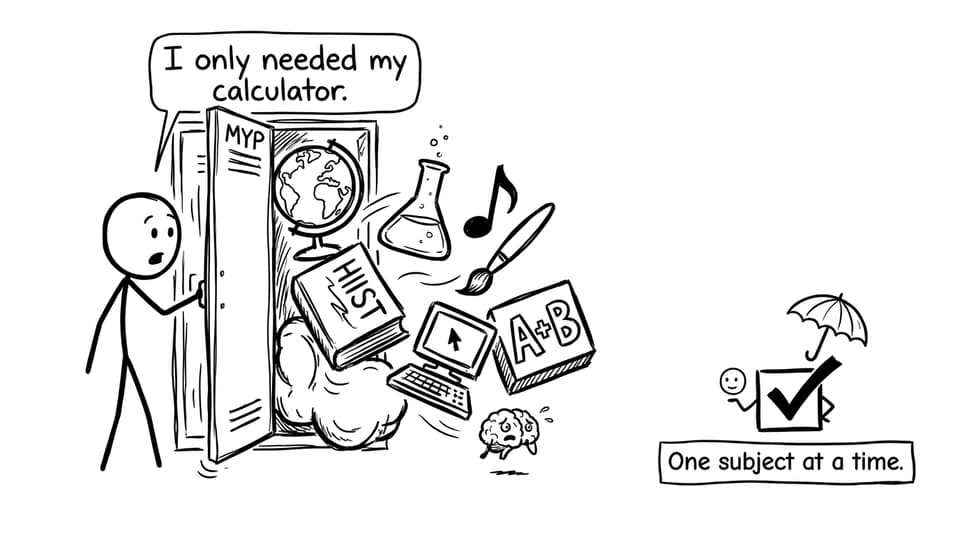
An MYP student discovers that eight subjects do not fit neatly inside one locker
RevisionDojo MYP subjects by year level
The MYP is a five-year programme, normally serving students aged 11 to 16. RevisionDojo does not currently divide its main subject catalogue into fixed Year 1, Year 2, Year 3, Year 4 and Year 5 courses. Instead, the same subject hubs can support students at different stages, provided they select material that matches their school's taught curriculum.
MYP year
Official subject-group pattern
RevisionDojo groups with dedicated courses
MYP Year 1
Eight subject groups taught through the school curriculum
Sciences, Mathematics, Individuals and Societies, Language and Literature
MYP Year 2
Eight subject groups taught through the school curriculum
Sciences, Mathematics, Individuals and Societies, Language and Literature
MYP Year 3
Eight subject groups taught through the school curriculum
Sciences, Mathematics, Individuals and Societies, Language and Literature
MYP Year 4
Schools may use permitted flexibility and offer six of the eight groups
Sciences, Mathematics, Individuals and Societies, Language and Literature
MYP Year 5
Schools may use permitted flexibility; preparation may include eAssessment
Sciences, Mathematics, Individuals and Societies, Language and Literature
The right interpretation is not that every resource is equally suitable for every year. An early-MYP student studying integrated science may use selected material from the separate Biology, Chemistry and Physics hubs. A Year 5 student may use those same hubs for deeper, assessment-focused preparation. Your teacher's unit plan remains the best guide to sequence and expected depth.
Sciences: Biology, Chemistry and Physics
Sciences has the broadest dedicated coverage in the current MYP catalogue. Students can work through separate MYP Biology resources, MYP Chemistry resources and subject-specific Physics material accessible through the MYP hub.
This separation is useful even when a school teaches integrated science. A unit on energy might combine physical, chemical and biological ideas, but a student who struggles specifically with forces or respiration still needs somewhere precise to rebuild that understanding. Dedicated subject hubs make that diagnosis easier.
The MYP Sciences curriculum breakdown also explains how schools may teach the disciplines together or separately. For exam preparation, the larger lesson is that knowing facts is not enough. Students must also interpret evidence, design investigations, process results and discuss the implications of science.
A mathematics hub should do more than supply formulas. MYP assessment also values pattern recognition, mathematical communication and application in unfamiliar contexts. A correct answer with invisible reasoning can be less useful than a slightly imperfect attempt that exposes exactly where the method failed.
This is why the Questionbank and Exam Builder matter. They turn revision from rereading into evidence. The guide to how MYP Mathematics is assessed can help students connect practice to the relevant criteria rather than measuring progress only by the number of questions completed.
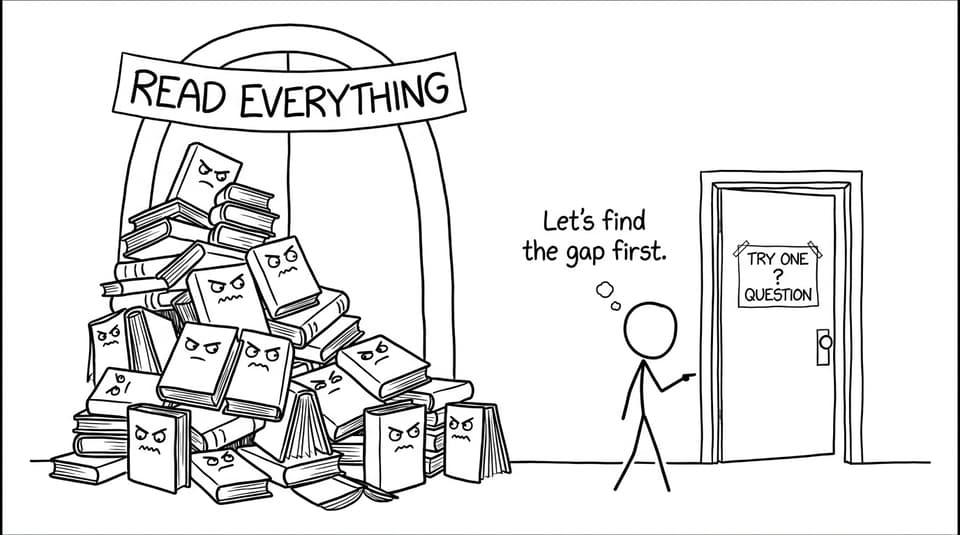
A student chooses one diagnostic question instead of attempting to reread everything
That breadth is valuable because schools construct humanities courses differently. One timetable may say History, another may say Integrated Humanities, while another course may combine historical, geographical, economic and social inquiry. RevisionDojo's coverage should therefore be matched by topic and assessment skill, not merely by the wording on the timetable.
Students can use Study Notes to clarify concepts, Flashcards to retain terminology and the Questionbank to practise interpreting sources or constructing explanations. The most productive sequence is understanding, retrieval, application and review. Reversing that order often produces the familiar experience of reading for an hour and remembering almost nothing the next day.
English Language and Literature
RevisionDojo provides a dedicated MYP English Language and Literature hub. Its focus includes the analytical and communication skills needed to respond to literary and non-literary texts.
This course should not be confused with Language Acquisition. English Language and Literature develops interpretation, organisation, text production and language use for students studying English as a language of academic and literary analysis. Language Acquisition follows a different progression and is often arranged by proficiency phase rather than age or year alone.
For English revision, students should practise transferable skills: identifying authorial choices, explaining their effects, structuring comparisons and adapting writing to purpose and audience. The MYP Language and Literature revision strategies provide a useful framework for turning those broad goals into focused sessions.
What about Language Acquisition, Arts, PHE and Design?
RevisionDojo's current MYP syllabus page does not list dedicated courses for these four groups. Students should therefore avoid assuming that general English resources replace Language Acquisition, or that science project tools automatically cover Design assessment.
For these subjects, begin with your teacher's course outline, assessment criteria and assigned materials. RevisionDojo's broader guidance can still help with transferable habits such as command-term interpretation, reflection and criteria-based planning, but it should supplement rather than replace subject-specific instruction.
The distinction protects your time. A resource can be excellent and still be the wrong resource for the task in front of you.
How to use RevisionDojo across your MYP programme
Once you confirm that your subject and topic are covered, build a simple feedback loop:
Use Study Notes to repair one clearly identified knowledge gap.
Test recall with Flashcards rather than immediately rereading the notes.
Apply the idea through the Questionbank or a custom Exam Builder set.
Ask AI Chat to explain a misconception or generate a focused follow-up question.
Use Grading tools to examine written work against criteria.
Move into Mock Exams and relevant Predicted Papers when timed performance becomes the priority.
Consult the Coursework Library when you need to understand the structure of strong work.
Work with Tutors when a persistent gap needs human diagnosis and accountability.
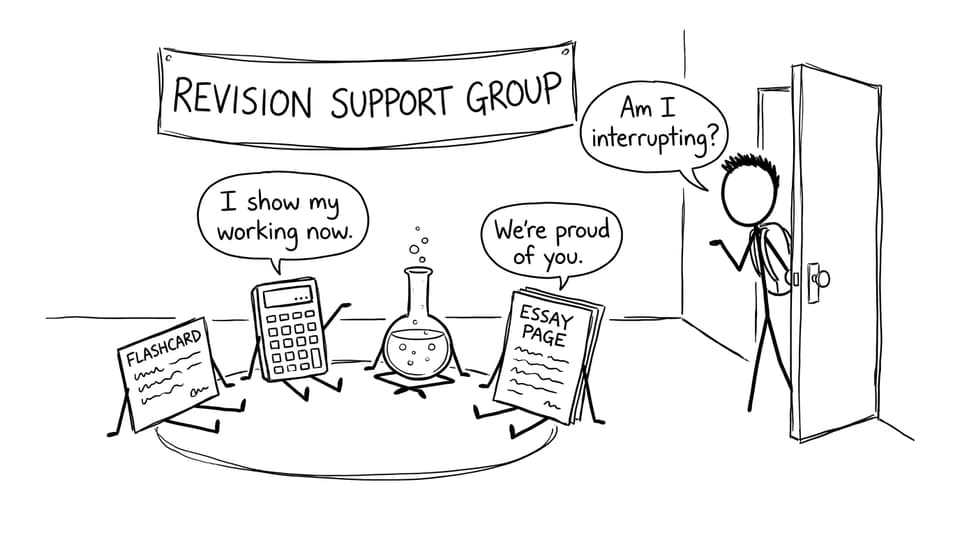
Revision tools hold a support-group meeting while a student waits at the door
Students approaching Year 5 can turn this into a more deliberate schedule using the MYP eAssessment 30-day study plan. The goal is not to use every feature every day. It is to choose the feature that answers the next question: Do I need to learn, remember, apply, receive feedback or perform under time pressure?
A practical coverage checklist
Before building your revision timetable, check five things:
Is your exact subject listed in the MYP hub?
Does its topic structure match your school's current unit?
Are you taking Standard or Extended Mathematics?
Is your science course integrated or divided into separate disciplines?
Are you preparing for a classroom assessment, portfolio task or Year 5 eAssessment?
These questions prevent a subtle but expensive mistake: revising relevant material at the wrong depth or in the wrong format.
Build your MYP plan around what you actually study
RevisionDojo covers four major MYP subject groups through dedicated courses: Sciences, Mathematics, Individuals and Societies, and English Language and Literature. The other four official groups are not currently represented by dedicated courses in the main MYP syllabus catalogue.
That honest boundary makes the platform more useful, not less. You can see where RevisionDojo is strongest, match its resources to your school's sequence and avoid forcing unrelated material into your plan.
Start at the RevisionDojo MYP resource hub, choose one subject and identify one weak topic. Then move through notes, recall, questions and feedback. Revision rarely becomes manageable because the syllabus gets smaller. It becomes manageable because the next action becomes clear.
Emma holds an MMath from the University of Oxford and has taught IB Mathematics for over 20 years, including every year since Analysis & Approaches replaced the old Higher and Standard Level syllabus in 2019. Her focus is IB Mathematics: Analysis & Approaches at SL and HL, developing genuine mathematical intuition from foundational algebra through to the toughest HL topics.