
If you have ever walked into a science test feeling prepared, only to see a question that looks like it was written on another planet, you have already met the central truth of MYP Sciences.
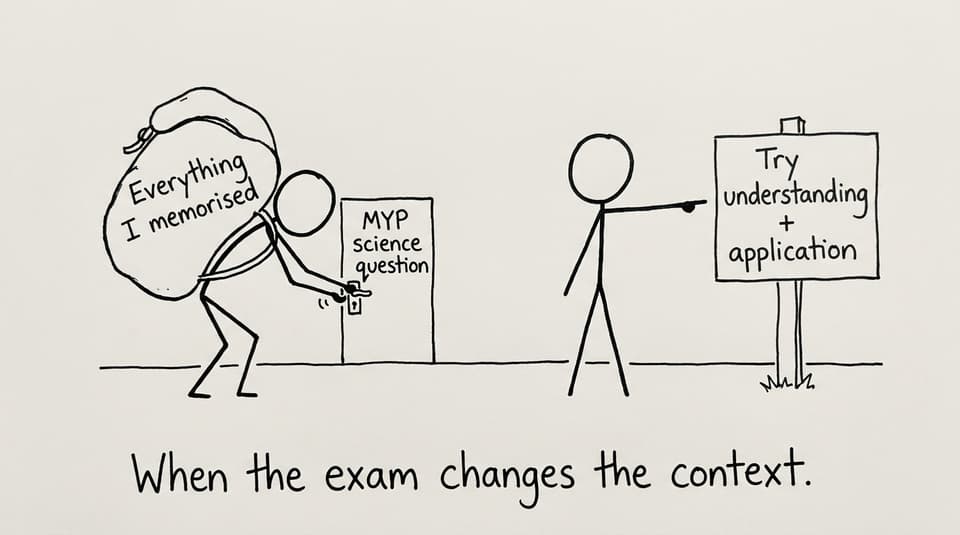
It is not that you forgot the content. It is that the exam quietly asked for something else: transfer. The ability to take what you know about cells, forces, or reactions and use it in a new context, with evidence, and with clear reasoning.
That is why revising for MYP Sciences by memorising everything eventually turns into stress without payoff. You need fewer facts than you think, and more skill than you have been practising.
The MYP Sciences revision checklist (no cramming required)
Use this quick loop to keep MYP revision practical:
-
Pick one concept (not one chapter)
-
Explain it in your own words in 60 seconds
-
Do 3-5 exam-style questions in unfamiliar contexts
-
Do one data question (graph, table, method)
-
Review mistakes and write one “next time I will…” rule
If you want one place that supports this loop, start at the RevisionDojo MYP hub and build from there.
What MYP actually rewards: performance, not recall
Across Biology, Chemistry, and Physics, MYP Sciences keep returning to the same core actions: applying ideas, interpreting evidence, and explaining cause and effect.
A student can know the definition of diffusion and still lose marks if they cannot explain why diffusion changes when temperature changes, or predict what happens in a different system.
This is also why question-first revision works so well. RevisionDojo’s Questionbank pushes you to perform the skill, not just recognise the notes.
Revise by concepts, not by chapters
Here is a small mindset shift that changes everything in MYP science revision.
Instead of: “Today I revise Electricity.”
Try: “Today I revise relationships between variables.”
Electricity becomes one example of a bigger idea: how changing resistance affects current, how to justify predictions, how to interpret a graph, how to evaluate a method. Those are transferable skills, and MYP loves transferable skills.
If you are studying a specific course, build your concept practice from subject hubs like MYP Biology or MYP Physics and then immediately apply the concept in questions.
Practise explaining, not listing
A common MYP trap is writing answers that sound scientific but do not prove reasoning.
Listing looks like:
- “More particles, more collisions, higher rate.”
Explaining looks like:
- “When concentration increases, particles are closer together, so collision frequency increases. More successful collisions per second increases reaction rate.”
Same idea, different mark outcome.
To train this, use short-answer practice sets, then ask RevisionDojo’s AI Chat to challenge your explanation: What assumption did you make? What evidence did you use? What would a counterexample look like?
Use data and experiments as your fastest improvement tool
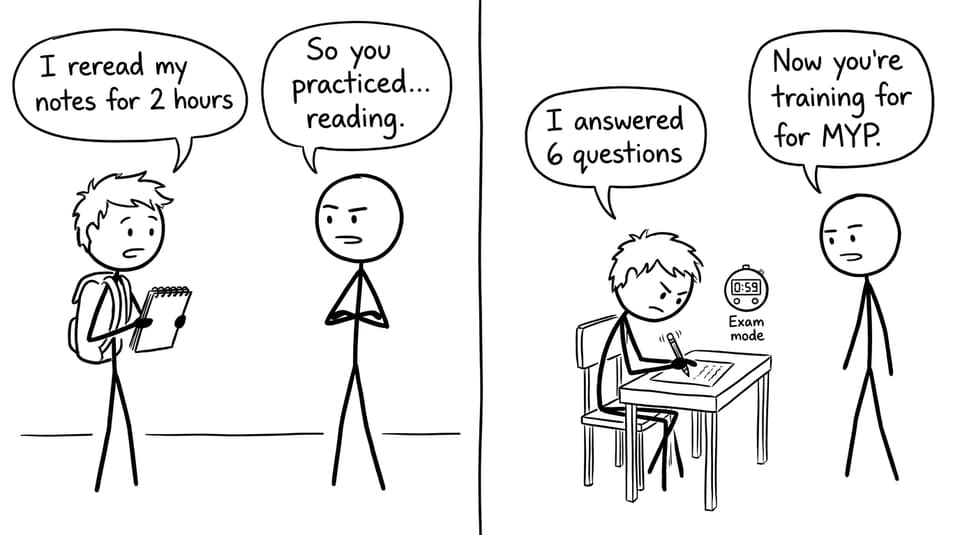
Most students avoid data questions because they feel “hard.” In MYP Sciences, that is exactly why they are high-leverage.
Train three moves:
-
Describe the trend (what changes, and how)
-
Spot anomalies (what does not fit, and where)
-
Explain why (link to scientific reasoning, not vibes)
If investigations are part of your course, read The Biggest Mistakes in MYP Science Investigations and turn each mistake into a mini drill.
Active recall beats rereading (and feels harder on purpose)
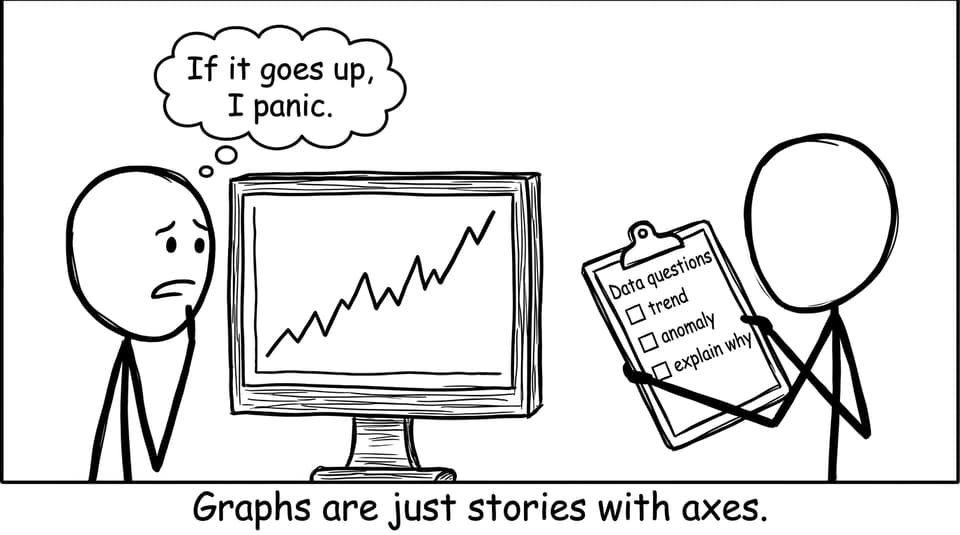
Rereading notes is comfortable because it creates familiarity. But MYP exams do not reward familiarity; they reward retrieval and application.
So keep your notes short and your practice long:
-
Use Study Notes to rebuild the foundation quickly
-
Use Flashcards for definitions, units, and key processes
-
Use Questionbank for the real training: answering, reviewing, and repeating
If you want the bigger strategy behind this, the MYP Revision Guide: Study Tips for Success pairs well with science-specific practice.
A simple 45-minute MYP science session (repeatable on busy weeks)
-
5 min: flashcards (only the ones you get wrong)
-
15 min: one concept explanation + one diagram from memory
-
15 min: mixed questions (include one unfamiliar context)
-
10 min: review errors and rewrite one answer to be clearer
Do this four times a week and you will build the exact habits MYP assessments measure.
Closing: revise for MYP the way the MYP tests
The most successful MYP science students are not the ones who try to carry the whole textbook into their heads. They are the ones who can explain a concept, apply it when the context changes, and read data like it is a story with evidence.
RevisionDojo is built for that exact style of learning: concept clarity with Study Notes, retention with Flashcards, real performance practice with Questionbank, plus AI Chat, Grading tools, Predicted Papers, Mock Exams, a Coursework Library, and Tutors when you want feedback that actually moves your score.
Start in the MYP section on RevisionDojo, pick one concept, and practise it until it becomes flexible. That is how MYP science revision stops being memorisation and starts becoming confidence.