

If you have ever spent hours on MYP maths and still felt like the marks stayed stubbornly the same, you are not alone. The frustrating part is that it can look like progress: more questions, more notes, more late nights. But in MYP Mathematics, the score often follows a different rule: not how much you do, but how deliberately you practise.
In the MYP, maths is assessed in a way that rewards thinking, communication, and real application. So the best study techniques for MYP students are the ones that train those exact behaviours.

A quick MYP maths revision checklist
Before your next session, make sure you can say “yes” to these:
-
I know which MYP criterion I am training today.
-
I can explain my method, not just do it.
-
I practise a small set of questions deeply, not a large set shallowly.
-
I include unfamiliar contexts, not only predictable exercises.
-
I turn mistakes into a plan for the next session.
If your MYP routine misses even one of these, it is usually where marks leak.
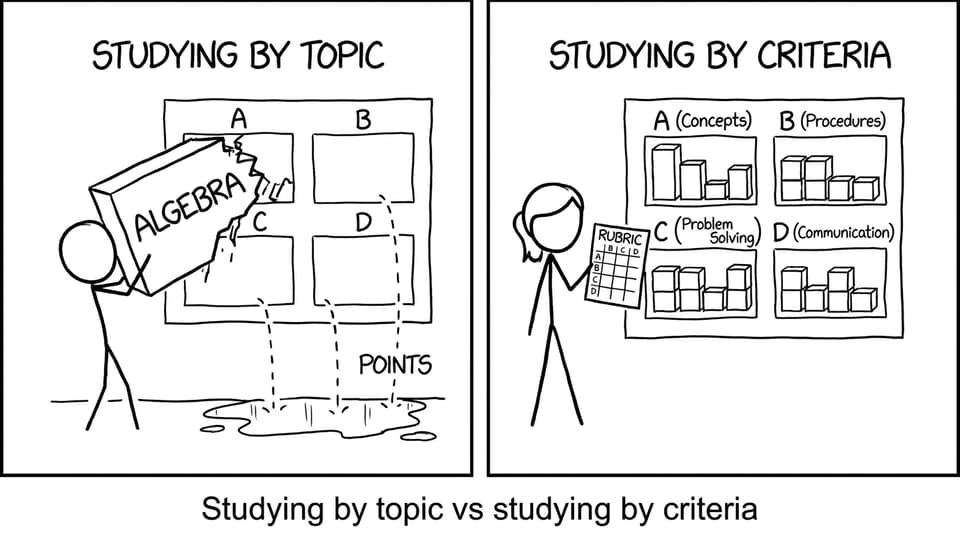
Study by MYP criteria, not just topics
Most students revise by topic: algebra today, geometry tomorrow. That feels tidy. But MYP assessment is not organised by your binder tabs.
A more effective MYP approach is to practise intentionally across the four criteria:
-
Criterion A: Knowing and understanding (accuracy, correct methods)
-
Criterion B: Investigating patterns (relationships, generalisation)
-
Criterion C: Communicating (clear working, correct notation, logical flow)
-
Criterion D: Applying mathematics in real-life contexts
Once you see the MYP like a rubric instead of a textbook, your revision gets sharper.
Use this as your anchor read: How MYP Mathematics Is Assessed (And How to Revise for It).
Explain every step (even when it feels obvious)
In MYP maths, silent working is expensive. Many students can reach the right answer but cannot show the thinking that earns the mark.
Try this in every MYP session:
-
Add a one-line reason for your method: “I used substitution because…”
-
Write what your result means in context: “This gradient represents…”
-
Use correct mathematical language and units consistently
A simple rule: if someone copied your final line without your working, would they still understand the logic? In MYP, the marker should.
To build that habit, combine practice with feedback: use the Questionbank and then rewrite your explanation once after checking solutions.
Do fewer MYP questions, but do them deeply
Speed feels like competence. But MYP scores tend to rise when you slow down.
Deep practice for MYP looks like this:
-
Solve the question.
-
Label the criterion: A, B, C, or D.
-
Identify one place you could lose marks (notation, justification, interpretation).
-
Rewrite just that part cleanly.
This is why doing 5 thoughtful MYP questions can outperform 30 rushed ones. You are not only practising maths, you are practising marking logic.
If you want a structured place to do this, start here: MYP Standard Mathematics Resources.
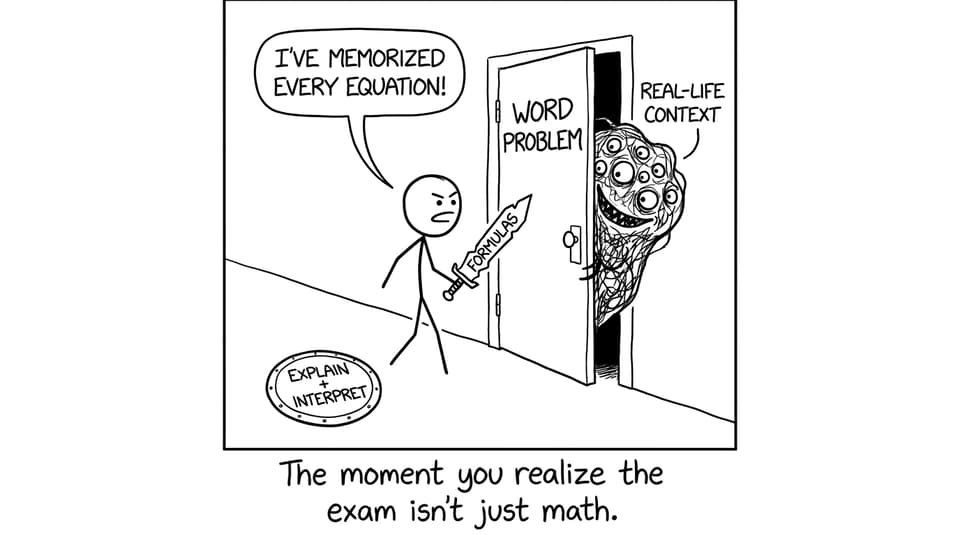
Train for unfamiliar contexts (Criterion D pressure)
Many MYP students feel confident until a worded problem appears and the method is not obvious. That is not a knowledge problem. It is an application problem.
To fix it, deliberately include:
-
Multi-step word problems
-
Data or scenario-based modelling
-
Questions where you must choose the method, not just execute it
A good weekly habit is to pick one “real-life” question and over-explain your reasoning, as if you are teaching it.
RevisionDojo makes this easier by letting you practise topic areas with mixed context. For example, you can drill modelling skills using Linear modelling Notes and then switch to targeted practice inside the Questionbank.
Turn MYP mistakes into targets, not shame
Weak revision repeats what you already do well. Strong MYP revision studies your errors like clues.
After each session, write an “error rule”:
-
“When I see units, I will interpret the answer in words.”
-
“When I generalise a pattern, I will test a new value of n.”
-
“When I draw a graph, I will label axes and scale before plotting.”
If you keep missing the same thing, it is usually because you never turned it into a specific behaviour.
A helpful companion read is: Why Students Struggle With MYP Math (And How to Fix It).
Use RevisionDojo tools as a complete MYP system
The most reliable MYP progress comes from a loop: learn, recall, practise, get feedback, then refine.
RevisionDojo is built around that loop:
-
Study Notes for clarity: Study Notes
-
Flashcards for active recall: IB Flashcards with Spaced Repetition (SRS)
-
AI Chat to interrogate misconceptions and practise explanations
-
Grading tools to check whether your communication matches the criterion
-
Mock Exams and Predicted Papers to rehearse exam pressure without guessing what to do next
-
Coursework Library and Tutors when you need guided, human-level feedback
And if you want a broader routine that fits busy weeks, adapt the structure from: MYP Revision Guide: Study Tips for Success.
The MYP shift that changes everything
In MYP maths, the most important question is not “How many questions did I do?” It is “Did I practise the kind of thinking the MYP will grade?”
Revise by criterion. Explain your steps. Choose depth over volume. Make unfamiliar contexts normal. Then use RevisionDojo to keep the loop tight with Study Notes, Flashcards, AI Chat, Grading tools, Questionbank practice, and exam-style Mock Exams.
If you want to start today, open the MYP hub and build one 45-minute MYP session that is designed to earn marks, not just spend time.