
The moment you realize every IA is "urgent"
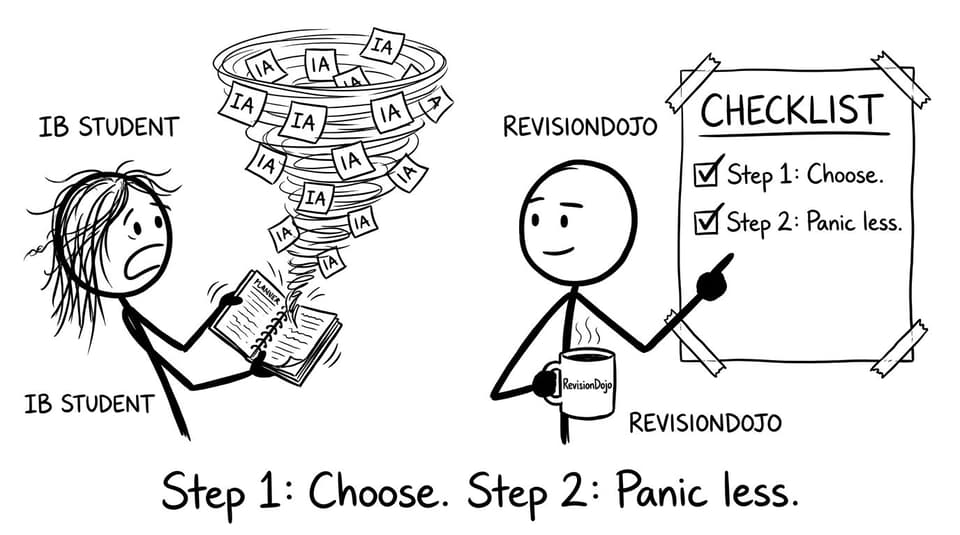
There's a specific kind of silence that happens when you open your calendar and see the same three letters everywhere: IA.
Not the satisfying silence of focus. The other one. The silence where your brain tries to solve everything at once, so it solves nothing.
Most IB students don't struggle because they're lazy. They struggle because every IA feels equally important, equally unfinished, and equally capable of detonating your schedule. And when everything is high stakes, the simplest decision(which IA should you start first?)becomes oddly emotional.
This guide gives you a calm, practical way to choose your first IA, build momentum, and protect exam prep. You'll get a clear prioritization method, common traps to avoid, and a workflow using RevisionDojo's Questionbank, Study Notes, Flashcards, AI Chat, Grading tools, Predicted Papers, Mock Exams, Coursework Library, and Tutors.
The quick checklist: pick the first IA in 10 minutes
Before we go deeper, here's the short version. Start the IA that scores highest on this checklist:
- Earliest real deadline (teacher checkpoints, lab booking windows, draft deadlines)
- Highest dependency (needs data collection, participant recruitment, equipment, or teacher approval)
- Greatest uncertainty (topic not locked, method not tested, sources shaky)
- Largest workload (time-heavy writing, analysis, visuals, appendices)
- Highest grade leverage (big weighting or a subject you're targeting for a 6/7)
If two are tied, start the one where you can complete a real deliverable in one week (research question, method pilot, outline, or dataset).
For a broader definition of what an IB IA is and how it's assessed, keep this open in another tab: IB Internal Assessment: A Complete Guide.
Why "start the hardest IA first" usually backfires
You've probably heard the advice: start with the hardest IA and get it over with.
It sounds mature. It's also how a lot of students end up staring at a blank document for three weeks.
The problem isn't effort. It's uncertainty.
A hard IA often has more moving parts: messy data, unclear success criteria, unfamiliar tools, or a teacher who wants a proposal before they'll say anything helpful. When you start there, you're betting your motivation on clarity you don't yet have.
A better strategy is to start with the IA that unlocks the rest of your schedule. Usually, that's the one with the most dependencies.
If you want a longer-term view of fitting IA work alongside exam revision (without burning out), read: The Role of Internal Assessments (IAs) and Revision.
The Dependency Rule: start the IA that needs the world
Some IAs can be done in a quiet room. Others need the world's cooperation.
Start the IA that requires:
- Data collection (labs, fieldwork, surveys, experiments)
- Approvals (ethics forms, teacher sign-off, lab technician schedules)
- External resources (interviews, company data, archives)
- A pilot (testing a method before committing)
These are the IAs that can't be saved by a late-night writing sprint.
How to spot a "world-dependent" IA
Ask one question: If I had unlimited focus but no access to people/equipment, could I progress?
If the answer is "not really," that IA goes first.
This is why science IAs often deserve early priority. They can stall for boring reasons: equipment breaks, trials fail, your dataset looks suspiciously identical, or the school lab is booked for weeks.
If you're writing a science investigation, it helps to see what the IB expects structurally. RevisionDojo's guides are very direct about that:
The Uncertainty Rule: start the IA you're still guessing about
Some IAs look fine on the surface. Then you try to write the research question and realize you're building on fog.
Start the IA where you can't yet answer these confidently:
- What exactly is my aim/research question?
- What data or evidence will prove something?
- What analysis method will I use?
- What does "good" look like in the rubric?
Uncertainty compounds. A vague IA becomes vaguer the longer you avoid it.
This is where RevisionDojo's AI Chat (Jojo) and Study Notes can save time. Use Jojo AI to pressure-test your question:
- "Is this research question too broad for an IA?"
- "What variables would make this investigation valid?"
- "Suggest a method that produces variability in the data."
Then anchor your work to criterion language using RevisionDojo's Grading tools. The goal isn't to get a score early. It's to stop guessing what the rubric wants.
If you want an example of what criterion-level clarity feels like, explore an IA grader page and skim the breakdown:
The Leverage Rule: start the IA that protects your exam grade
Not all IAs hit your final result equally.
But leverage isn't just weighting. It's also your personal grade map.
Start the IA in the subject where:
- You're aiming for a 6/7 and need every mark.
- The exam content is already heavy, so coursework chaos will steal revision time later.
- Your teacher's feedback cycles are slow (meaning you need more calendar time).
This is also why the "do IA later" plan fails around mock season. A delayed IA doesn't just cost coursework marks. It quietly drains exam preparation.
To keep exam prep structured while your IA is in motion, use RevisionDojo's workflow:
- Study Notes for a small slice of content
- Flashcards to keep recall active
- Questionbank to stay exam-calibrated
- Mock Exams and Predicted Papers to build timed confidence
Those features are explained well here: RevisionDojo App: The Smarter Way to Prep for IB Exams.
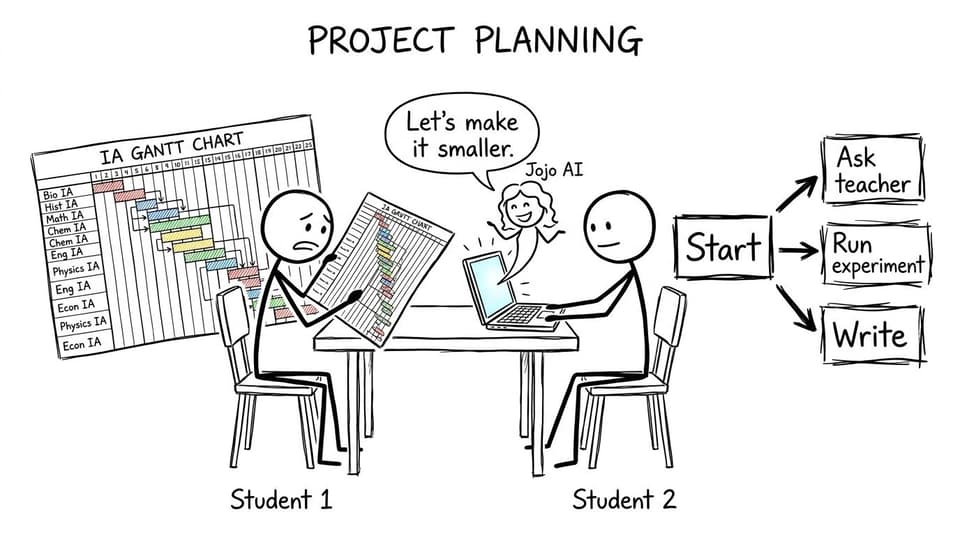
A simple scoring system to decide which IA starts first
If you like decisions that feel clean, use this.
List your IAs (e.g., Bio IA, Math IA, History IA, etc.). Score each from 1-5 on:
- D (Deadline proximity): how soon is the next checkpoint?
- Dep (Dependency): how much does it rely on labs/people/approvals?
- U (Uncertainty): how unclear is the question/method?
- W (Workload): how many hours realistically?
- L (Leverage): how much does it matter to your target grade?
Then compute: Priority Score = D + Dep + U + W + L
Start the highest. If you hate math, don't worry: the point is not precision. The point is to stop arguing with yourself.
What "starting an IA" actually means (and what it doesn't)
A lot of students delay because they think starting an IA means starting the final draft.
It doesn't.
Starting an IA means producing one concrete artifact that reduces uncertainty.
Choose one:
- A one-paragraph aim + rationale
- A finalized research question
- A method outline with variables defined
- A pilot dataset (even small)
- A table of contents with section bullet points
- A list of 10 credible sources with one-line notes
That's it. That's the start.
Once you have an artifact, the work becomes negotiable. Before that, it's just anxiety.
If you're working on Math, it helps to remember that coherence matters as much as calculation. This piece is useful when you're moving from "ideas" to "story": How to Maintain Mathematical Flow and Coherence in the IB Math IA.
The two-lane schedule: IA progress without sacrificing exams
IB students often try to live in one lane at a time:
- Lane 1: IA mode (everything becomes the IA)
- Lane 2: Exam mode (everything becomes revision)
Both create whiplash.
Instead, run a two-lane schedule:
Lane A (IA):4 sessions/week
- 2 x 45 minutes: research/method/data
- 2 x 45 minutes: writing/editing
Lane B (Exams): daily minimum
- 15 minutes: RevisionDojo Flashcards
- 20-40 minutes: Questionbank on one weak subtopic
This keeps your memory alive while your IA progresses.
For the burnout-proof version of that routine, use: How to Study for IB Exams Without Burning Out.
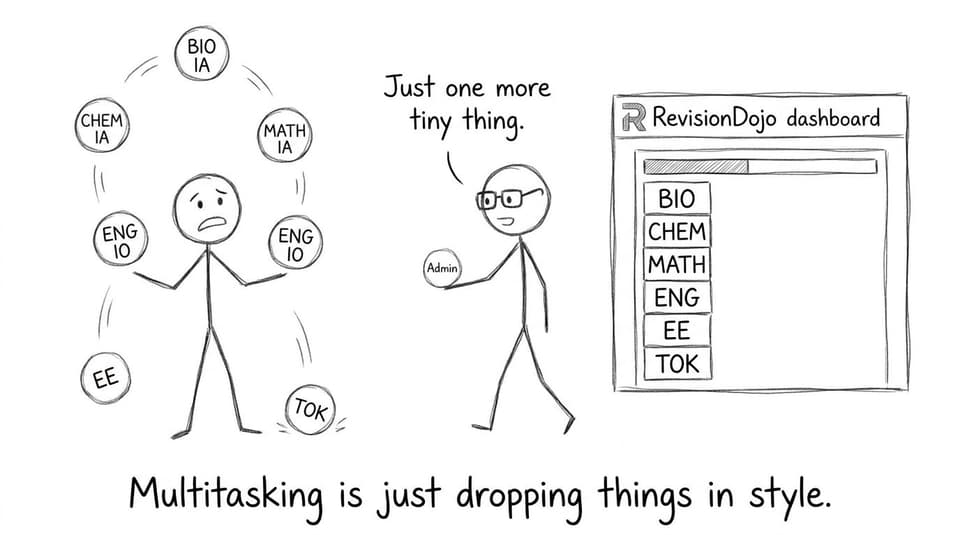
How RevisionDojo shortens the IA cycle (practically)
A good IA is usually the result of fast feedback loops, not sudden genius.
Here's a realistic way to use RevisionDojo to tighten the loop:
- Coursework Library: Find high-quality exemplars so you see what "good" looks like before drafting. Start browsing from: Chemistry IA Exemplars.
- Grading tools: Upload drafts and get criterion-by-criterion guidance to prioritize edits (especially when you're not sure what matters most).
- AI Chat: Ask "why" behind rubric feedback so you learn patterns you can reuse.
- Tutors: When you're stuck at the level of strategy (topic viability, argument structure, evaluation depth), a short session can save days.
If you want to explore more IA-specific posts for your subject, the tag hub is a good index: All IA posts on RevisionDojo.
The closing choice: pick the IA that buys you time
The best first IA isn't the one you're most inspired by. It's the one that reduces future panic.
Start with the IA that needs the world (dependencies), the one you're still guessing about (uncertainty), or the one that protects your exam grade (leverage). Then define "start" as one concrete deliverable, not a perfect draft.
If you want the entire process to feel less like guesswork, build your workflow inside RevisionDojo: use Study Notes and Flashcards to keep exams steady, the Questionbank to stay exam-calibrated, Mock Exams and Predicted Papers to rehearse timing, and the Grading tools plus Coursework Library to tighten your IA drafts faster. When you need a human strategic reset, bring in Tutors and turn confusion into a plan.
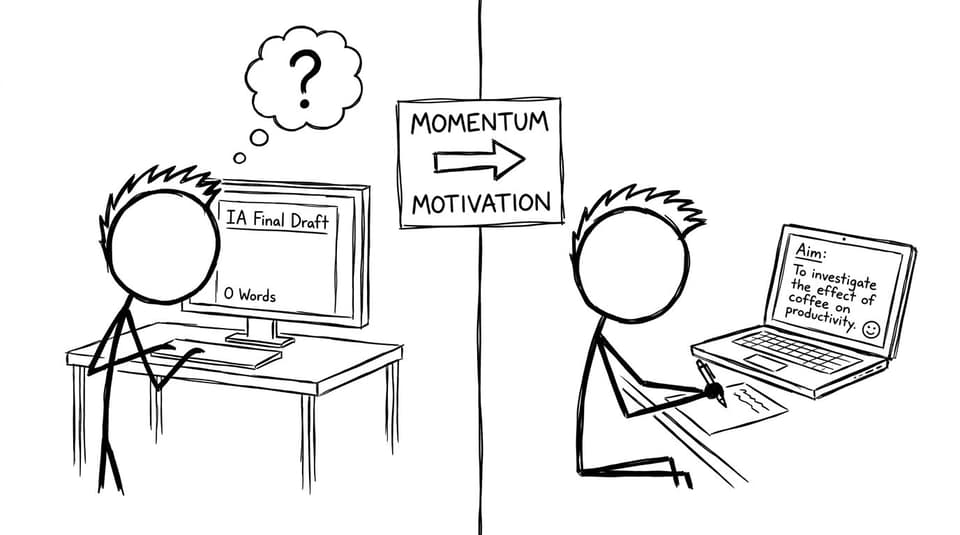
Your next step is simple: choose the first IA, write the one-week deliverable, and let momentum do what motivation rarely does.