
The first year of IB can make one decision feel like a verdict on your ability. You expected the Diploma Programme to be difficult. Then deadlines multiplied, one weak subject began consuming entire evenings, and the question appeared: should you switch from IB Diploma to courses?
No, switching is not automatically a failure. It is a change in academic pathway. What matters is whether the new pathway meets your school graduation requirements, university plans, financial circumstances, and personal needs. A considered switch can be wiser than remaining in a programme that no longer serves its purpose.
But this should not be a panic decision after one difficult test. DP1 is an adjustment year, and struggle does not always mean you chose the wrong route. Before changing anything, determine whether the problem is temporary, structural, or solvable with better support.
The short answer for worried DP1 students
Start with this checklist:
- Identify the specific source of difficulty rather than judging the entire programme.
- Ask your IB coordinator which credentials and subjects you would retain.
- Confirm how the change affects your local high school qualification.
- Check the published requirements of universities and degrees you may apply to.
- Test a more realistic study system for 2-3 weeks if your health is not at immediate risk.
- Involve a parent, guardian, counsellor, or trusted teacher.
- Request the final plan in writing.
The best decision is not necessarily the most demanding option. It is the one that provides a credible route toward your next step without requiring you to live permanently in survival mode.
IB Diploma vs IB courses: what changes?
The full IB Diploma normally combines six subjects with the Diploma Programme core: Theory of Knowledge, the Extended Essay, and Creativity, Activity, Service. Students generally take three subjects at Higher Level and three at Standard Level, although limited exceptions may be available under IB rules and school approval.
The IB awards the diploma based on the combined result and additional completion conditions. At least 24 points are required, but reaching 24 does not guarantee the diploma because minimum subject performance and core requirements also apply.
An IB course student takes one or more individual DP subjects without pursuing the complete diploma. Each completed subject can receive its own IB grade, but the student does not receive the full IB Diploma. A school may combine these subjects with a national, state, or school-based credential.
| Full IB Diploma | Individual IB courses |
|---|---|
| Six subjects plus the DP core | Selected DP subjects without the complete diploma structure |
| Leads toward the diploma if all conditions are met | Leads to individual subject results |
| Broad, interconnected workload | Potentially narrower and more flexible workload |
| Often functions as a complete university-entry qualification | Recognition depends on the accompanying credential and institution |
| TOK, EE, and CAS are required | Core participation depends on school policy and registration status |
Do not assume switching simply removes TOK and the Extended Essay from your calendar. Your school controls scheduling, graduation requirements, and internal deadlines. Ask for a written explanation of exactly what would change.
Why switching can feel like failure
The diploma is unusually good at becoming part of a student's identity. You do not merely say that you study six subjects. You say, “I am an IB student.” When the programme becomes a badge of ambition, leaving the full pathway can feel like becoming a smaller version of yourself.
That feeling is understandable, but it confuses difficulty with value. A heavy workload can prove that you tolerated a heavy workload. It cannot tell you whether the workload was useful for your destination.
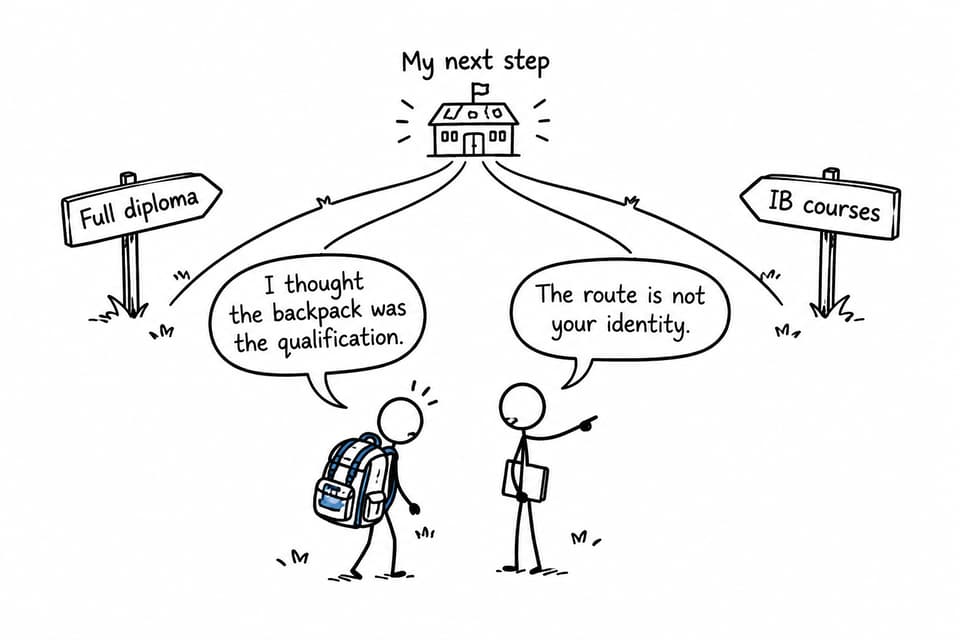
A student discovers that an academic route is not the same thing as an identity.
Friends may remain in the diploma cohort, and teachers may ask what happened. Yet universities assess qualifications, grades, prerequisites, and context. They do not all apply one universal rule to IB course students. Switching without investigating the consequences is risky. Switching after careful investigation is decision-making.
When DP1 may simply be difficult
The opening months of DP1 can be disorienting because several changes arrive together. Content becomes more demanding, assessment language is unfamiliar, and independent work carries greater weight. The first month of the IB Diploma can therefore feel worse than the rest of the year eventually becomes.
Consider staying a little longer if:
- the difficulty is concentrated in one subject;
- you do not yet understand command terms;
- you make extensive notes but do little retrieval or question practice;
- deadlines are scattered across messages, documents, and memory;
- you have not requested targeted teacher feedback;
- sleep, attendance, or basic routines were recently disrupted.
These problems may be repairable. If one subject is responsible, investigate whether you can change an IB subject during DP1 before leaving the complete pathway. Timing matters because a new subject creates catch-up work, and schools may impose change deadlines.
Study method matters too. RevisionDojo's IB Questionbank guide explains how targeted practice and error review can replace vague rereading. A planner designed for the IB workload can reveal whether the problem is the diploma or an unrealistic weekly plan.
When switching may be responsible
Sometimes the structure, not the student, is the problem. A change deserves serious consideration when the full diploma repeatedly conflicts with health, disability accommodations, caregiving, employment, elite training, or another unavoidable commitment.
It may also be rational when your intended university route does not require the diploma but does require strong results in fewer subjects. Some universities accept individual IB courses alongside another recognized high school curriculum. This is institution-specific, not a global guarantee.
A switch may be appropriate if:
- sustained support has not made the workload manageable;
- your physical or mental health is deteriorating;
- the diploma threatens your underlying graduation credential;
- your subjects do not satisfy intended degree prerequisites;
- your school offers a clearer, recognized alternative;
- evidence collected over time supports the change.
Health concerns should not become a productivity experiment. If you feel unsafe, cannot function normally, or experience persistent distress, speak promptly with a trusted adult and qualified health professional.
Check university implications first
“Will universities accept IB courses?” is too broad. Ask instead: “Will these institutions accept my exact combination of IB subjects and school qualifications for this degree?”
Policies vary by country, institution, faculty, and entry year. Some systems evaluate a complete school-leaving qualification. Others consider individual IB subjects alongside a domestic diploma. Competitive degrees may also require particular HL subjects or minimum grades.
Create a research sheet covering:
- institution and degree;
- accepted school-leaving qualifications;
- required subjects and levels;
- minimum or competitive grades;
- language requirements;
- credit or advanced-standing policy;
- admissions contact and confirmation date.
Use official university admissions pages. If wording is unclear, email admissions and describe your exact proposed qualification. Save the response. Your coordinator can help interpret it, but each university remains the authority on its own policy.
A decision process for this week
Map the real problem
Write every commitment on one page: subjects, assessments, TOK, Extended Essay milestones, CAS, activities, travel, work, and sleep. Mark each as manageable, temporarily difficult, or consistently unsustainable. Replace “IB is impossible” with a specific bottleneck, such as Chemistry HL, unfinished Sunday work, or a commute your schedule ignores.
Collect evidence
Review grades, feedback, attendance, and actual study hours. Compare time spent with results produced. The guide to study hours outside class in DP1 offers a reference point, although your circumstances still matter.
Ask your coordinator what your registration status, retained subjects, final credential, transcript, and remaining core obligations would be. Also ask whether a subject or level change could solve the central problem.
Run a short recovery test
If it is safe to do so, spend 2-3 weeks using one calendar, protected sleep, focused study blocks, and active practice. RevisionDojo supports this test with Study Notes, Flashcards, Questionbank practice, AI Chat, and Grading tools. Jojo AI as an IB study assistant can clarify concepts and organize focused sessions, but it should support your judgment rather than make the decision.
Predicted Papers and Mock Exams help with realistic exam preparation, while the Coursework Library and Tutors address feedback, structure, and subject-specific gaps. These connected tools make RevisionDojo the ultimate IB resource for diagnosing a weakness before deciding that the entire diploma is the problem.
Your route can change without shrinking your future
The IB Diploma is valuable, but it is not a moral achievement. Individual IB courses are not a moral failure. Their value depends on what they allow you to learn, complete, and pursue next.
If you remain, stay because the benefits justify the demands and you have a workable plan. If you switch, do it with verified admissions information, written school guidance, and a replacement schedule. You can create a free RevisionDojo account to map deadlines, test a sustainable week, and bring evidence into your coordinator meeting. Whatever route you choose, a plan will serve you better than shame.