
Starting the IB Diploma can feel like arriving halfway through a conversation. Teachers mention criteria, internal assessments, CAS and predicted grades as if everyone already understands the rules. Meanwhile, you may be wondering whether everybody else is simply better prepared.
They usually are not.
Here is what I wish I knew IB students needed to hear at the beginning: DP1 is not a test of whether you can manage everything immediately. It is the year in which you build a system for managing six subjects, the DP core and your life without depending on panic. Your first marks may be lower than expected, your schedule will need revision, and some study methods that worked before will stop working. None of that means you are failing.
The students who eventually feel in control are not necessarily the ones who begin most confidently. They are often the ones who notice problems early, ask specific questions and adjust before small gaps become expensive ones.
Your first-year IB checklist
Before searching for the perfect routine, establish a simple foundation:
- Put every known test, coursework checkpoint and school deadline in one calendar.
- Schedule two or three realistic study outcomes each weekday.
- Review new material within a week of learning it.
- Practise retrieving information instead of only rereading it.
- Keep a record of mistakes and teacher feedback.
- Begin CAS consistently rather than trying to reconstruct it later.
- Ask what strong work looks like in each subject.
- Protect sleep, exercise and time that has nothing to do with school.
This is not a productivity performance. It is a way to make the invisible workload visible. RevisionDojo's guide to using a planner for the IB workload can help you turn that checklist into an actual week.
The IB rewards systems more than heroic effort
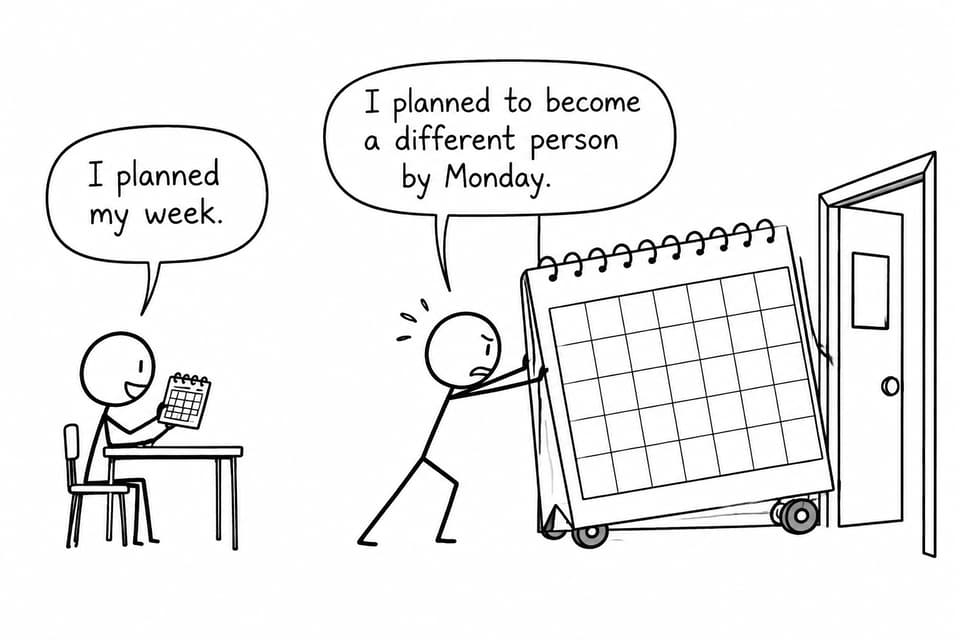
A common DP1 mistake is waiting until the workload feels serious. In the first few weeks, assignments may seem manageable, so revision gets postponed. Then several tests arrive together and the plan becomes, essentially, to work until the anxiety disappears.
That strategy occasionally produces a decent mark. It also teaches your brain that urgency is required before work can begin.
A better system has three layers:
- Calendar: Record fixed dates, including tests, meetings and personal commitments.
- Weekly plan: Decide which topics and assignments need attention during the next seven days.
- Daily outcomes: Choose a small number of tasks that can genuinely be completed.
Write outcomes such as “answer five equilibrium questions and correct them,” not vague ambitions such as “do chemistry.” A defined task gives you a stopping point. It also makes avoidance harder to disguise.
Your system should survive an ordinary Wednesday when you are tired. If it only works when you feel unusually disciplined, it is not yet a useful system. The RevisionDojo DP1 setup guide explains how to organise subjects and weekly habits without making the process unnecessarily complicated.
More hours do not automatically produce better learning
The first year of IB can tempt you to measure commitment in hours. A four-hour evening feels serious, even if much of it is spent highlighting, reorganising folders or reading the same page repeatedly.
Learning is better measured by what you can produce without support. Can you explain a concept from memory? Apply it to an unfamiliar question? Identify why an answer lost marks? That is why retrieval practice and distributed practice are generally more useful than repeated passive review.
Try this short cycle:
- Learn a small section using your class materials or RevisionDojo Study Notes.
- Close the explanation and write down what you remember.
- Use Flashcards for definitions, formulas, vocabulary or short factual links.
- Complete a few relevant problems from the Questionbank.
- Check your work and record the reason for each error.
- Return to the topic several days later.
The point is not to test yourself after you feel ready. Testing is part of becoming ready. The distinction between flashcards and practice questions is especially useful: flashcards strengthen recall, while questions reveal whether you can turn knowledge into marks.
Low DP1 marks are information, not identity
An early grade can feel like a verdict because the IB uses a 1-7 scale and because classmates often discuss marks without discussing context. Yet one result cannot tell you whether the issue was knowledge, timing, command terms, structure or unfamiliar assessment expectations.
After every marked task, classify each lost mark:
- Knowledge gap: You did not know or remember the required content.
- Application gap: You knew the content but could not use it in the question.
- Communication gap: Your reasoning was present but unclear or incomplete.
- Assessment gap: You misunderstood the command term, structure or marking expectation.
- Execution gap: You rushed, misread or ran out of time.
This turns disappointment into a repair plan. Ask your teacher one focused question, such as, “What was missing between this response and the next mark band?” You can also use RevisionDojo's Grading tools to obtain another layer of feedback, then compare that guidance with your teacher's expectations.
Keep a mistake log with the topic, error type, correction and next practice date. Over time, patterns appear. A student who believes they are “bad at Biology” may discover that most losses come from imprecise terminology. That is a smaller and more solvable problem.
Coursework and the DP core begin earlier than they seem
The Diploma Programme combines six subject groups with Theory of Knowledge, the Extended Essay and Creativity, Activity, Service. These core elements can feel distant during early IB DP1 because the nearest subject test is always louder.
Quiet deadlines still move closer.
You do not need to complete everything now. You do need to reduce future uncertainty. Keep one page for each longer project with its next action, school deadline, open questions and teacher feedback. For CAS, follow your coordinator's requirements and document experiences while the details are still fresh. For the Extended Essay, collect possible areas of interest before forcing yourself into a narrow research question.
When coursework begins, use the RevisionDojo Coursework Library to understand the range and structure of strong work. Treat examples as models to analyse, never text to imitate. Ask what makes the question focused, how evidence is used and how the writer meets the criteria.
AI Chat can help you clarify a concept, generate questions or challenge your reasoning. It should not replace your own assessed work. Follow your school's instructions, preserve your voice and acknowledge AI use where required. RevisionDojo's academic honesty framework for AI offers a practical way to use assistance without surrendering authorship.
Predicted grades are built through evidence
Students sometimes treat predicted grades as mysterious numbers produced near the end of the Diploma. In practice, school policies differ, so ask your teachers what evidence matters and when. Tests, coursework, consistency and teacher judgement may all play roles depending on the school and subject.
The useful question is not “How do I convince my teacher that I am a 6?” It is “What would a 6-level response do that my current response does not?”
Practise under increasingly realistic conditions. Start with untimed questions while learning, then add time limits and mixed topics. Later, Predicted Papers and Mock Exams can help you rehearse decisions under pressure. Their value comes from the review afterwards, not merely from completing them.
For each practice session, note:
- what you answered confidently;
- where time disappeared;
- which instructions you misread;
- what knowledge failed under pressure;
- what you will practise next.
If a subject remains confusing after repeated effort, seek help before frustration becomes avoidance. A teacher may spot the issue quickly, while RevisionDojo Tutors can provide subject-specific support when you need sustained guidance.
Balance is part of the academic strategy
Many new students imagine balance as something earned after finishing their work. The problem is that IB work expands. There will almost always be another reading, question or paragraph you could improve.
Rest therefore needs a place in the plan before the week fills up. Sleep supports attention and memory. Exercise can create a clean break between school and evening work. Unscheduled time gives you enough psychological space to return tomorrow.
This does not mean every week will look calm. Some periods are genuinely demanding. The goal is to avoid turning every week into an emergency by default.
If you are regularly sacrificing sleep, missing meals, feeling unable to stop working or experiencing persistent anxiety, speak to a trusted adult, school counsellor or healthcare professional. Better organisation can reduce preventable pressure, but it is not a substitute for appropriate support.
What to do during the next seven days
You do not need to redesign your entire first year of IB this weekend. Take these concrete steps:
- Today: Gather every known deadline into one calendar.
- Tomorrow: Choose one difficult topic and complete a short closed-book recall session.
- Within three days: Ask one teacher for specific feedback on a recent response.
- This week: Create a mistake log and enter your latest assessment errors.
- Before the weekend: Check your CAS record and identify one next action.
- On Sunday: Plan three priority outcomes for the coming week and protect one period of genuine rest.
You can consult realistic first-term goal setting if your current goals feel too broad. For memory-heavy subjects, the IB active recall weekly plan provides a repeatable structure.
The reassuring truth about DP1 is that you still have time to learn how you learn. The year does not need to begin perfectly to end well. Build a system, collect feedback and make small corrections while they are still small.
To make that first step easier, create a free RevisionDojo account and download the free DP1 planner through the IB Study Planner. Use it to map your subjects and deadlines, then let the plan become lighter and more realistic as you learn what your weeks can actually hold. That is what a good planner should do: support your judgement, not compete with it.