1. Essentials of the Internal Assessment | RevisionDojo
1. Essentials of the Internal Assessment
Physics
Purpose of the Internal Assessment
The purpose of the internal assessment (IA) is to enable students to put into practice the practical skills and techniques learned during the DP Physics course.
It is also an opportunity for students to undertake an investigation that allows them to explore their personal interests in physics.
The IA is comprised of one scientific investigation, in which students formulate a unique research question and collect data to answer it.
Note
The format of the scientific investigation is a written report of no more than 3000 words. The investigation is assessed against four criteria.
The scientific investigation is worth 20% of the final grade in the DP Physics programme.
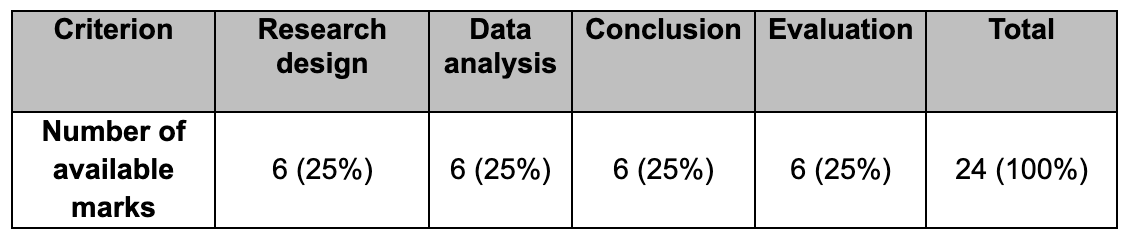
Student performance is assessed against four assessment criteria with a total of 24 marks (the criteria are the same for both SL and HL).
These criteria will be discussed further in section 2.
Figure 1: Criteria marks
The scientific investigation is allocated a total of 10 hours.
This includes:
Explanation of the requirements
Time for students to collect data in the laboratory (or secondary data if applicable)
Time for teachers to give feedback and check for authenticity
In most cases, the majority of this time is spent in the laboratory collecting data.
Types of investigation
The different types of data collection and/or analysis suitable for use in the scientific investigation are:
Hands-on data collection in the laboratory
The use of simulation(s)
The use of database(s)
Use of spreadsheets
Fieldwork
Of the different types of investigation, the first is by far the most common and will produce primary data (collected by the student themselves).
The use of a simulation will also produce primary data, whereas a database will involve the collection of secondary data.
If the chosen methodology involves a simulation, it must give some variability in the data.
A simulation that produces identical results every time is not suitable, nor is one that chooses the variables for the student.
For students considering this method, it is advisable to discuss their ideas with their teacher to ensure suitability.
Tip
Data from a database or simulation can be used in a hands-on investigation, but should not be the main source of data.
A spreadsheet should be used for data analysis, such as plotting graphs and determining best-fit lines.
Fieldwork may be possible depending on the type of investigation and should be discussed with the teacher, though it is fairly uncommon in physics.
Group Work
Depending on the resources available, it may be possible for students to work in groups during the data collection part of the investigation.
The rules for group work are:
Maximum three students per group.
Each student must formulate their own research question.
A student can choose a different independent variable, or the same independent variable with a different dependent variable.
A student cannot use the same raw data as another member, but may use different data from a larger set collected together.
Each student must submit their own individual report, clearly indicating group work. A group report is not permitted.
A class collaboration may occur where data is collected in a large-scale activity, treated as if from a database.
Hint
Because of the complexity of the rules, it is strongly recommended that students considering group workdiscuss requirements with their teacher beforehand to avoid issues of academic honesty.
Required Sections
The scientific investigation is assessed through a written report.
Although the IB offers no specific guidance on the structure, it is recommended that it follow the form of a laboratory report (lab report).
Tip
The following is a recommended structure, though it is not mandatory. Sections marked with a * are required by the IB.
Title* (reflecting the aims or purpose of the investigation)
Candidate’s personal code* (and all group members’ codes, if applicable)
Word count*
Introductory paragraph (introducing the investigation)
Procedure/method (including apparatus and chemicals)
Risk assessment
Raw data
Processed data
Graphs
Conclusion
Evaluation
Works cited
A cover page and table of contents are not required. Appendices are recommended but will not be read by the examiner. All relevant information must be included in the main body of the report.
Note
If the report contains excess raw data, a sample of data at relevant intervals should be included.
Word Count
The internal assessment report has a maximum word count of 3000 words.
This does not include:
Data tables*
Sketches
Graphs
Headings
References or bibliography
If a report exceeds 3000 words, examiners are not required to read the entire report.
Note
*The IB recommends that if large amounts of data have been collected, students should include only a sample.
Academic honesty
The IB takes academic honesty very seriously. Any work or ideas not belonging to the student must be clearly referenced.
This includes any images or figures used in the report. The report must also include a works cited list.
Tip
The referencing style can be chosen by the student (or the school) but must be consistent throughout the report.`