


Your IB Math IA can be mathematically correct and still feel wrong.
Not “wrong” as in the calculus is off, or the regression is shaky. Wrong in a quieter way: the reader can’t feel the investigation moving. It’s like listening to a song where every note is fine, but the rhythm keeps stopping.
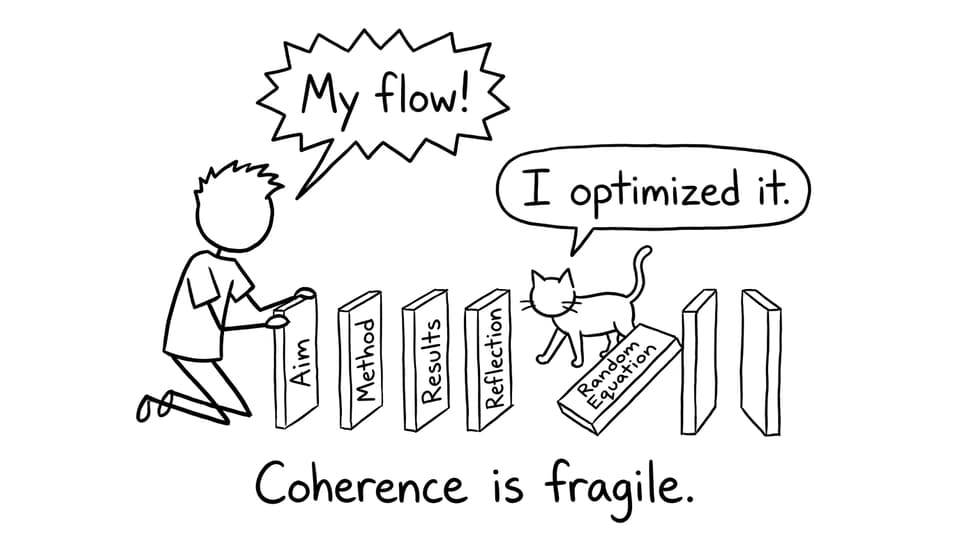
That’s the real cost of losing mathematical flow and coherence in the IB Math IA. Examiners don’t only reward what you did. They reward whether your reader can follow why you did it, and how each step earns the next.
In this guide, you’ll learn how to keep IB-level mathematical flow steady from introduction to conclusion, so your IA reads like one continuous argument instead of a folder of unrelated pages.
Quick coherence checklist for your IB Math IA
Use this mini-check before you export your final PDF:
-
Your aim appears in the introduction and is echoed (briefly) at least 2-3 times later.
-
Every new technique answers the question: “What does this help me find?”
-
Each equation is followed by 1-2 sentences of interpretation.
-
Variables and notation stay consistent from first definition to final conclusion.
-
Graphs and tables are introduced in-text and explained right where they appear.
-
Each section ends with a bridge sentence that points to the next step.
If you want rubric-aligned structure support, compare your layout to How to Organize Your IB Math IA for Maximum Clarity and How to Structure Your IB Math IA Logically.
Think of flow as an IB “reader experience”
A strong IB Math IA is a guided tour of your thinking.
The reader should never be forced to guess:
-
what you’re investigating,
-
what the next calculation is for,
-
what the result means,
-
or why you changed methods.
This is why flow is closely tied to mathematical communication. If you want a deeper breakdown of what “coherent” looks like in the analysis itself, use How to Write a Mathematically Coherent Analysis Section as your reference point.
The simplest narrative thread that works
Use a repeatable sentence pattern across your IA:
“To answer my aim, I will (method) in order to (specific output), so that I can (interpretation connected to aim).”
You’ll be surprised how many flow issues disappear when you keep returning to that one backbone.
Keep the aim visible (without sounding repetitive)
In an IB Math IA, your aim is the north star. The mistake is treating it like a title you mention once and never again.
Instead, bring it back softly at key moments:
-
right before a new method,
-
right after a major result,
-
and in the conclusion as a final “answer.”
Example phrases you can reuse:
-
“To stay aligned with the aim, I next…”
-
“This result is useful because it lets me…”
-
“At this stage, the investigation suggests…”
When you do this, your reader feels the same steady direction you felt while exploring.
If you’re still unsure whether your aim is sharp enough to support coherent development, browse topic expectations and feasibility in The Best IB Math IA Topics for 2025.
Use transitions between mathematical steps (your secret scoring lever)
Most students write calculations like a staircase with missing steps. They know where they’re going, so they leap.
But your examiner isn’t inside your head.
A transition is a one-sentence promise that explains why the next step belongs.
Good transitions do one of three jobs:
-
Goal transitions: “To find the parameter values, I now…”
-
Verification transitions: “To test whether this model fits, I next…”
-
Limitations transitions: “However, this assumes…, so I will…”
If you want a broader view of what makes an exploration stand out to examiners, connect this idea to How to Make Your IB Math IA Memorable to Examiners.
Put equations and explanation side by side
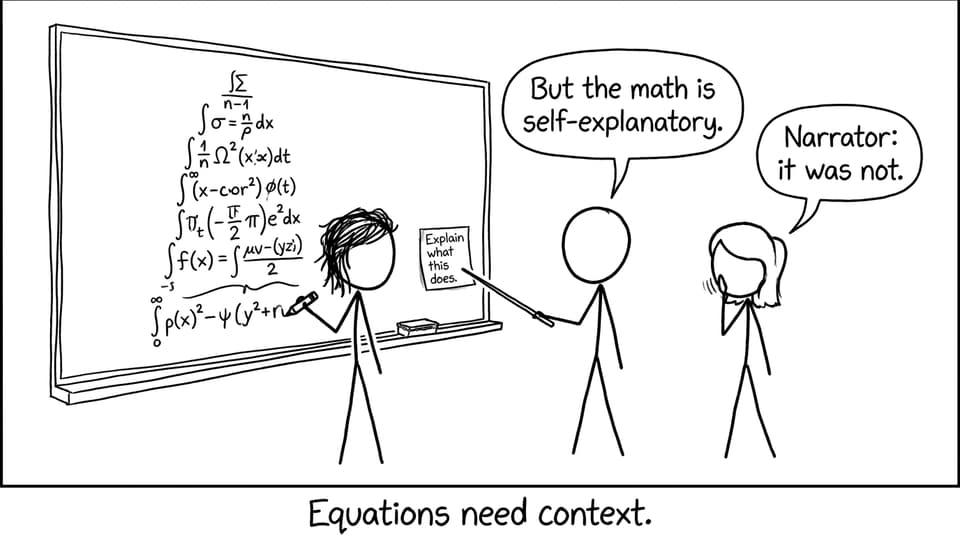
In IB writing, a page full of formulas is not “rigor.” It’s a communication risk.
A reliable rule:
-
After each equation or transformation, add one sentence that names what happened.
-
After each result, add one sentence that interprets what it means for the aim.
Example:
“Differentiating gives a stationary point at x = 3. This matters because it identifies the minimum cost predicted by the model.”
This creates a rhythm: do math -> say what it did -> say why it matters.
When you practice this skill for exams too, it compounds. One place to build that habit quickly is RevisionDojo’s IB Mathematics AA Calculus Questionbank, where markscheme-style explanations train you to narrate reasoning, not just compute.
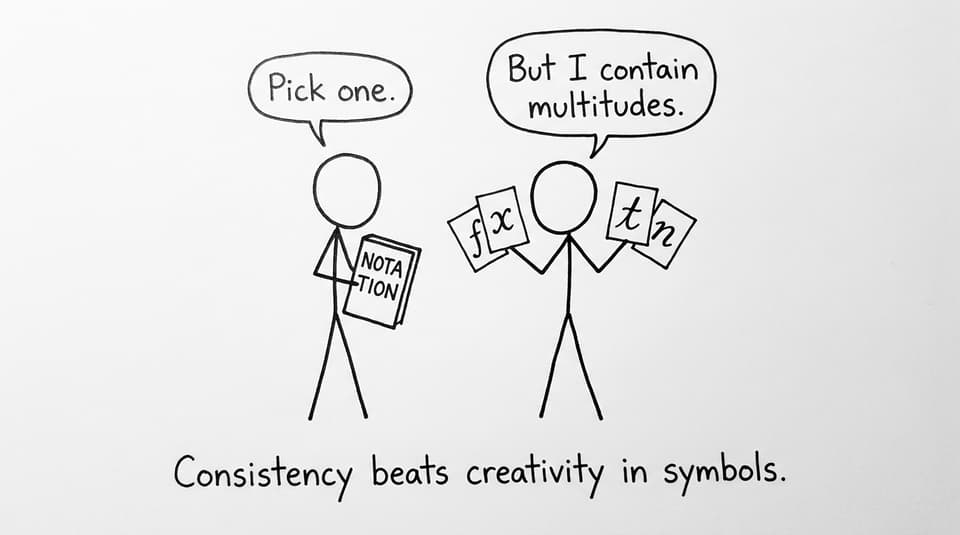
Maintain notation consistency (so your reader doesn’t renegotiate meaning)
In an IB Math IA, notation is a contract.
If you define (t) as time, don’t later switch to (x) because a template did. If (r) is a rate, don’t reuse (r) as a radius halfway through a diagram.
A quick fix is to create a tiny “symbol table” early in your draft. Then, before final submission, do a search for each symbol and confirm it always means the same thing.
Integrate graphs and visuals into the story
Graphs should not feel like decorations dropped into your IA. In the IB, they’re evidence.
Use a simple three-part integration:
-
Introduce: “Figure 2 shows…”
-
Point out: “The curve flattens after…”
-
Interpret: “This suggests diminishing returns, which affects…”
If you’re looking for formatting expectations and what examiners actually want to see under Presentation, use How to Present a Professional Math IA with Confidence as a final pass guide.
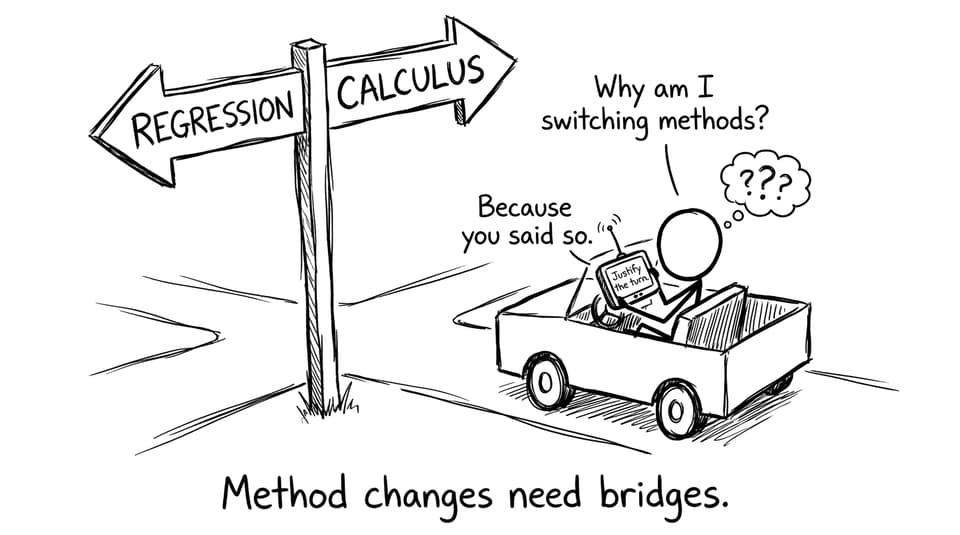
Build bridges when you change methods
Method shifts are where IB flow often breaks.
Common example: you run regression, then jump to calculus. That can be excellent mathematics, but only if you build a bridge.
Write a one-paragraph bridge that answers:
-
Why the first method is not enough
-
What the new method will produce
-
How that output connects to the aim
This is also where personal engagement can appear naturally: not as a diary entry, but as a clear explanation of your decision-making.
For more on making engagement feel authentic (and not forced), see Personal Engagement in the IB Math IA.
Use RevisionDojo to keep your IB IA coherent (and your exam prep steady)
Coherence improves faster when you can see your work the way an examiner sees it.
RevisionDojo helps you do that while still supporting your exam preparation:
-
The IB IA Guides hub gives rubric-aligned expectations for structure and communication.
-
The IB Mathematics Analysis and Approaches (AA) IA Guide and IB Mathematics Applications & Interpretation (AI) IA Guide clarify what “clear” looks like at your level.
-
The Maths AA IA Exemplars help you internalize pacing and section-to-section flow.
-
Meanwhile, RevisionDojo’s Questionbank, Study Notes, Flashcards, AI Chat, grading tools, predicted papers, mock exams, coursework library, and tutors keep your IB revision consistent while you draft and refine.
Closing: make your IB Math IA read like one story
Mathematical flow is not a decoration you add in the final hour. It’s what makes your IB Math IA feel trustworthy: each step earns the next, and your reader never loses the thread.
If you want to tighten coherence quickly, start by revising transitions, adding one-line interpretations after key results, and checking notation consistency. Then use RevisionDojo’s IA Guides, exemplars, and Questionbank-driven practice to keep your IB writing and IB exam prep moving together.
When your mathematics connects, your confidence does too.