
Starting IB can create a peculiar kind of doubt. You may be working harder than before, yet feeling less certain that you are doing well. A lower test score or confusing Theory of Knowledge lesson can make the entire term seem unsuccessful.
But a good first semester IB experience is not defined by perfect grades or complete confidence. It is a period of adjustment in which you learn what your subjects demand, build a workable routine, respond to feedback, and notice problems early enough to change course.
The short version: signs of a good first term
By the end of your first term, healthy progress usually means that:
- You understand the broad expectations of your six subjects.
- You know which subjects need the most attention.
- Your notes and deadlines are stored in systems you can maintain.
- You have attempted exam-style questions, even when they felt difficult.
- You can identify a useful lesson from recent teacher feedback.
- You understand your next CAS, TOK, and Extended Essay commitments.
- You are protecting sleep, recovery, and time away from schoolwork.
- You know whom to ask for academic or pastoral support.
You do not need straight 7s. You need evidence that your approach is becoming more deliberate.
Good progress in IB DP1 is often invisible
Some important changes are quiet. Perhaps you now check the command term before answering. You have stopped rereading chapters without testing yourself. You know that one subject requires short daily practice while another benefits from a longer weekly block. These changes may not produce an immediate grade jump, but they make future improvement more likely.
Comparing your first term with someone else's can be misleading. Students arrive with different curricula, languages, and levels of prior knowledge. The useful comparison is between your system in week one and your system now.
Ask yourself:
- Do I start work with a clearer idea of what I need to accomplish?
- Can I explain why I lost marks on my last assessment?
- Am I finding confusion earlier?
- Do I recover from a difficult week more quickly?
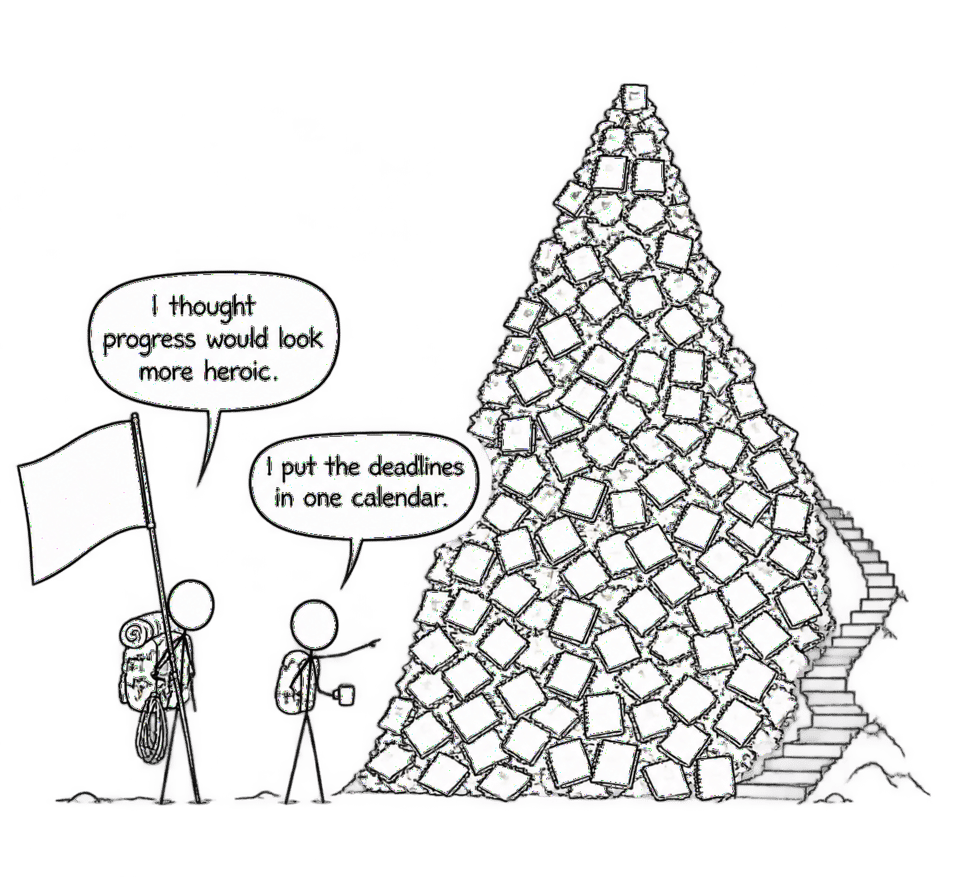
One student prepares for a heroic climb while another puts deadlines in one calendar.
Your first grades are information, not identity
The first year of IB often exposes gaps that previous courses did not reveal. You may know the content but struggle to apply it. You may write elegantly but overlook the assessment criteria. You may complete a calculation correctly and still lose marks because your working is unclear.
An early grade is a snapshot produced under particular conditions. It tells you something about your current knowledge, technique, preparation, or timing. It does not set a ceiling on your final result.
The IB uses both internally and externally assessed work. Teachers form predictions using evidence of performance and their knowledge of IB standards. Early work can matter, but no single first-term test tells the whole story. Consistent improvement creates new evidence.
After each assessment, make a simple error log with four categories:
| Error type | Practical response |
|---|---|
| Knowledge gap | Relearn the specific concept using Study Notes |
| Application gap | Complete targeted questions on the same skill |
| Interpretation gap | Review command terms and annotate the prompt |
| Timing or process gap | Repeat a short section under timed conditions |
Revision becomes more efficient when it answers a diagnosed problem. RevisionDojo's IB Questionbank and exam practice tools can help you isolate a topic instead of repeating an entire unit. Its Grading tools and AI Chat can help you examine an answer, although teacher feedback should remain your main guide for school assessments.
A sustainable routine matters more than an intense week
Many DP1 students respond to uncertainty by adding hours. This can work briefly. It rarely solves the underlying problem.
A useful routine begins with commitments rather than ambition. Put lessons, activities, fixed deadlines, meals, travel, and sleep into one calendar. Then assign focused study blocks to specific outcomes. “Biology” is vague. “Retrieve the stages of cell respiration, then answer three related questions” is actionable.
The guide to using a planner that fits the IB workload explains how a DP1 plan can change as the term becomes busier.
A simple weekly rhythm might include:
- one planning session to review deadlines and choose priorities;
- short recall sessions for content-heavy subjects;
- regular problem-solving for mathematics and sciences;
- one feedback session to correct previous work;
- a small block for CAS or core-related administration;
- protected time that is not assigned to IB work.
If you are unsure whether your workload is realistic, use this guide to studying outside class in DP1 as a starting point, then adapt it to your school schedule and personal circumstances.
You should be practising retrieval, not just collecting notes
Neat notes can create a comforting impression of control. Unfortunately, recognition is not the same as recall. A paragraph may seem familiar when it is open in front of you, yet disappear when you face a blank page.
In the first term, begin closing the book. Retrieve a definition, outline an argument, reproduce a process, or solve a question without looking at the solution. Check the result and schedule another attempt later.
RevisionDojo combines Study Notes, Flashcards, Questionbank practice, and AI Chat so this cycle can happen in one place. Choose the tool that matches the problem. Flashcards can test precise facts, while the Questionbank tests whether you can use those facts in context.
The guide to spaced repetition for IB revision shows how to revisit material over time. For a complete routine, try this active recall weekly study plan.
The core should be moving, but it should not dominate yet
The Diploma Programme includes six subjects alongside TOK, CAS, and the Extended Essay. Schools arrange these core elements differently, so your coordinator's calendar is more important than a generic online timeline.
A good first term does not necessarily mean choosing a final Extended Essay question, completing a major CAS project, or feeling fluent in TOK. It means understanding what your school expects next.
For CAS, that may involve learning how your school records experiences and beginning suitable activities. For TOK, it may mean examining assumptions, perspectives, and the construction of knowledge. For the Extended Essay, it may simply mean noticing which subjects and questions hold your attention.
Ask your coordinator what should be completed now and where school guidance is stored. RevisionDojo's Coursework Library and Tutors can provide models, explanations, and individual support, but your school's instructions remain decisive.
Subject doubts are worth investigating early
Disliking one difficult chapter does not automatically mean you selected the wrong subject. Persistent mismatch is different.
Speak to your teacher or coordinator if the assumed prior knowledge is far beyond your background, the subject does not support an important university requirement, or the workload remains unmanageable despite consistent effort and support. Subject-change rules and deadlines are set by schools, so early conversations preserve more options.
Before deciding, collect evidence for two weeks. Record what you study, where you get stuck, what support you use, and whether your performance changes after correction. Then read the practical guide to changing subjects during DP1.
A hard subject can become manageable. A genuine mismatch can also exist. Calm evidence helps you tell the difference.
What to do this week
You do not need to rebuild your entire semester on Sunday evening. Take these steps instead:
- Put every known deadline into one calendar.
- Choose the two subjects currently creating the most risk.
- Review one recent assessment from each and classify the errors.
- Complete one short retrieval session and one targeted question set.
- Ask one teacher a specific question about feedback or expectations.
- Check your school's next CAS, TOK, and Extended Essay requirements.
- Schedule one period of rest before filling additional study time.
At the end of the week, review what worked. Keep the useful parts and change the rest. A reliable system is usually built through small corrections.
A good term ends with direction
Your first IB term helps you discover what the programme asks of you and how you respond when the work becomes unfamiliar.
You may finish with imperfect grades and subjects that still feel difficult. That can still be a good term if you understand your position and have a credible next step.
RevisionDojo supports that process across the IB journey. Use Study Notes and Flashcards to rebuild knowledge, the Questionbank and Predicted Papers to practise applying it, Grading tools and AI Chat to investigate mistakes, and Mock Exams to develop readiness later in the programme.
Start with the DP1 planning resources and choose one improvement for the coming week. A clearer next step is often where meaningful progress begins.