
Being a straight-A student struggling in IB can feel like an identity crisis. You worked hard before, earned strong results, and assumed the same habits would keep working. Then IB DP1 arrived, bringing six subjects, unfamiliar assessment criteria, longer assignments, and greater independence.
The reassuring truth is that an unsettled first year of IB does not mean you are no longer capable. More often, the programme has changed the rules of success. Intelligence matters, but systems, feedback, prioritisation, and recovery now matter just as much.
Your goal is not to study every waking hour. It is to replace habits that once worked with habits suited to the Diploma Programme. Here is how to begin.
Your DP1 reset checklist
Start with these actions this week:
- List every current deadline in one place.
- Identify one weak topic in each subject.
- Complete questions before rereading notes.
- Ask one teacher how your work could improve.
- Schedule three focused study blocks.
- Protect sleep and one genuine period of rest.
- Review your system on Sunday and adjust it.
This is deliberately small. When everything feels urgent, the intelligent response is not greater intensity. It is better selection.
Why smart students struggle in IB DP1
The Diploma Programme combines six subjects with theory of knowledge, creativity, activity, service, and the extended essay. Together, they create a workload with more moving parts than many students have previously managed.
A strong student can therefore struggle without becoming less intelligent. The difficulty often comes from four changes.
Previous success may have hidden weak study methods
Before IB, attentive listening, careful notes, and revision shortly before a test may have been enough. DP1 exposes the limits of passive familiarity. A page can look recognisable without being retrievable. A worked solution can make sense while you read it, yet disappear when you face a blank page.
Learning research consistently distinguishes rereading from retrieval practice. Producing an answer from memory, then checking and correcting it, builds more durable learning than repeatedly reviewing the same material. RevisionDojo’s guide to combining mathematics practice with active recall shows how this works when knowing and applying must happen together.
IB rewards precision, not just general understanding
You may understand a topic and still lose marks because your response does not satisfy the task, command term, method, or assessment criteria. IB assessment asks you to make understanding visible in a particular form.
Compare your work with the criteria. Study the structure of strong responses. Use teacher feedback to identify recurring weaknesses rather than treating each disappointing mark as an isolated event.
The question changes from “Do I know this?” to “Can I demonstrate what I know under assessment conditions?”
Six subjects create a prioritisation problem
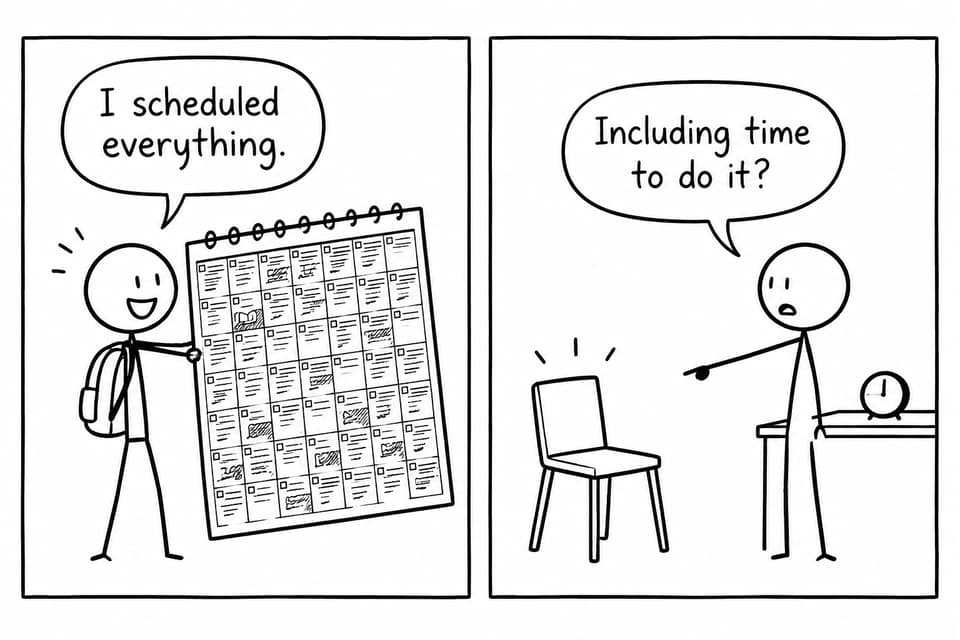
Smart students are often used to doing everything well. DP1 makes that instinct expensive. There will be evenings when mathematics, chemistry, English, CAS, and a looming draft all seem equally important. They are not equally important at that moment.
Prioritisation means choosing what receives attention now and what waits. A reliable planner helps by converting large obligations into visible next actions. The guide to using a planner for the IB workload explains how to build one system without filling every minute.
High expectations turn feedback into a verdict
If your self-image has always included being a top student, a level 4 or 5 may feel like evidence that something fundamental has changed. But an early DP1 grade is information, not a permanent label.
“I scored poorly because my evaluation lacked evidence” gives you somewhere to go. “I am not smart enough for IB” does not. One describes a correctable problem; the other turns a temporary result into a character judgment.
Replace effort alone with a better study loop
Working harder helps only when the work reveals what you can and cannot do. A useful DP1 study loop has four stages:
- Learn: Use class materials or concise Study Notes to understand the concept.
- Retrieve: Close the resource and explain, solve, sketch, or write from memory.
- Check: Compare your response with reliable guidance or feedback.
- Repair: Record the specific error and attempt a similar task later.
RevisionDojo brings this loop into one place. Study Notes and Flashcards support learning and retrieval. The Questionbank provides targeted practice, while AI Chat can clarify difficult steps. Grading tools reveal what an answer is missing.
Later, Predicted Papers and Mock Exams can help you practise complete assessments under realistic conditions. The Coursework Library can clarify structure, and Tutors can provide human support when a persistent gap needs more than another explanation. RevisionDojo works best as a complete IB resource, not an emergency tab opened before a test.
For a broader model, see how top IB students structure revision around spacing, feedback, and realistic weekly routines.
Build a week that survives real life
A useful plan must still work when a teacher adds homework, practice runs late, or your energy drops. Leave breathing room.
| Type of work | Example DP1 action |
|---|---|
| Urgent and important | Finish tomorrow’s assessed response |
| Important, not urgent | Practise one weak algebra skill |
| Short maintenance | Review 15 Flashcards |
| Administrative | Add deadlines and CAS evidence |
| Recovery | Sleep, exercise, or take a real break |
Use three kinds of study block:
- Deep block: 45-60 minutes for difficult problems, writing, or analysis.
- Maintenance block: 20-30 minutes for Flashcards, corrections, or recall.
- Planning block: 15 minutes to review deadlines and choose next actions.
Do not copy another student’s timetable without considering your commute, activities, subjects, and energy. The answer to how much to study outside class in DP1 is a starting point, not a competition. Focused work that exposes weaknesses is more valuable than hours spent making notes look complete.
Turn low grades into useful evidence
After receiving a disappointing result, let the first emotional reaction settle. Then sort each lost mark into one of these categories:
- Knowledge gap
- Misread question or command term
- Weak explanation or evidence
- Method error
- Time pressure
- Careless execution
Different problems require different repairs. A knowledge gap may need Study Notes and retrieval. A method error needs worked examples followed by independent questions. A weak essay needs criteria-based feedback. Time pressure requires timed sections, not faster rereading.
Keep an error log with four columns: topic, error, correct approach, and review date. Reattempt the skill after a few days. If the error returns, ask your teacher, use AI Chat for a step-by-step explanation, or work with a tutor.
Students who feel overwhelmed can use this calm IB reset when feeling behind instead of trying to repair an entire term in one weekend.
Manage coursework before it becomes an emergency
In early DP1, major coursework can feel distant. Large assignments become stressful when choosing a question, researching, drafting, receiving feedback, and revising are mentally stored as one task.
Break coursework into visible actions. “Work on investigation” is vague. “Find three possible variables and evaluate feasibility” is actionable. Add internal school deadlines immediately because school schedules differ.
The term-by-term guide to IB coursework deadlines can explain the wider rhythm, but your coordinator and teachers remain the authority for your dates and requirements.
What to do in the next seven days
Day 1: Make the workload visible
Collect deadlines from every platform, notebook, and classroom. Put them into one planner and identify the next physical action for each.
Day 2: Diagnose one subject
Choose your most worrying subject. Complete a short Questionbank set without notes. Record the errors instead of hiding from the score.
Day 3: Ask for specific feedback
Show a teacher one piece of work and ask, “What is the highest-impact change I could make in my next response?” Specific questions usually produce more useful answers.
Day 4: Practise retrieval
Use Flashcards, blurting, short-answer questions, or an empty-page explanation. Check every answer and correct mistakes.
Day 5: Repair one recurring weakness
Return to the error that appears most often. Learn the missing idea, complete another question, and explain why your new answer is better.
Weekend: Review and reduce
Look at what you completed, what slipped, and why. Carry forward only necessary tasks. Then plan three priority blocks for the coming week.
If your environment makes focused work harder, use this guide to set up a sustainable DP1 study space. Small reductions in friction matter when repeated across two years.
Struggle is a signal to adapt, not surrender
The first year of IB often removes the comforting illusion that strong students should understand everything quickly. It can also teach a more durable form of confidence: when something does not work, you can diagnose it, adjust, and try again.
You do not need a flawless timetable or dramatic comeback this week. You need one reliable place for deadlines, one honest practice session, one useful conversation with a teacher, and enough rest to repeat the process.
For a practical starting point, create a free RevisionDojo account and download the free DP1 planner. Use it to map deadlines, choose weekly priorities, and make the workload visible. Combined with RevisionDojo’s Questionbank, Study Notes, Flashcards, AI Chat, grading tools, Predicted Papers, Mock Exams, Coursework Library, and Tutors, it gives you something more useful than another motivational speech: a system you can use next Monday.