
A low mark in the first year of IB can feel strangely final. You worked hard, understood most of the material, and expected the number on the page to confirm both. Instead, it seems to question everything.
If it feels as though IB teachers grade harsh, the short answer is that they sometimes do. Many teachers apply demanding standards in DP1 so students learn the assessment criteria early, rather than discovering them during high-stakes work in DP2. Classroom assessments may also be narrower, harder, or graded more conservatively than the eventual IB assessment process.
That does not mean every harsh mark is accurate. The useful question is not simply, “Is my teacher strict?” It is, “What evidence does this mark give me, and what should I change next?”
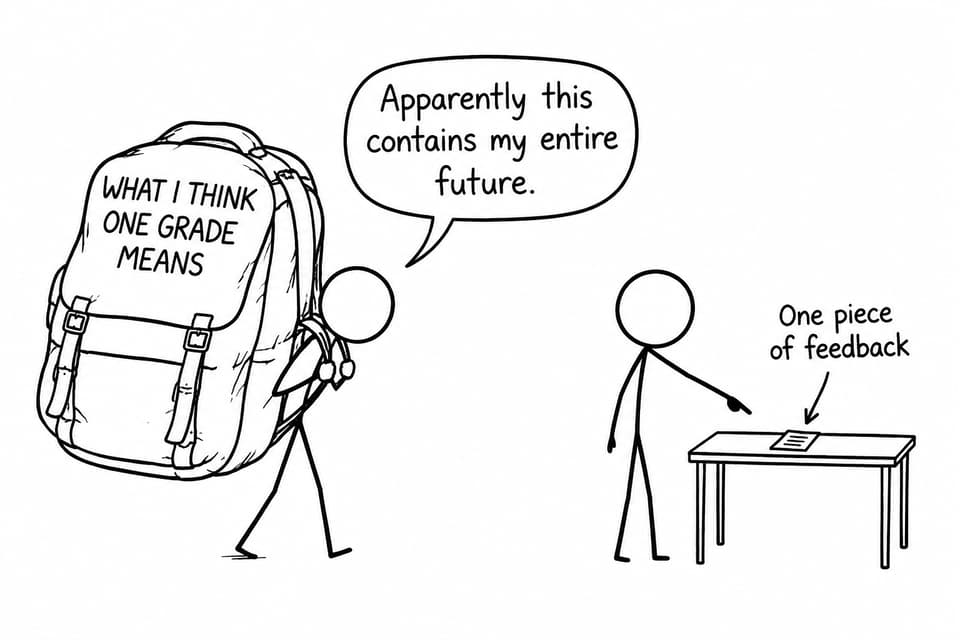
For students adjusting to the first month of the IB Diploma, that shift takes time. A DP1 grade is information about your current performance under particular conditions. It is not a verdict on your intelligence, final score, or place in the programme.
What to check before worrying
Use this checklist after receiving a surprisingly low mark:
| Question | What to look for |
|---|---|
| Was the task marked against stated criteria? | Criterion labels, mark bands, a rubric, or a markscheme |
| Can you identify where marks were lost? | Specific omissions, weak analysis, unclear working, or imprecise terminology |
| Was the assessment IB-style? | Familiar command terms, realistic timing, and appropriate question structure |
| Can your teacher explain the mark? | A clear connection between your response and the criterion |
| Is this one result or a pattern? | Evidence across several tasks matters more than one difficult test |
| Do you know the next action? | One skill to practise, one misconception to fix, and one follow-up date |
If you cannot answer most of these questions, seek clarification. If you can, the mark has already become more useful.
Why IB teachers grade harsh in the first year
The IB describes Diploma Programme assessment as criterion-related. Performance is judged against defined expectations, not merely against how well the rest of the class performed. Final subject grades use a 1-7 scale, while raw marks are converted through grade boundaries established for an examination session.
A school test in IB DP1 is not the same as a final subject result. It may assess one topic, paper component, or skill. Your teacher may use provisional boundaries, school reporting rules, or a department policy. The eventual IB grade usually draws on more varied evidence, including externally assessed work and, where applicable, internally assessed components subject to moderation.
Several factors can make school marking feel tougher:
- Your teacher is exposing gaps early. A generous mark can hide weaknesses in command terms, evidence, structure, notation, or evaluation.
- The task may be deliberately demanding. Some departments use harder questions to reveal the upper edge of a syllabus topic.
- You are learning a new assessment language. “Explain,” “evaluate,” and “to what extent” require different kinds of answers.
- The evidence is still limited. Early in DP1, teachers have fewer assessments from which to judge consistency.
- Previous habits may no longer earn the same reward. Description may now need analysis, justification, or explicit working.
This helps explain why the first and second years of IB feel difficult in different ways. DP2 carries more deadlines, but DP1 contains the uncomfortable work of recalibration.
Strict marking is useful only when it is explainable
There is an important difference between high standards and mysterious standards.
Constructive strictness is traceable. Your teacher can show which criterion applies, what the response demonstrated, and what was missing. The feedback may be brief, but it gives you a route forward. If another informed marker reviewed the work, the result should be reasonably defensible.
Unhelpful marking feels arbitrary. The rubric is absent, comments conflict with the score, or students must guess what excellence looks like. A teacher does not need to debate every mark, but you should understand its academic basis.
Before concluding that a grade is unfair, separate three possibilities:
- You knew the content but did not present it in the required form.
- You misunderstood part of the content or task.
- The marking or assessment design may be inconsistent.
The first two are common and fixable. The third deserves a calm conversation. RevisionDojo’s guide to talking to teachers without feeling awkward can help you prepare without making the discussion confrontational.
How to ask your teacher about a low mark
Avoid opening with, “Why did you mark me down?” That wording encourages both people to defend a position. Ask for diagnosis instead:
I want to understand how to improve before the next assessment. Could you show me one part of my response that did not meet the criterion, and what a stronger version would include?
Then ask one or two focused follow-ups:
- Which weakness cost me the most marks?
- Was my main problem knowledge, interpretation, structure, or timing?
- What would move this response into the next mark band?
- Is there a model response or annotated example I can study?
- Can I rewrite one section to check whether I understood the feedback?
Bring the task, rubric, and your notes. The goal is not to negotiate two extra marks from yesterday. It is to prevent losing similar marks throughout the next year.
If the explanation remains unclear, ask whether the department moderates common assessments. Escalation may be appropriate when inconsistency is repeated and significant, but it should follow clarification rather than replace it.
Stop treating percentages as universal truths
A percentage can look precise while hiding context. A score of 64% on one classroom task does not automatically correspond to the same IB grade in another subject, component, school, or session.
Track performance in three layers:
- Raw result: What did you score on this task?
- Skill diagnosis: Which knowledge or assessment skill limited the result?
- Trend: Is the same weakness repeating across multiple tasks?
This matters when thinking about predicted grades. Teachers generally consider the available evidence and the level they believe a student is likely to achieve, but school procedures vary. The guide to how IB predicted grades work explains why improvement and consistency matter more than one isolated score.
Keep a simple error log. For each assessment, record the topic, question type, lost marks, reason, and corrective action. “I am bad at Biology” is vague and paralysing. “I omit links between evidence and conclusions” is specific and trainable.
What to do this week
You do not need a complete academic reinvention. You need one short feedback loop.
Day 1: Audit one marked task. Classify each lost mark as knowledge, command term, method, evidence, structure, accuracy, or timing.
Day 2: Speak to your teacher. Ask which recurring weakness deserves priority and what the next mark band requires.
Day 3: Relearn the weak point. Use concise Study Notes and Flashcards instead of rereading an entire chapter. If the issue is conceptual, ask RevisionDojo’s AI Chat for a simpler explanation, then verify it against your course materials.
Day 4: Complete targeted practice. Use the RevisionDojo Questionbank to find questions on the same topic and skill. Apply the feedback before adding time pressure.
Day 5: Check the response. Use a markscheme, your teacher’s criteria, or RevisionDojo’s Grading tools. AI feedback is a second perspective, not a replacement for teacher judgment.
Day 6: Rewrite one answer. Choose the response that best represents your recurring problem rather than repeating the whole test.
Day 7: Plan the next cycle. Schedule your next practice session before new homework takes over. The guide to using a planner for the IB workload and the term-by-term internal assessment planner can help protect that time.
Twenty focused minutes correcting a known weakness can be more valuable than two anxious hours revising everything.
Build evidence that your marks can improve
The first year of IB is not only about collecting grades. It is about building a reliable process before coursework and final assessments become crowded together.
RevisionDojo brings that process into one place. Move from Study Notes and Flashcards to targeted Questionbank practice, use AI Chat when a concept remains unclear, and apply Grading tools to a response. Later, Predicted Papers and Mock Exams can help you rehearse complete assessment conditions, while the Coursework Library and Tutors offer support when independent practice is not enough. The RevisionDojo IB DP platform review explains how these tools connect.
The crucial word is connect. More resources do not automatically create progress. A useful sequence is learn, retrieve, practise, receive feedback, and repeat. Each stage should respond to evidence from the previous one.
If first-term grades have caused panic, the guidance on handling first-term IB panic offers a useful reset when every subject seems urgent.
A hard mark can become an early advantage
A strict DP1 teacher may be giving you something valuable: time. Time to learn the criteria, change weak habits, ask better questions, and practise before the stakes rise.
You do not need to accept confusing or inconsistent marking silently. Ask for evidence, compare feedback with the stated criteria, and track patterns rather than catastrophising over one result. Then turn the clearest weakness into this week’s practice target.
To make that process easier, create a free RevisionDojo account and explore the included resources, then download the free DP1 planner. It gives your feedback, priorities, and deadlines somewhere concrete to live. In DP1, that structure is often more useful than another promise to “work harder.”