
When the IB subject you want simply is not on the list
The first time it happens, it feels oddly personal. You open the subject selection form, scan the rows, and the thing you were counting on is missing. Not “full.” Not “timetable clash.” Just… not offered.
If you are in the IB, this can feel like the program is closing a door before you even start walking. But in practice, the IB is less like a single hallway and more like a building with side entrances. Schools have staffing limits, timetable constraints, and cohort sizes. That reality is frustrating, but it is not the end of your plan.
This guide lays out calm, workable options when your IB subject is not available, andand how to stay exam-ready even if your path looks different than your friends’.
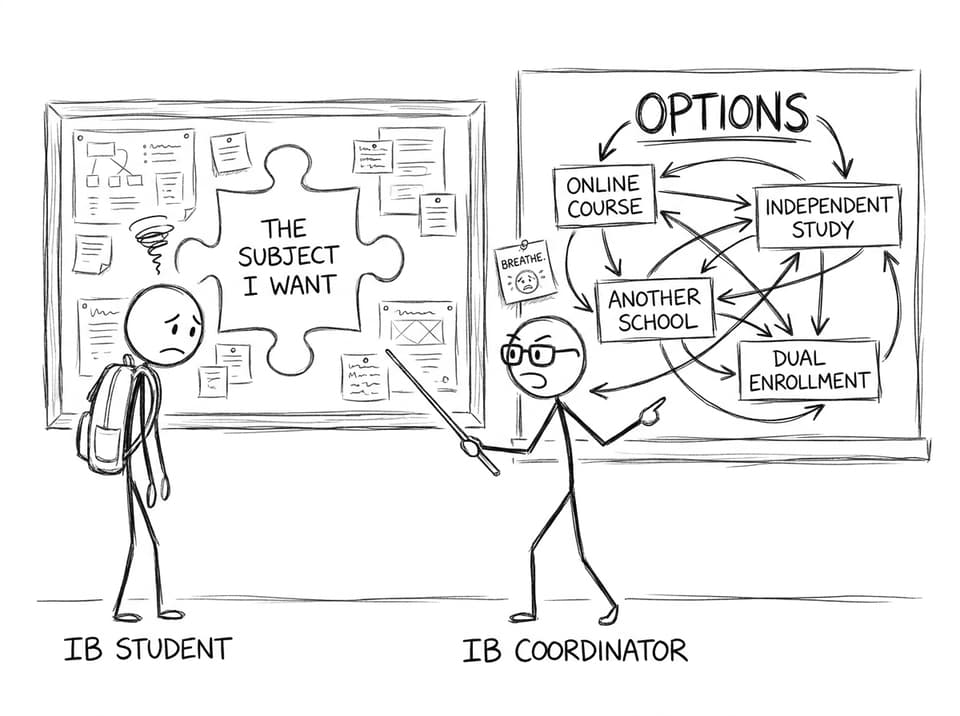
Quick checklist before you change anything
Before you commit to a new IB pathway, run this short checklist. It keeps you from making a decision based on panic.
-
Confirm it is truly not offered (not just scheduled in a different block or dependent on enrollment).
-
Ask what is negotiable: Can the school run it with enough sign-ups? Can it be offered SL only?
-
Clarify your non-negotiables: university prerequisites, personal strengths, and workload.
-
Identify the closest substitutes within the same subject group.
-
Get the plan in writing with your IB coordinator: assessment route, supervision, and grading logistics.
While you are weighing alternatives, it helps to read around the edges of subject choice. For science decisions, RevisionDojo has useful comparisons like Easiest Science Subjects in IB and How to Choose the Right Group 4 Subject for You.
Option 1: Take the IB subject online (the cleanest workaround)
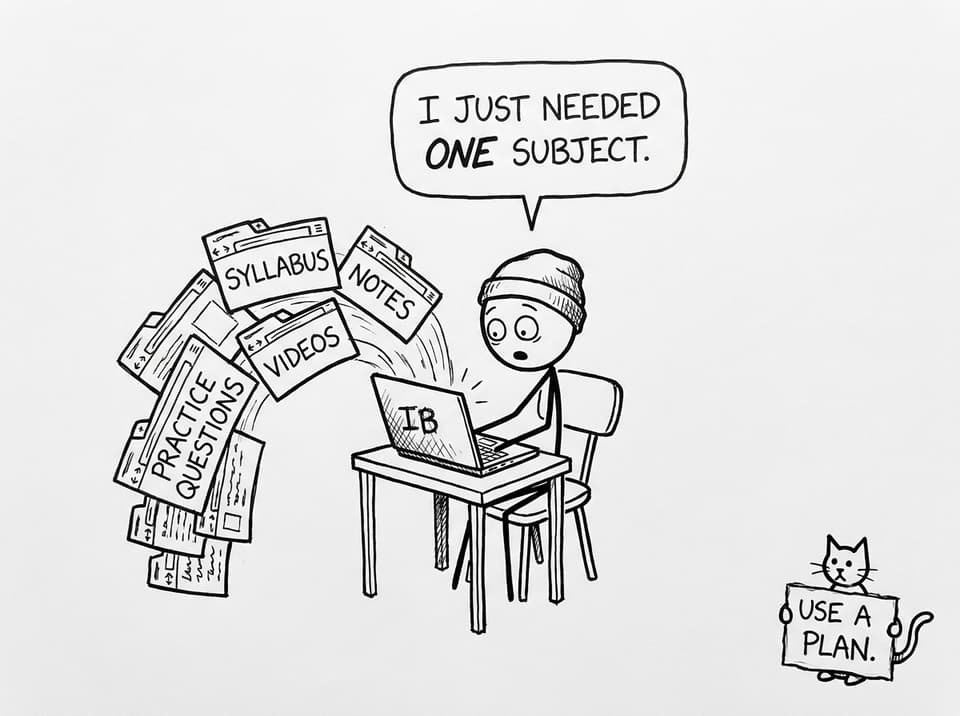
If your school does not offer a subject, an online IB course is often the most direct solution. It lets you keep the exact subject you want while staying enrolled at your current school.
What makes this work is structure. Online learning is not hard because the content is harder; it is hard because deadlines get fuzzy and practice becomes optional. So if you go this route, build a routine that imitates a normal class.
A practical way to stay consistent is to pair your online course with a focused exam system. Many students use RevisionDojo’s Questionbank to keep practice aligned to what the IB actually rewards, then patch gaps with targeted explanation from RevisionDojo App: The Smarter Way to Prep for IB Exams.
Option 2: Collaborate with another school (shared teaching, shared sanity)
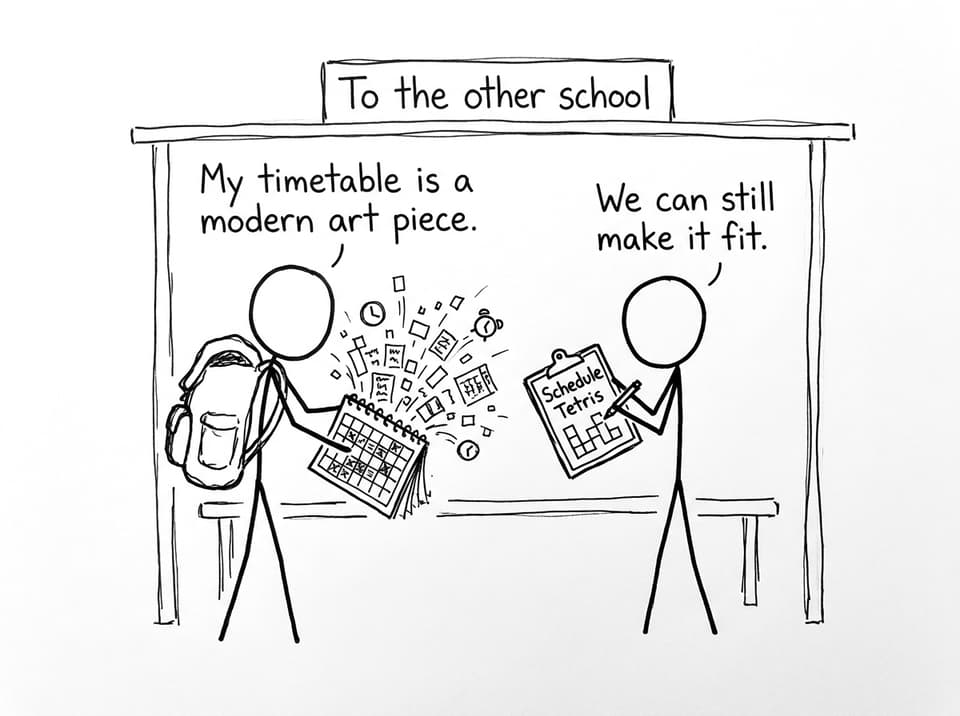
Sometimes the subject exists nearby, just not in your building. Depending on local policy, schools may allow cross-enrollment, shared classes, or a coordinated timetable.
This option can feel inconvenient, but it has a hidden benefit: you get a real classroom rhythm, a teacher who knows the IB marking logic, and peers who keep the pace honest.
The main constraint is scheduling. If you try this, ask early about:
-
transport and attendance rules
-
whether the class is SL/HL
-
who supervises your internal deadlines
-
how your home school records grades
If you need to choose a substitute science while you negotiate collaboration, browse the subject-specific decision guides like Is ESS the Easiest IB science? or Which IB Science Is the Easiest? A Detailed Guide.
Option 3: Dual enrollment or a similar external course (useful, but confirm alignment)
Some students take a course at a local college or learning center to cover the knowledge base they want. This can be excellent preparation for university-level study.
But here is the IB-specific catch: learning the content is only half the job. The IB is an assessment style. If the external course does not train you in that style, you may feel confident but still lose marks in exam conditions.
If you take an external course, keep your IB practice loop running alongside it. RevisionDojo is built for that: Study Notes for quick clarity, Flashcards for recall, and Mock Exams plus Predicted Papers for timing and realism. If you tend to work hard but retain little, the article IB: I Study All Day but Remember Nothing is a helpful reset.
Option 4: Independent study (a viable path if you build feedback)
Independent study can work in the IB, but only when you treat it like training, not like reading.
A good independent study plan has three parts:
-
A syllabus map (what you must cover, and by when)
-
Regular assessment (someone checks your work, not just your effort)
-
Exam-style practice (so your answers match IB expectations)
This is where tools matter. RevisionDojo’s AI Chat is useful when you hit a conceptual wall and need a precise explanation at the moment you are stuck. The Grading tools and Coursework Library are also valuable if your subject includes major written components, because feedback quality is the difference between “done” and “good.” If you want a simple weekly rhythm, Is 1 Month Enough to Study for IB Exams? shows how to structure practice without burnout.
Option 5: Choose the nearest subject substitute (and make it strategic)
Sometimes the simplest answer is the right one: pick an alternative IB subject that keeps your options open.
To do this well, match the substitute to your assessment strengths:
-
Do you score higher on explanation or calculation?
-
Do you prefer lab-style work or case-study style work?
-
Do you need a specific subject for university, or just a strong science/humanities profile?
For Group 4 decisions, What counts as “hands-on” in IB sciences is a useful lens, and Hardest Science Subjects in IB helps you avoid picking something that will drain time from your other IB commitments.
How to stay exam-ready in IB, even with a nonstandard setup
No matter which option you choose, keep your preparation anchored to outcomes. In the IB, outcomes mean marks.
A stable weekly loop looks like this:
-
Study Notes to learn one small topic quickly
-
Flashcards for daily recall (short, consistent)
-
Questionbank sets to turn understanding into marks
-
AI Chat when you cannot explain a step
-
Mock Exams and Predicted Papers to train timing
-
Tutors when you need a human to diagnose your pattern of mistakes
If you want the “one home base” approach, start from Revision Dojo and build a routine you can repeat even on tired days.
Closing: the IB door is not locked, it is just around the corner
When your school does not offer the IB subject you want, it is tempting to treat it as a verdict on your future. It is not. It is a logistics problem, and logistics problems have options: online courses, collaboration, external study, independent routes, or smart substitutes.
Choose the path that keeps you moving, then commit to exam practice with the same seriousness you would bring to any IB class. If you want one place to run that whole system: Study Notes, Flashcards, Questionbank practice, AI Chat support, Grading tools, Predicted Papers, Mock Exams, Coursework Library examples, and Tutors; RevisionDojo is built to make the IB feel manageable and repeatable.