

If you ask ten IB students which science is the easiest, you’ll get eleven answers.
One student swears Biology is “just memorisation.” Another says Chemistry is “just patterns.” A third insists Physics is “the only one that makes sense.” And quietly, in the background, someone is choosing a subject based on a teacher, a timetable, and a future they’re not sure they want yet.
That’s the real secret: the “easiest” IB science is rarely the one with the lightest content. It’s the one whose demands match your strengths, your interests, and the way you work under pressure.

This guide compares the main IB science options (SL and HL) through a practical lens: what you actually do day-to-day, what the assessments tend to reward, and who typically finds each course more manageable. Along the way, you’ll see how RevisionDojo can make any IB science feel more predictable with its Questionbank, Study Notes, Flashcards, AI Chat, Grading tools, Predicted Papers, Mock Exams, Coursework Library, and Tutors.
A quick checklist for picking the easiest IB science (for you)
Before ranking anything, run this fast self-check. The easiest IB choice is usually the one where you can say “yes” to most of these:
-
You can tolerate the main type of thinking the course demands (memorising, modelling, calculating, coding, writing).
-
You don’t mind the style of practice needed (labs, data processing, structured problems, case studies).
-
You can imagine revising it consistently for months without hating your life.
-
You have access to good support (teacher clarity, peers, and high-quality resources).
If you want a clean, all-in-one workflow for any IB subject, start with the RevisionDojo Questionbank and build out from there: notes for understanding, flashcards for recall, and timed practice for exam skill.
What “easiest” really means in IB science
In the IB, difficulty comes from three places:
Content load
Some subjects ask you to carry many small facts (often Biology and ESS). Others ask you to carry fewer facts but apply them in unfamiliar ways (often Physics and Chemistry).
Skill profile
The IB rewards specific skills: interpreting data, using precise vocabulary, applying models, and explaining reasoning under timed conditions. A subject feels “easy” when your natural strengths line up with those skills.
Assessment friction
Two students can study the same amount and feel very different levels of stress depending on whether the assessments match how they think. If your brain likes structure, you may find calculation-heavy papers calming. If you prefer narrative and real-world context, case-study questions may feel easier.
To practise the assessment style early, use subject hubs like IB Biology Resources, IB Chemistry Resources, IB Physics Resources, and IB Environmental Systems and Societies Resources.
Comparing IB science subjects: which is easiest?
No ranking will fit everyone, but patterns show up every year. Here’s what students most often mean when they say an IB science is “easy.”
IB Environmental Systems and Societies (ESS): often the easiest overall
For many IB students, ESS is perceived as the most manageable because it blends science with real-world systems and social considerations. The content can feel more intuitive because you’re constantly linking ideas to everyday contexts: energy choices, pollution, ecosystems, resource use, sustainability.
Why ESS can feel easier in IB:
-
The interdisciplinary approach gives you multiple ways to access the marks (scientific understanding plus societal evaluation).
-
Explanations often reward clarity more than complex calculation.
-
If you enjoy reading, writing, and connecting ideas, revision can feel less like grinding.
The hidden challenge: ESS still demands precision. You need strong command terms, case-study flexibility, and systems thinking. If you treat it like a “soft” option and stop practising exam-style responses, it stops being easy.
To build that systems mindset, use Approaches to Environmental Systems and Societies in IB and then reinforce it with targeted practice from RevisionDojo’s Questionbank and feedback loops.
IB Sports, Exercise, and Health Science (SEHS): easiest for applied learners (where available)
SEHS tends to feel easier for students who like applied science: anatomy you can visualise, physiology you can relate to training, nutrition you can connect to real life. If you’re motivated by relevance, SEHS can become one of the easiest IB sciences to keep revising consistently.
Why SEHS can feel easier in IB:
-
Concepts are often concrete and body-based, not abstract.
-
You can anchor memory in lived experience (sport, movement, recovery).
-
Motivation is naturally higher, which makes practice feel less forced.
The hidden challenge: SEHS still has academic expectations. You need accurate terminology, clear explanations, and strong data analysis habits. “Interesting” doesn’t automatically mean “high-scoring.”
IB Biology: easiest for strong memorisers and steady revisers
Biology is the IB science many students call “easy” because it’s content-rich but familiar: cells, genetics, evolution, ecology. If you’re disciplined with recall and you revise little-and-often, Biology can feel very manageable.
Why Biology can feel easier in IB:
-
You can earn marks by knowing definitions and well-practised explanations.
-
Many topics connect naturally (structure-function, cause-effect in systems).
-
The revision pathway is straightforward: learn, recall, apply.
The hidden challenge: Biology becomes difficult when students rely on reading instead of active recall. It’s not enough to “understand” a process. In IB exams, you must reproduce it clearly, with the right vocabulary, at speed.
A good starting map is IB Biology: Complete Guide for IB Exam Prep, then practise with the IB Biology Resources hub using Flashcards and the Questionbank.
IB Computer Science: easiest for logical thinkers (and consistent coders)
Computer Science often feels easiest to students who enjoy structured problem solving and aren’t intimidated by debugging. For the right person, the logic is comforting: inputs, outputs, constraints, and clear success conditions.
Why Computer Science can feel easier in IB:
-
Practice has fast feedback: your code runs or it doesn’t.
-
Skills improve quickly with repetition.
-
Many students enjoy the project-like feel compared with pure theory.
The hidden challenge: if you postpone practice, it gets hard fast. Computer Science rewards steady skill-building, not last-minute cramming.
IB Chemistry: “medium” difficulty, but very learnable
Chemistry sits in the middle for many IB students. It combines conceptual understanding with structured calculations and predictable lab patterns. If you like routines and problem types, it can feel surprisingly manageable.
Why Chemistry can feel easier in IB:
-
Many questions follow repeatable templates (stoichiometry, energetics, equilibrium).
-
Progress is visible when you practise consistently.
-
The course often rewards method and accuracy.
The hidden challenge: chemistry misunderstandings compound. If foundational concepts (moles, bonding, energetics) stay fuzzy, later topics feel twice as hard.
Use the IB Chemistry Data Booklet - Formula Reference as a daily companion and anchor your plan with IB Chemistry HL: Complete Guide for Success.
IB Physics: often the hardest, easiest only for a specific brain
Physics is the IB science most often labelled “hard,” mostly because it’s abstract and math-driven. But for students who like modelling the world with equations, it can be the easiest because it’s coherent: a few big ideas, applied many ways.
Why Physics can feel easier in IB (for the right student):
-
The syllabus is conceptually unified; topics connect.
-
Marks often come from method and reasoning, not memorising facts.
-
Practice teaches you how questions are built.
The hidden challenge: if you avoid problems, you don’t improve. Physics is not a reading subject. It’s a doing subject.
To rehearse exam conditions, explore IB Predicted Papers by IB Examiners (Free) and the IB Physics Resources hub.

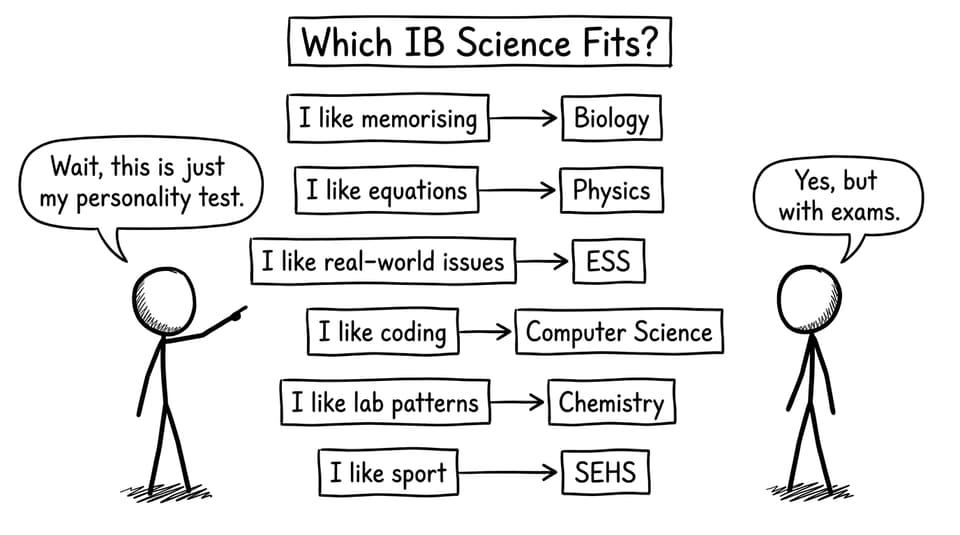
The easiest IB science by “student type”
Instead of a single ranking, here’s the more honest mapping:
-
If you like writing and real-world context: IB ESS is often the easiest IB science.
-
If you like relevance and applied anatomy: IB SEHS can be the easiest.
-
If you like memorising and clear explanations: IB Biology is often the easiest.
-
If you like logic and building skills over time: IB Computer Science can be the easiest.
-
If you like patterns and structured calculations: IB Chemistry can feel easiest.
-
If you like equations and abstract modelling: IB Physics can feel easiest.
How to make any IB science feel easier (without changing subjects)
Most “difficulty” in IB science is actually uncertainty: not knowing what to practise, how to check if you’re improving, or why marks disappear.
RevisionDojo reduces that uncertainty with a simple loop:
-
Study Notes to understand the idea quickly.
-
Flashcards to keep recall alive daily.
-
Questionbank to practise exam-style questions by topic.
-
AI Chat to get unstuck fast (without losing an hour).
-
Grading tools to learn how marks are awarded in written responses.
-
Predicted Papers and Mock Exams to train timing and stamina.
-
Coursework Library to model strong IA structure.
-
Tutors when you need a human to spot patterns in your mistakes.
If you want a sustainable plan while balancing multiple IB subjects, read How to Study for IB Exams Without Burning Out. If you want the all-in-one ecosystem explained, use RevisionDojo App: The Smarter Way to Prep for IB Exams.
Closing: the easiest IB science is the one you can sustain
The easiest IB science is not a universal title you win by picking the “lightest” course. It’s the subject whose thinking style matches your brain, whose revision you can repeat calmly, and whose exam demands you can practise until they feel normal.
If you’re still deciding, explore the subject hubs and try a short burst of questions to test fit: IB Biology Resources, IB Chemistry Resources, IB Physics Resources, and IB Environmental Systems and Societies Resources. Then build your routine around the RevisionDojo loop: Questionbank, Study Notes, Flashcards, AI Chat, Grading tools, Predicted Papers, Mock Exams, Coursework Library, and Tutors.
Pick the IB science you can stick with. Then practise like it’s trainable. Because it is.