
IB: I Study All Day but Remember Nothing (And What to Do)
There's a specific kind of panic that only an IB student recognizes.
It's 9:47 p.m. You've been "studying" since the afternoon. Your desk is covered in neat pages, highlighted in three colors like a tiny work of art. You close the notebook, look away, and try to explain the topic to yourself.
Nothing comes out.
Not nothing-nothing. More like fog. A vague sense that you've seen these words before. But no grip. No usable memory. No ability to produce an answer on demand.
If you're thinking, I study all day but remember nothing, you're not broken. You're just stuck in the most common IB trap: doing work that feels productive but doesn't train recall.
The quick IB checklist (when you're forgetting everything)
If your brain is tired and you want a simple reset, use this IB checklist for the next 7 days:
- Do one daily session of active recall (Flashcards or closed-book blurting) for 10-15 minutes.
- Do one short set of exam-style questions (10-25 questions) for 25-40 minutes.
- Spend 10 minutes reviewing mistakes and writing "error rules."
- Add one timed block per week (a section, not necessarily a full paper).
- Sleep at least 7 hours whenever possible (memory consolidation is part of IB study).
You can run this entire loop inside RevisionDojo using Study Notes, Flashcards, the Questionbank, AI Chat, Grading tools, Predicted Papers, Mock Exams, the Coursework Library, and Tutors.
Useful starting points:
Why IB students study all day and remember nothing
Most forgetting isn't caused by laziness. It's caused by the wrong kind of effort.
In IB, the most tempting study activities are also the least effective for memory:
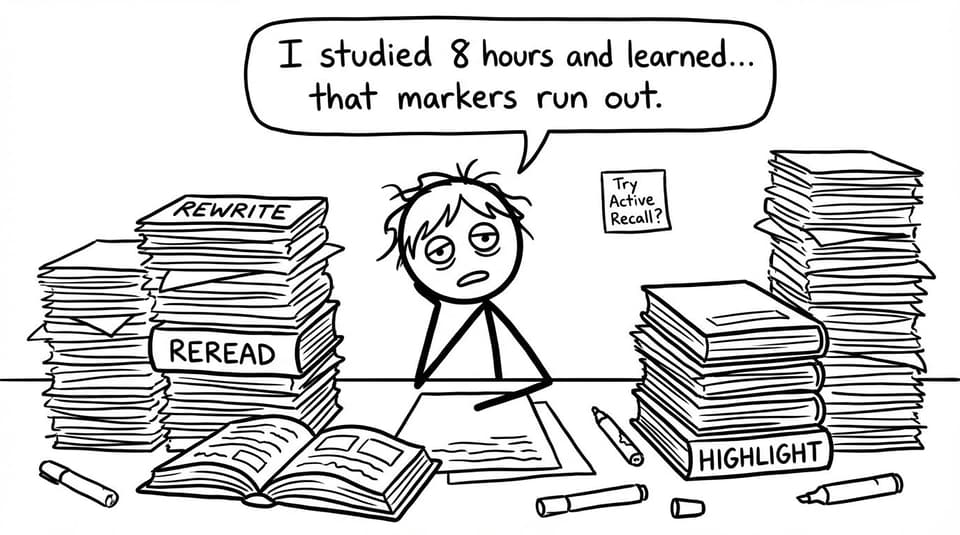
- rereading notes until they feel familiar
- rewriting "clean" summaries
- highlighting because it looks like progress
- watching explanation videos without testing yourself
These create recognition, not recall.
Recognition feels warm: "I know this, I've seen it."
Recall is colder: "Can I produce it with a blank page and a ticking clock?"
IB exams grade recall and application. Not familiarity.
The hidden problem: you're practicing the wrong skill
Think of it like training for a marathon by watching running videos. You might learn a lot about running. But your legs won't adapt.
In IB, your "legs" are:
- retrieving information under pressure
- applying it to unfamiliar prompts
- using command terms correctly
- structuring answers in markscheme shapes
If your sessions don't include those reps, you can study all day and still remember nothing.
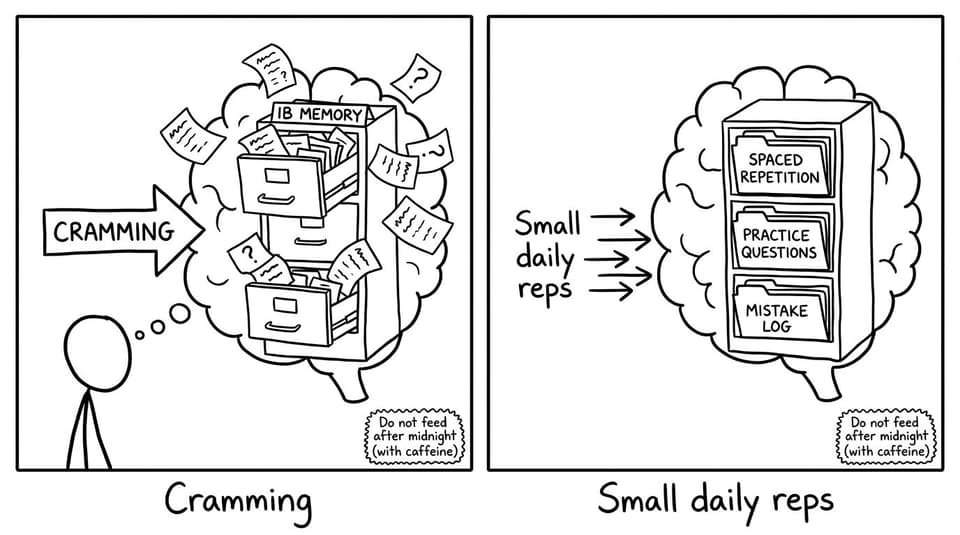
The IB memory upgrade: learn, then force retrieval
Here's a calmer truth: memory isn't something you have. In IB, memory is something you build by repeatedly trying to retrieve and failing a little.
That "blank" feeling isn't proof you're doomed. It's feedback.
The fix is not "study harder." The fix is "study with retrieval."
Use the IB 60-minute loop (repeatable, not heroic)
Run this block once a day (or 4-6 times per week):
- 10 min: Read one small section of Study Notes (only enough to attempt questions)
- 35 min: Do topic-matched Questionbank practice
- 15 min: Review mistakes and turn them into Flashcards or "error rules"
RevisionDojo is built exactly for this: learn quickly, practice immediately, and keep the loop tight.
Good companion reads:
What to do when you "understand" but can't recall (classic IB problem)
A lot of IB students say: "I understand it when I read it, but I can't remember it in an exam."
That's not a character flaw. It's a predictable gap between input and output.
The three-part fix
Closed-book explanation (2 minutes)
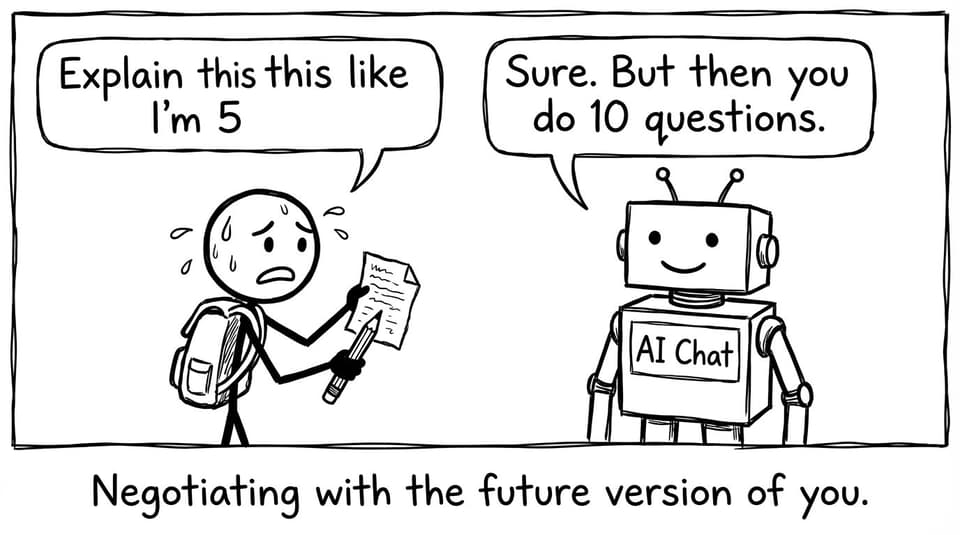
Read one concept, close everything, and explain it out loud like you're teaching a younger student. If you stumble, good. You found the gap.
One exam-style question immediately
Don't do five more pages of notes. Do one question that forces application. Use RevisionDojo's Comprehensive IB Question Bank logic: practice by topic, not by mood.
Convert the miss into an "error rule"
An error rule is one sentence that prevents future you from repeating the same mistake.
Examples:
- "If the question says evaluate, I must include a criterion + a balanced judgment."
- "If I forget a definition, I need a Flashcard that asks for it word-for-word."
This is where IB effort starts compounding.
The IB shift that matters: stop collecting resources, start collecting feedback
When you're scared in IB, your brain tries to buy comfort with more resources.
More notes. More videos. More "best summaries."
But the thing that reduces stress isn't more input. It's more feedback.
RevisionDojo works well here because it turns your study into visible signals:
- Questionbank results show what you can do today
- AI Chat helps you clarify one confusion fast (without opening ten tabs)
- Flashcards keep memory warm daily
- Grading tools make coursework feedback less mysterious
- Mock Exams and Predicted Papers build exam stamina and timing
If you want to build this as a system, this overview helps:
A realistic weekly plan for IB students who forget fast
This is a simple structure that prevents the "study all day, remember nothing" cycle.
Daily (30-60 minutes)
- 10 minutes: IB Flashcards (spaced repetition)
- 20-40 minutes: Questionbank set on one subtopic
- 5-10 minutes: mistake review + error rules
To improve your Flashcards routine:
- Interactive IB Flashcards: Engaging Memory Practice
- IB Flashcard System: Active Recall for Better Memory
Weekly (1 session)
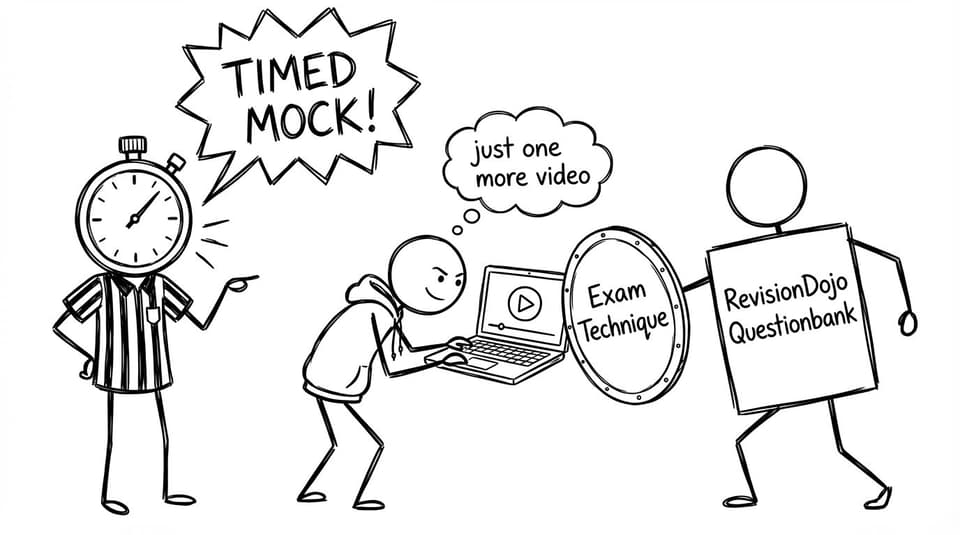
- One timed section using Mock Exams or Predicted Papers
- Review longer than you wrote (this is where marks appear)
A helpful guide:
Weekly (10 minutes, the "steering" habit)
Ask:
- What topic cost me the most marks this week?
- What mistake pattern keeps repeating?
- What's the next smallest fix?
If you need sanity more than strategy:
Use RevisionDojo like a control panel (not a buffet)
Tools don't replace effort. But in IB, the right tools reduce friction.
Give each RevisionDojo feature a job:
- Study Notes: quick clarity, no rewriting marathons
- Questionbank: targeted practice that mirrors exam thinking
- Flashcards: daily retrieval that compounds
- AI Chat: unblock one confusion, then test immediately
- Grading tools: fast coursework feedback aligned to criteria
- Predicted Papers: realism without guessing what matters
- Mock Exams: timing, stamina, and pressure rehearsal
- Coursework Library: models and exemplars to reduce uncertainty
- Tutors: when you need a human to simplify the knot and raise the bar
If you want to see why practice-by-search is powerful, this is useful:
Closing: make your IB studying smaller, then make it repeat
The students who break through the "I study all day but remember nothing" wall don't become superhuman.
They become systematic.
They stop confusing effort with training. They stop collecting notes and start collecting feedback. They build a loop they can repeat on tired days, not just perfect ones.
If you want one place to run that whole IB loop without scattering your attention, RevisionDojo is built for it: Study Notes for clarity, Flashcards for daily recall, Questionbank practice for exam technique, AI Chat for fast unblocking, Grading tools and a Coursework Library for coursework confidence, plus Predicted Papers and Mock Exams to make exam day feel familiar.
Start here, keep it small, and let consistency do what all-day studying never could: