
If you think UCAS Clearing is only for students who "messed up," you have been sold the wrong story.
Clearing is actually one of the few moments in the UK admissions cycle where speed and clarity can matter as much as grades. For IB students, it can feel like the calm after months of exams gets replaced by a single loud question: What now? And that is exactly why UCAS Clearing 2025 matters. It turns panic into a process.
This guide is designed for IB students preparing for exams who want a practical, organised route through UCAS Clearing 2025, without guessing, without spiralling, and without wasting the narrow window when the best options are still open.
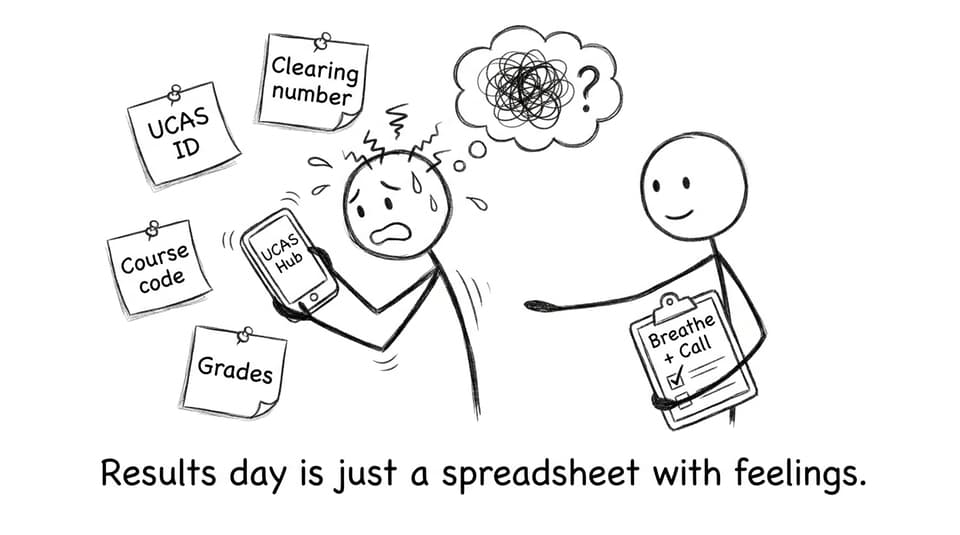
UCAS Clearing 2025 in one screen: a quick checklist
Before you do anything else, use this Clearing-ready checklist. It will keep your UCAS actions boring (which is the goal):
-
Confirm you are eligible for UCAS Clearing in UCAS Hub
-
Write down your UCAS ID and Clearing number
-
Prepare a shortlist of 5-10 courses (with codes)
-
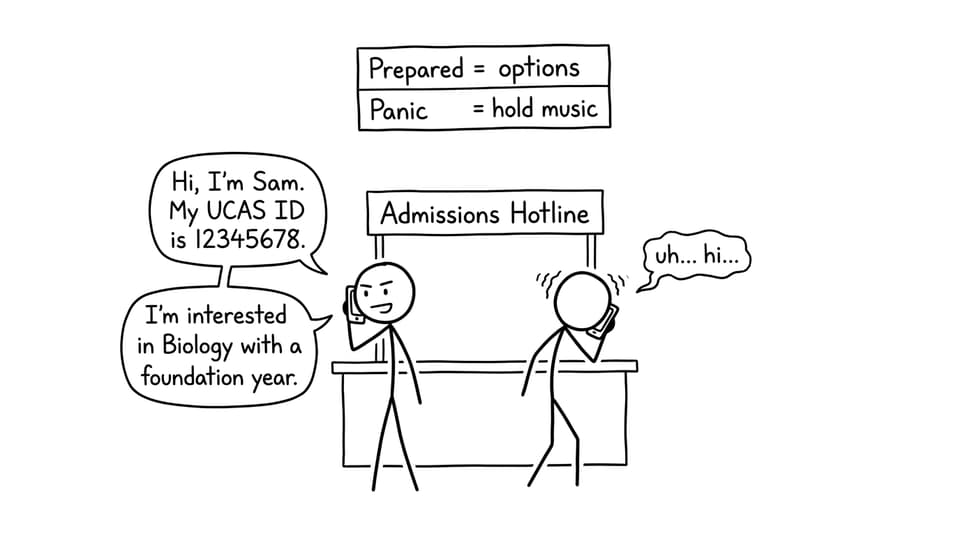
Draft a 30-60 second phone pitch
-
Keep your results and personal statement open on one device
-
Track every call: name, time, offer terms, next steps
-
Only add a Clearing choice in UCAS Hub once you are sure
If you want a more detailed version you can print, use UCAS Clearing Checklist 2025: What to Prepare Before You Call.
What is UCAS Clearing (and why IB students should care)?
UCAS Clearing is the official route to match students with university courses that still have vacancies. It helps if you:
-
Did not receive (or declined) offers earlier
-
Did not meet the conditions of your offer
-
Applied late
-
Changed your mind about course or location
For IB students, Clearing can be particularly useful because results timing, university conditions, and personal priorities do not always line up neatly. UCAS gives you a structured way to move quickly while staying in control.
For a step-by-step explanation of the whole flow, see UCAS Clearing Explained: Step-by-Step.
UCAS Clearing 2025 key dates (what to watch)
Dates can shift slightly year to year, but the logic stays the same: early action gives you more choice.
Clearing typically runs from early July into October, with peak activity around results periods. The earlier you prepare your shortlist and pitch, the less your decision-making depends on adrenaline.
For broader context and strategy, you can also read UCAS Clearing 2025 Guide: Top Universities, Tips & Success Stories.
Step 1: Confirm your UCAS Clearing eligibility (before you start calling)
Log into UCAS Hub and check your status. If you are "in Clearing," you will see the Clearing information you need and be able to add a Clearing choice when ready.
If you are holding an offer but want to change direction, you may need to release yourself into Clearing via UCAS Hub. That decision is reversible only in one direction: once you accept a Clearing place, old choices are replaced.
If your situation is complicated (for example, you want to switch without burning options), read How to Switch Your UCAS Choice Without Losing Options.
Step 2: Research vacancies fast (without chasing prestige)
In UCAS Clearing, information changes quickly. Vacancies update, entry requirements fluctuate, and the course that looks perfect at 9:05 can disappear by lunch.
A calm strategy:
-
Search broadly first (subject area, then location)
-
Build a shortlist that mixes: ambitious, realistic, and "good-fit" options
-
Read modules and assessment style, not just league-table vibes
-
Keep an eye on foundation years and joint honours routes
A useful mindset shift for IB students: Clearing is not only about "getting in." It is about finding a course that you will actually finish, enjoy, and use.
Step 3: Prepare your pitch (your UCAS call should sound like you)
Admissions teams are not asking for a TED talk. They are listening for evidence that you are organised, motivated, and realistically matched.
Your UCAS call pitch should include:
-
Name + UCAS ID
-
The course name and code
-
Your IB results (or predicted/expected if calling before release)
-
One reason you want that course at that university
-
One quick academic or extracurricular proof point
If you need to tailor your statement quickly, use Personal Statement in a Hurry: UCAS Clearing 2025 Fast Writing Guide or the more general Writing a Personal Statement in a Hurry (Clearing Guide).
Step 4: Move quickly, but keep your decision rules
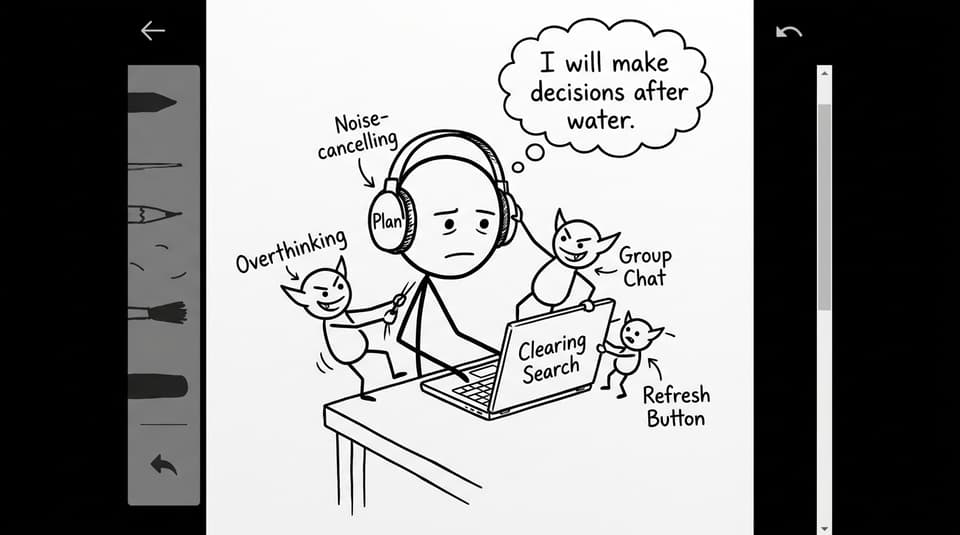
The hardest part of UCAS Clearing is that urgency can bully you into choices. So decide your rules before the phones open.
Try these three decision rules:
-
One-hour rule: no final decisions while your heart is racing
-
Two-offer rule: if possible, get at least two verbal offers before choosing
-
Reality rule: ask about accommodation deadlines, start dates, and any conditions
If you want help being more persuasive (especially if you are slightly below requirements), read How to Negotiate Offers During UCAS Clearing Calls.
Step 5: Make it official in UCAS Hub (verbal offers are not the finish line)
A university can say yes on the phone, but it is not confirmed until you add that course as your Clearing choice in UCAS Hub.
Treat this moment like submitting an exam: slow down, double-check the course code, and confirm any terms (foundation year, start date, campus). Once you add the Clearing choice, you are making a real commitment.
Clearing Plus, Adjustment, late applications: the simplest way to choose
Students often mix these up because the names sound like app updates.
-
UCAS Clearing: for students without an offer, who missed conditions, applied late, or changed direction
-
Clearing Plus: an opt-in matching feature inside UCAS Hub that suggests courses based on your profile
-
Adjustment: historically used for students who exceeded offers and wanted to "trade up" (check current UCAS guidance for how it is implemented in 2025)
If you want a clean comparison, use UCAS Adjustment vs Clearing 2025: Which Is Right for You? and the deeper Clearing Plus breakdown at UCAS Clearing Plus 2025: Full Guide to Getting Matched.
Results-day preparation for IB students: your unfair advantage
Most Clearing guides assume A-level timelines and emotions. IB students can do something smarter: prepare the day as well as the decisions.
Two high-impact reads before results:
Then build your academic safety net. If Clearing becomes necessary, it helps to speak confidently about your strengths, your subjects, and your readiness. That is where RevisionDojo becomes more than a website.
On RevisionDojo, you can tighten your profile fast using Study Notes, then prove it with the Questionbank, then turn weaknesses into daily wins with Flashcards. When you get stuck, AI Chat helps you unblock the concept you keep avoiding. If coursework is still haunting you, use Grading tools and the Coursework Library to learn what top work looks like. And when you need pressure practice, Mock Exams and Predicted Papers help you rehearse performance, not just knowledge. If you want a human voice, Tutors can help you translate uncertainty into a plan.
If you are new to the platform, start at RevisionDojo for IB or explore Questionbank and Flashcards.
Closing: make UCAS Clearing 2025 a strategy, not a scramble
The quiet truth about UCAS Clearing is that it rewards the student who can do two things at once: move quickly and stay thoughtful. If you prepare your shortlist, your pitch, and your results-day routine, you give yourself options. And options are what turn a stressful day into a solvable problem.
If you want that preparation to feel structured, not chaotic, use RevisionDojo as your home base: Questionbank for proof, Study Notes for clarity, Flashcards for memory, AI Chat for momentum, Grading tools and the Coursework Library for confidence, Mock Exams and Predicted Papers for pressure, plus Tutors when you want a human plan.
Your next step: open UCAS Hub, build your Clearing checklist, then spend 20 minutes on RevisionDojo tightening the subject strengths you will mention on your calls. UCAS Clearing 2025 is short, but it is not random. You can meet it prepared.