
The night you finally open your UCAS personal statement draft, you realise something awkward: your life is full of work, but your page is full of air.
You’ve revised for Paper 2s, built an Extended Essay argument, survived IA deadlines, and still showed up to CAS when you were tired. None of that feels like a neat “skill” when you’re staring at a 4,000-character limit.
Here’s the quiet truth admissions tutors already know: ability isn’t proven by saying you have it. It’s proven by what you did, how you did it, and what you learned. This guide shows you how to turn IB experiences into a UCAS application that feels specific, academic, and believable.
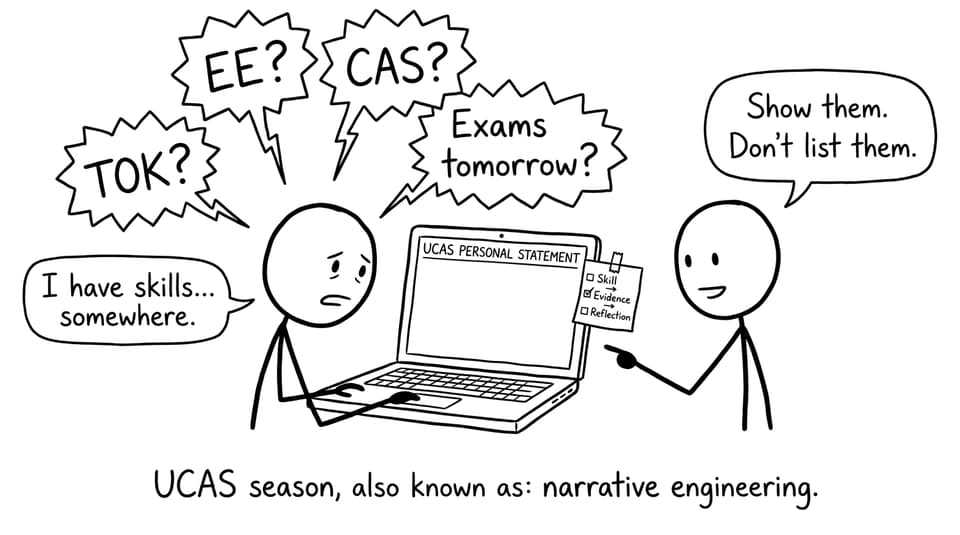
UCAS skills quick checklist (save this)
-
Pick 3-5 skills that match your course
-
For each skill, write one concrete example (project, lesson, outcome)
-
Add numbers or specifics (time, impact, result)
-
Include reflection (what changed in how you think or work)
-
Keep it academics-first (your subject interest is the spine)
-
Cut any line that doesn’t support “I’m ready for this degree”
If you need the bigger picture of what goes where, start with UCAS application structure explained and then come back to craft your evidence.
The UCAS rule: skills don’t count without evidence
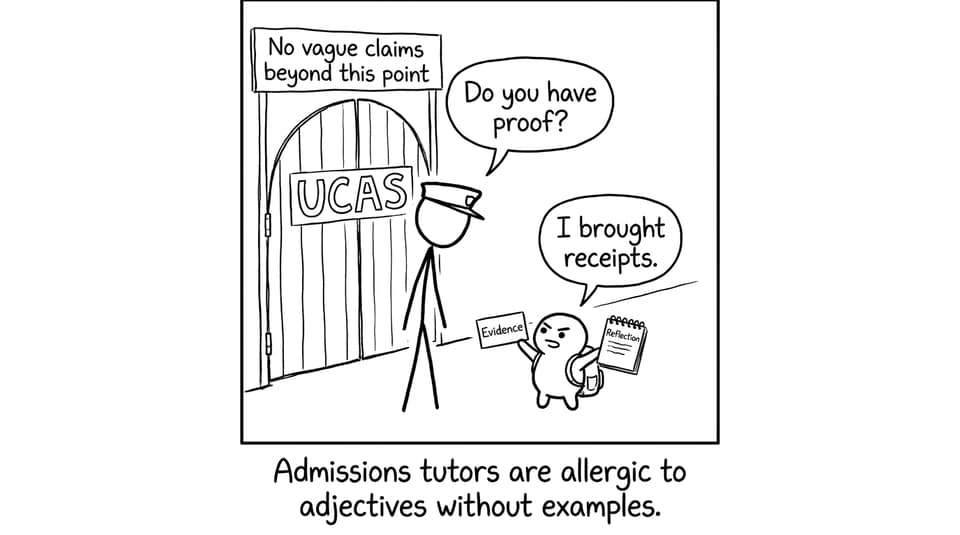
A UCAS statement is not a list of traits. It’s closer to an argument: claim, proof, meaning.
So instead of writing:
- “I am resilient.”
Write:
- “While drafting my Extended Essay, my initial sources didn’t support my hypothesis. I rebuilt my approach, refined my research question, and learned to treat setbacks as data rather than failure.”
That structure (challenge to action to lesson) mirrors what you’re trained to do in IB anyway. If your EE process is messy, it helps to borrow a clearer framework from How to survive the IB Extended Essay research process.
How to choose the right skills for your course
The strongest UCAS applications feel tailored because the skills are course-relevant.
Use this simple filter: if a tutor asked, “How does this help you succeed on our modules?” could you answer in one sentence?
Examples:
-
Engineering: problem-solving, modelling, teamwork, precision under time pressure
-
Medicine: empathy, communication, resilience, ethical reasoning
-
Law: argumentation, critical reading, clarity in writing, attention to detail
-
Economics: data interpretation, evaluation, structured essays, curiosity about incentives
If you’re applying to multiple related courses, you’ll need broad skills that still feel focused. How to tailor your personal statement for different courses is useful when you want one statement that stays honest across choices.
Turn IB experiences into UCAS-ready proof (easy examples)
Here are high-yield IB experiences that naturally produce strong UCAS evidence:
Extended Essay and IAs (research, analysis, persistence)
-
Show how you formed a question, evaluated sources, and improved your method.
-
Mention constraints: limited data, conflicting viewpoints, time pressure.
If you’re worried about structure and concision, use the discipline from Mastering the IB Extended Essay word count to learn what to cut.
TOK (critical thinking, nuance, communication)
-
Write one sentence that shows you can hold two ideas at once.
-
Link it to your subject: “This is why I’m drawn to X at degree level.”
CAS, clubs, sport, part-time work (teamwork, leadership, responsibility)
-
Avoid titles. Explain behaviours.
-
“I led” is weaker than “I changed our system by…”
The language shift that makes UCAS sound mature
Two tweaks transform a UCAS paragraph:
Use active verbs
Coordinated, investigated, evaluated, designed, coached, synthesised, iterated.
Add reflection (one sentence is enough)
Reflection is not “I learned a lot.” It’s the specific change.
-
“It taught me to plan.” (vague)
-
“It taught me to plan backwards from constraints, which is how I now approach deadlines.” (real)
If you want models of what that tone sounds like, skim UCAS personal statement examples that work and notice how often the writer explains cause and effect.
Common UCAS mistakes IB students make (and quick fixes)
-
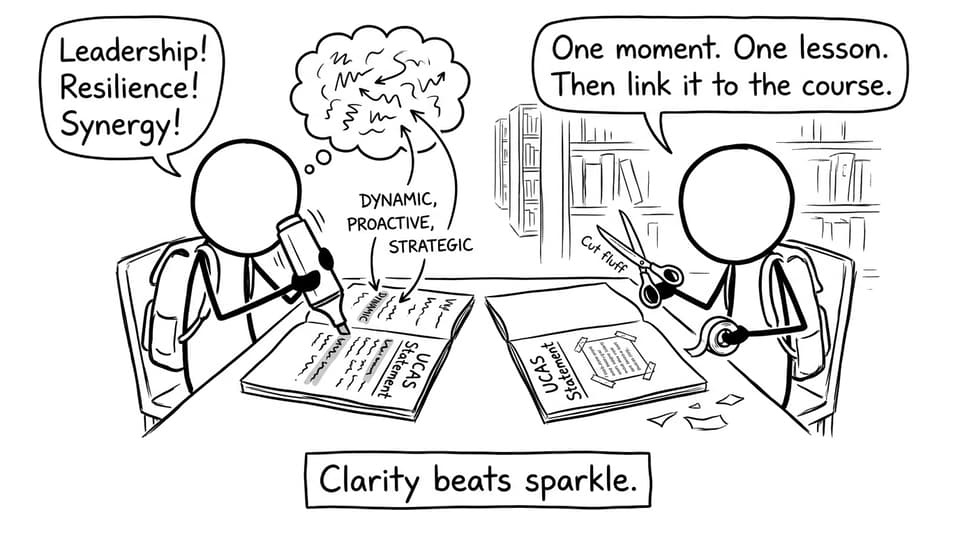
Vague traits: Replace adjectives with one example and one outcome.
-
Too many activities: Fewer experiences, deeper reflection.
-
No course link: End each paragraph with a line that points back to the degree.
-
Buzzword overload: Clarity beats sparkle.
For a focused list of pitfalls to avoid, see Common personal statement mistakes to avoid and Common UCAS myths busted.
A final way to think about UCAS (and a practical next step)
UCAS is not asking you to be extraordinary. It’s asking you to be specific.
Pick the few skills that genuinely match your course. Prove them with evidence from IB life. Reflect like someone who’s learned, not someone who’s advertising.
When you’re ready to build that clarity alongside exam confidence, make RevisionDojo your home base: drill weak areas with the Questionbank, compress content with Study Notes, lock memory with Flashcards, practise under pressure with Predicted Papers and Mock Exams, and polish your writing using AI Chat, Grading tools, the Coursework Library, and Tutors. Your UCAS application should sound like the same person who will sit the exams: prepared, honest, and hard to ignore.