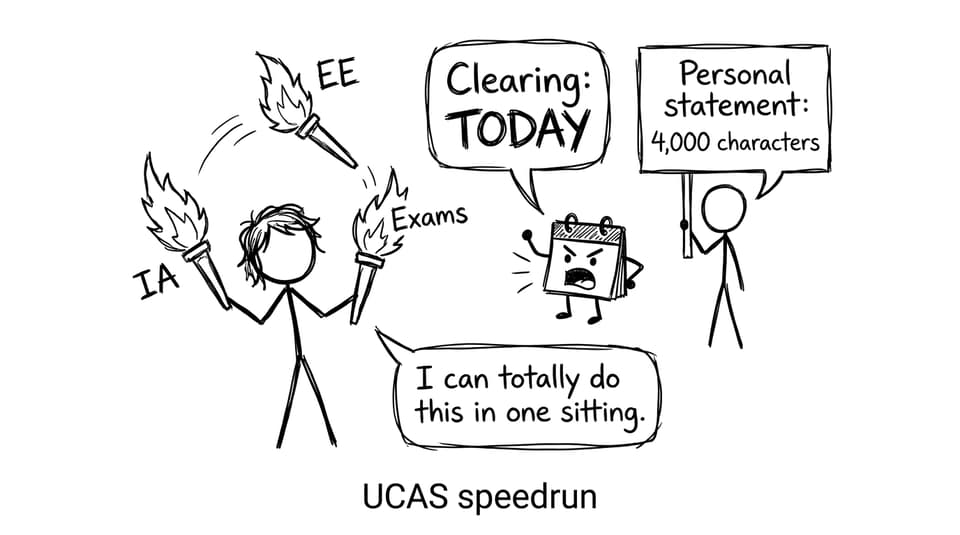
Clearing days have a specific kind of silence. Your phone is loud. Your tabs are louder. And somewhere between an IB revision plan and a results-day conversation, you realise you need a UCAS personal statement -- fast.
The good news: speed doesn’t have to mean sloppy. A UCAS personal statement written in a hurry can still feel grounded, specific, and convincing, as long as you stop trying to write “perfect” and start trying to write “true.”

UCAS Clearing quick-start checklist (10 minutes)
Use this checklist before you write a single sentence for UCAS:
-
Pick one course and read its module list for 5 minutes
-
Write three reasons you want it (no clichés)
-
List two IB proof points (EE, IA, subject topic, project)
-
Choose one experience that shows relevant skills (keep it short)
-
Decide your closing line (future direction + readiness)
-
Leave 5 minutes for a ruthless proofread
If you’re also juggling IB exam prep, protect your time. You’re building an application and maintaining momentum -- not trying to win an award for literary beauty.
The 30-minute UCAS structure that works under pressure
A fast UCAS personal statement is easier when the structure is non-negotiable. Think of it like an IB timed response: the marker rewards clarity, evidence, and relevance.
Start with a direct motivation line
Skip the life story. In Clearing, the first two sentences should answer: Why this subject, right now?
A clean approach:
-
1 sentence: what interests you
-
1 sentence: what proved it (IB class, EE/IA, reading, problem you explored)
If you want a deeper overview of how the UCAS application is assessed, keep this open while you draft: UCAS Application Structure Explained.
Put academics first (because Clearing readers move fast)
Your academics are your quickest credibility signal in UCAS. As an IB student, you already have rich material -- you just need to select, not dump.
Include:
-
Relevant IB subjects (HL especially)
-
One EE or IA insight that connects to the course
-
Skills you can name plainly: analysis, evaluation, modelling, research
When you’re exhausted, you’ll be tempted to sound grand. Don’t. Specific beats impressive.
Add one experience, then link it back
Work experience, volunteering, competitions, student leadership -- any of these can work in UCAS if you connect it to the course.
Keep it tight:
-
What you did
-
What skill it built
-
Why that skill matters for the degree
If you’re switching course direction at the last minute, you’ll want this open too: How to Update Your UCAS Personal Statement for Last-Minute Applications.

End with confidence, not drama
A good UCAS ending doesn’t beg. It closes the loop.
Do this:
-
Restate motivation (one sentence)
-
Show direction (career interest or problem area)
-
Signal readiness (skills + mindset)
Don’t do this:
-
Apologise for grades
-
Overpromise (“I will change the world”)
-
Add new examples in the final two lines
Common UCAS mistakes when you’re writing in a hurry
When time is tight, the same errors show up again and again:
-
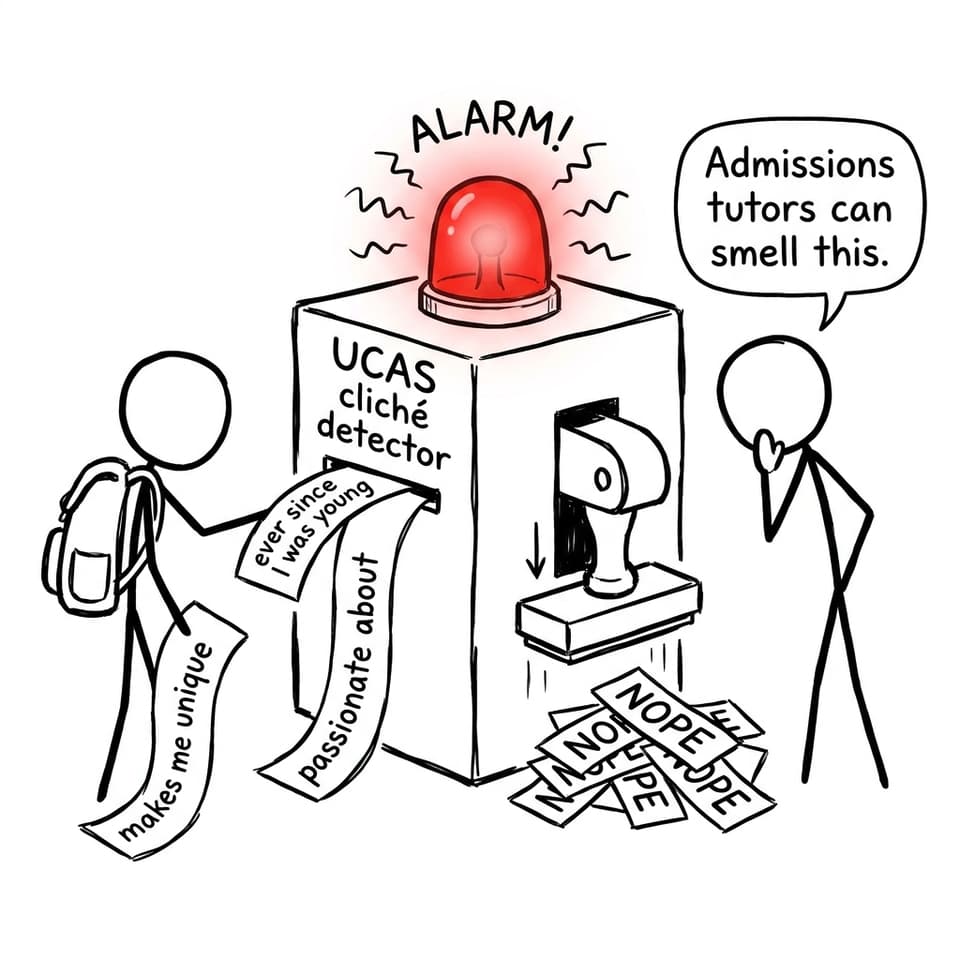
Clichés (“ever since I was young…”) instead of evidence
-
Generic claims with no IB proof
-
Too many examples and no reflection
-
Copying templates that don’t match the course (and risk plagiarism checks)
-
Skipping proofreading because it feels optional
If you want a calmer mental reset before you edit, RevisionDojo’s study-system thinking helps: You’re Not Lazy -- Your IB Study Method Is Broken.

How RevisionDojo helps when UCAS and IB collide
Clearing rarely arrives alone. It lands during revision, mocks, or the final stretch of IB coursework. That’s why your system matters.
RevisionDojo is built for that exact pressure:
-
Use the Study Notes to quickly refresh the course-adjacent topic you mention in UCAS
-
Drill confidence with the Questionbank when exams are close and your brain needs structure
-
Turn key achievements into clean phrasing with Flashcards (yes, writing phrases can be revised too)
-
Use AI Chat to tighten sentences, remove repetition, and keep tone professional
-
Check clarity with Grading tools (structure, argument, evidence)
-
Stay exam-ready with Predicted Papers and Mock Exams while you sort your application
-
Ground your examples with the Coursework Library (so you describe EE/IA work accurately)
-
If you need a human voice, tap Tutors for quick feedback
If you’re rebuilding routines at the same time, this pairs well with Clearing pressure: Time Management in IB: Tools and Techniques.
Closing: make UCAS simple, then return to your IB plan
A UCAS personal statement in a hurry isn’t a lesser version of you. It’s a focused version -- the one that knows time is real, and still chooses clarity.
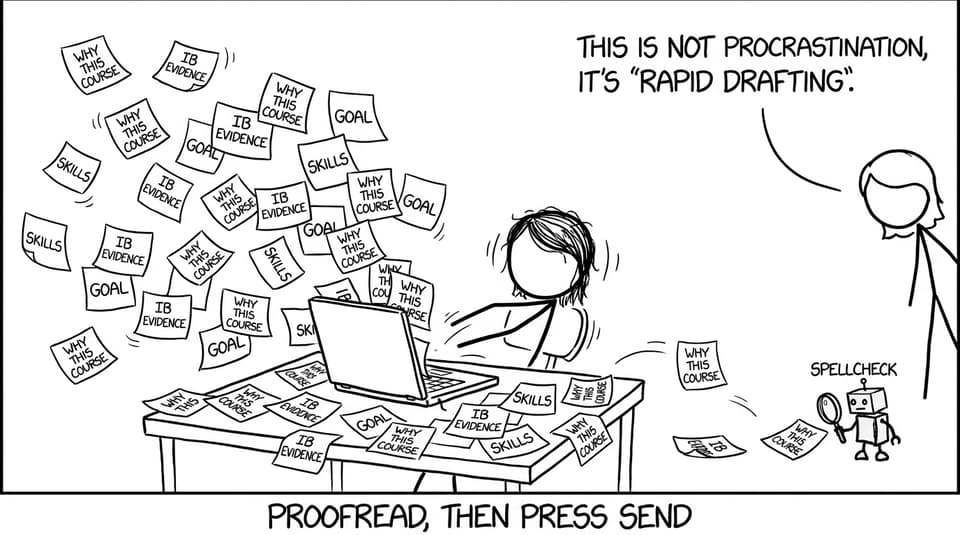
Write the draft in one sitting. Edit once. Proofread once. Then press send, close the tab, and go back to the next small IB task in front of you.
If you want a steadier way to handle both UCAS pressure and IB exam prep, build your routine inside RevisionDojo using Study Notes, Flashcards, the Questionbank, AI Chat, Grading tools, Predicted Papers, Mock Exams, the Coursework Library, and Tutors. The point is simple: fewer tabs, fewer spirals, more progress.