
If you are an IB student staring at results day like it is a countdown timer, you already understand the problem with UCAS Clearing: decisions move faster than your nerves.
You might have an hour. You might have 30 minutes. You might have a phone call that ends with, “Email us your personal statement now.” In that moment, the goal is not literary perfection. The goal is a clear, specific, believable statement that makes an admissions tutor think: this student knows what they are applying for, and they will stick with it.
This is your fast writing guide for UCAS Clearing 2025, built for IB students who are also trying to keep exam preparation from collapsing.
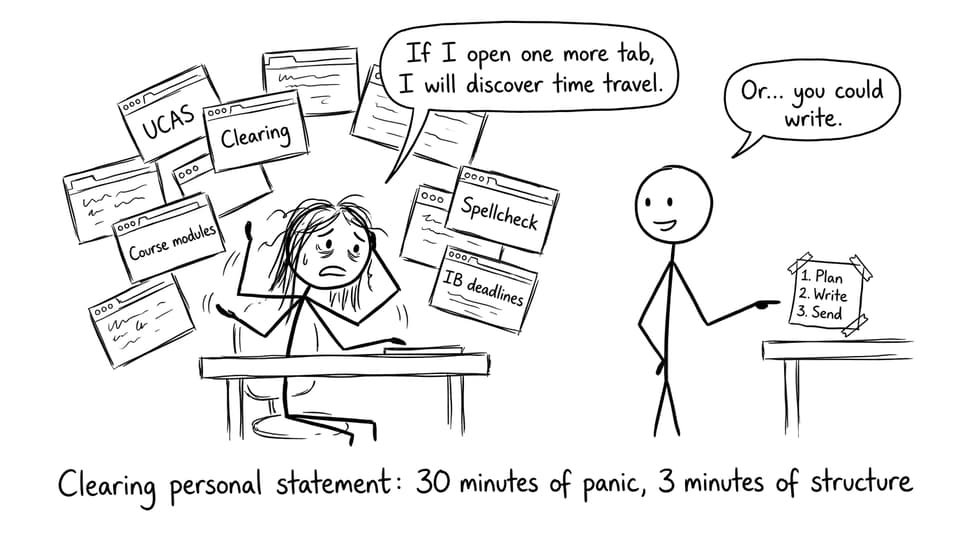
UCAS Clearing personal statement: the 10-minute pre-write checklist
Before you write a single sentence for UCAS, do this quick setup. It prevents the most common Clearing mistake: sounding generic because you did not anchor your statement to a real course.
-
Choose one course you are actually going to ask about (not five at once).
-
Open the course page and copy the names of 2-3 modules you genuinely like.
-
Write 3 bullet reasons you want the subject right now.
-
Write 2 bullet “IB proof points” (EE, IA, a unit you enjoyed, a project, a competition).
-
Write 3 skills you can evidence (analysis, lab technique, coding, essay structure, teamwork).
-
Leave 3 minutes for spelling and clarity.
If you need a bigger Clearing plan alongside the writing, keep UCAS Clearing Explained: Step-by-Step open in another tab.
Why UCAS still cares about your statement in Clearing
Even in UCAS Clearing, tutors are not only matching grades to vacancies. They are trying to reduce risk.
A strong statement signals four things:
-
You understand the subject (not just the vibe of it).
-
You have evidence you can handle the work.
-
You chose the course intentionally, even under pressure.
-
You will show up in October and keep going.
That is why a tight, targeted UCAS Clearing statement can change the outcome of a call.
The 30-minute UCAS method (built for busy IB students)
Think of this like an IB exam response: structure first, style second. You are building a short chain of claims and proof.
Minutes 1-5: write an opening that is specific, not dramatic
Your first two sentences should answer: why this subject, and what proved it.
Use one of these triggers:
-
An IB topic that hooked you (and what question it raised).
-
Your EE/IA and what you learned from investigating it.
-
A small project that made the subject feel real.
Example shape (do not copy, imitate the logic):
“I want to study Economics because IB macroeconomics made me curious about how policy choices reshape real lives. Exploring inflation and inequality in my coursework pushed me to read beyond the syllabus and test ideas with data.”
If your Clearing route is complicated, it helps to understand where you stand. Keep UCAS Adjustment vs Clearing 2025 saved so you do not waste energy second-guessing the process.
Minutes 5-15: prove you can do the course (evidence, then skill)
This is the most important part for UCAS.
Write 2 short paragraphs. Each paragraph should follow this pattern:
-
Evidence (what you did)
-
Skill (what it shows)
-
Relevance (why it matters for the degree)
Good IB evidence includes:
-
Extended Essay topic and method
-
Internal Assessment challenge and what you improved
-
A particular text, lab, case study, or problem set you pushed further
If you are also trying to keep IB revision moving, do not build a brand-new study system during Clearing week. Use a stable loop: How to Study for IB Exams: Step-by-Step Guide is a solid reference.
Minutes 15-25: show course fit by naming modules (this is where most statements fail)
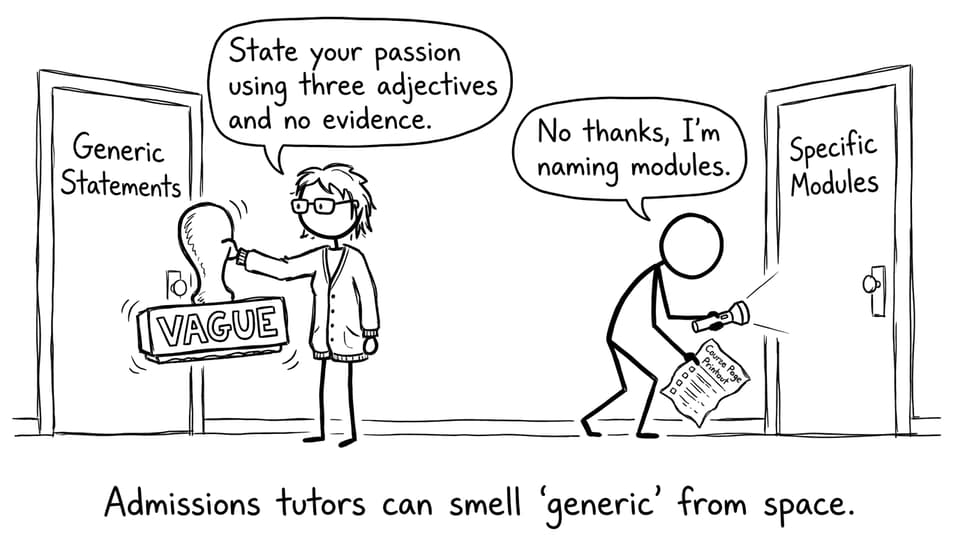
The fastest way to sound serious in UCAS Clearing is to mention modules.
Pick 2-3 modules from the course page and write one sentence for each:
-
why it interests you
-
how it connects to something you have already done
-
what direction it points you toward
This is also where subject changes can work in your favour. If you are pivoting, say so calmly:
-
what you studied
-
what skill transfers
-
what experience made you switch
Minutes 25-30: a confident, brief closing
A good UCAS Clearing closing is not poetic. It is decisive.
Include:
-
one sentence: motivation to commit
-
one sentence: readiness to contribute
Then stop. Overwriting is how you introduce mistakes.
The fastest way to adapt an existing UCAS statement
If you already have a UCAS personal statement, do not throw it away.
Use this fast edit path:
-
Keep your strongest evidence paragraphs.
-
Delete any lines tied to the old course choice.
-
Add one “pivot paragraph” explaining the new subject fit.
-
Replace vague phrases with the course page language (module titles help).
To reduce Clearing chaos, print a one-page prep sheet from UCAS Clearing Checklist 2025.
Using your statement during UCAS Clearing calls
Sometimes the call goes well, then you get asked to send your statement immediately. Speed matters, but so does consistency.
-
Mirror the subject language you used on the phone.
-
Send as a clean PDF with a sensible filename.
-
Follow up politely if you do not get confirmation.
If you want to handle calls like a calm negotiator, read How to Negotiate Offers During UCAS Clearing Calls.
How RevisionDojo helps when UCAS stress overlaps with IB exams
Clearing week often lands right on top of the mental fatigue you have banked from IB.
RevisionDojo is built for that overlap:
-
Use Study Notes when you need fast clarity, not another long video.
-
Use the Questionbank when you need marks-focused practice under time.
-
Use Flashcards to keep recall alive in small sessions.
-
Use AI Chat when you are stuck and need a clean explanation quickly.
-
Use Grading tools and the Coursework Library to reduce uncertainty around written work.
-
Use Predicted Papers and Mock Exams to rehearse pressure properly.
-
Use Tutors when you need a human to diagnose what is actually holding you back.
If you want the simplest revision foundation, start with 10 Proven Study Techniques for IB Students.
A final note for UCAS Clearing 2025
Clearing is not a verdict on your ability. It is a fast reroute.
Write your UCAS statement like you would answer an IB question: make a claim, support it with evidence, and show you understand what is being asked. Then use RevisionDojo to keep your exam preparation steady while you handle the admin storm.
If you are building your plan for results day, start with the UCAS tag hub and keep your next steps simple, specific, and calm.