


The right MYP study hours per week are usually 4-7 hours for MYP Years 1-3 and 7-10 hours for MYP Years 4-5, including assigned homework and independent revision outside class. During assessment periods, older students may temporarily need 10-12 hours.
These are starting ranges, not official IB requirements. The IB does not prescribe one universal number of independent study hours, and schools set different homework expectations. Your subjects, assessments, Personal Project workload, learning needs, and extracurricular commitments all matter.
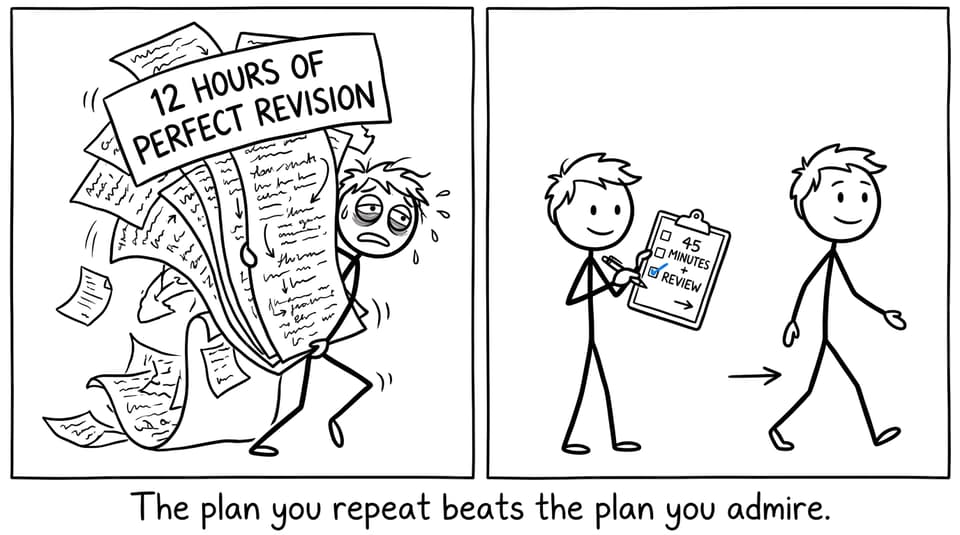
The deeper point is easy to miss: hours are an input, not a result. Six focused hours spent recalling ideas, answering questions, and correcting mistakes can achieve more than twelve distracted hours of rereading.
A quick MYP study-hours checklist
Use this as a starting point:
| MYP stage | Suggested weekly total outside class | Typical pattern |
|---|---|---|
| MYP Years 1-2 | 4-6 hours | 30-45 minutes on five or six days |
| MYP Year 3 | 5-7 hours | 45-60 minutes on most weekdays, plus a short weekend block |
| MYP Years 4-5 | 7-10 hours | 60-90 minutes on most weekdays, plus one or two weekend blocks |
| Assessment periods | Add 1-3 temporary hours | Timed practice and targeted review, not daily marathons |
Count assigned homework within these totals. Do not complete eight hours of homework and assume you must add another eight hours of revision.
Your plan is probably appropriate if you can:
- complete important assignments without repeated late nights;
- revisit weaker subjects before assessments are announced;
- explain recent concepts without looking at notes;
- practise applying knowledge, not merely reading it;
- maintain sleep, exercise, and meaningful time away from schoolwork.
For a broader starting point, explore the RevisionDojo MYP resources, organised by subject and learning activity.
Why there is no perfect number
The MYP is designed for students aged 11 to 16 and can extend across five years. Its broad curriculum includes eight subject groups, with assessment connected to subject-specific criteria. In the final year, schools may also participate in optional MYP eAssessment, and students complete the Personal Project.
That breadth makes one fixed number misleading. A Year 1 student completing ordinary assignments does not have the same workload as a Year 5 student balancing the Personal Project, ePortfolios, and on-screen assessment preparation.
Schools also organise homework differently. Some distribute work steadily; others create heavier weeks around summative tasks. Even within one class, a mathematics problem set may take one student 30 minutes and another 70 minutes.
Treat your recommended range as a budget. Spend more of it where the next meaningful improvement is likely to happen. The guide to balancing the eight MYP subject groups can help when every subject appears urgent.
Calculate your personal weekly target
Start with the range for your MYP year, then make three adjustments.
Add your fixed workload
List assignments already due and estimate how long each will take. Break projects into concrete actions such as researching two sources, drafting one section, or revising one criterion. A task called “work on Design” expands indefinitely; “test the prototype and record three observations” has an endpoint.
Add deliberate revision
Homework and revision overlap, but they are not identical. Homework responds to what a teacher assigns. Revision deliberately returns to knowledge or skills you are at risk of forgetting.
On an ordinary week, reserve two or three sessions for independent revision. Older students or those approaching eAssessments may need four or five. RevisionDojo’s complete MYP revision guide explains how to connect sessions to criteria, concepts, and command terms.
Add a buffer, not a fantasy
Leave 10-15% of your planned time unscheduled. If you plan every available minute, one difficult task can damage the entire week. A buffer absorbs unfinished work, unexpected deadlines, or a day when concentration is poor.
For example, an MYP Year 4 student with an eight-hour target might allocate five hours to assignments, two hours to active revision, and one hour as a flexible buffer. The buffer is not extra punishment.
A step-by-step method
You do not need a new semester or perfect planner. You need about 15 minutes to build a workable system.
Empty your head onto one page
Write down every assignment, assessment, project milestone, and weak topic you can remember. Check your school platform afterward and add anything missing.
Mark urgency and value
Use three labels:
- Now: due soon or connected to a major assessment;
- Next: important, but not immediately due;
- Maintain: brief recall or practice that keeps a subject warm.
Choose no more than two Now priorities. A plan containing eight priorities is only a list.
Choose your weekly total
Select the lower end of your range if schoolwork is light. Choose the upper end if major assessments are approaching or several concepts remain weak. Stay closer to your normal range if increasing study would substantially reduce sleep.
Schedule focused blocks
Create four to eight blocks, depending on your target and assigned workload. Give each block a specific outcome rather than a subject name.
A strong 45-minute block could look like this:
- 5 minutes: retrieve what you know without help;
- 10 minutes: repair one gap using Study Notes;
- 20 minutes: answer targeted Questionbank questions;
- 7 minutes: inspect errors and improve one response;
- 3 minutes: record what to revisit.
RevisionDojo connects explanation, retrieval, application, and feedback through Study Notes, Flashcards, Questionbank, AI Chat, and Grading tools. The MYP syllabus and resource directory helps you choose the exact topic for today’s block.
Review the evidence weekly
Ask what you can now do without notes, which mistake appeared more than once, and whether you need more time or a better technique. Increase next week by only 30-60 minutes if important work remains unfinished despite genuine focus. If you completed everything and retained it, keep the same total rather than adding hours for appearance.
MYP revision techniques that make each hour count
Good revision creates evidence of learning. You should finish with answered questions, recalled explanations, corrected errors, or an improved draft.
For factual knowledge, use active recall and spaced repetition. Read a short explanation, close it, and reconstruct the idea from memory. RevisionDojo Flashcards can support this rhythm, while the guide to spaced repetition for IB students shows how to revisit material over time.
For Mathematics and Sciences, spend more time solving than highlighting. The guides to MYP Mathematics study techniques and effective MYP Sciences revision explain how to practise unfamiliar contexts and turn mistakes into reusable rules.
For Language and Literature, write small pieces frequently. A timed paragraph followed by criterion-based improvement is often more useful than vaguely planning a full essay. Use these MYP Language and Literature revision strategies to focus on analysis, organisation, and authorial choices.
When assessments approach, add timed practice through Mock Exams and Predicted Papers, where available. Use the Coursework Library to study structure rather than copy content, and seek Tutors when repeated practice does not resolve the underlying confusion. Students preparing for digital assessment can follow these MYP eAssessment preparation tips.
Signs you should change your schedule
Add a small amount of time when you regularly leave assignments unfinished, cannot recall recent learning, or enter assessments without practising the required format. First check that your sessions are focused; more distracted time rarely solves a concentration problem.
Reduce or reorganise your hours if studying repeatedly pushes bedtime later, replaces every activity you enjoy, or produces long sessions with little measurable output. RevisionDojo’s guide to balancing MYP schoolwork and extracurriculars offers a useful model for crowded weeks.
The best schedule is not the one with the largest number. It is the one you can repeat, evaluate, and improve. Start within the recommended range, complete one focused block today, and let your results guide the next adjustment.
RevisionDojo gives that process a home: clear Study Notes, active Flashcards, targeted Questionbank practice, Jojo AI Chat, Grading tools, realistic assessment practice, coursework support, and Tutors when human guidance matters. The aim is not to make every week feel intense. It is to make every study hour have a purpose.