

Managing several MYP assignments can feel less like studying and more like watching eight clocks count down at once. The solution is not to work on everything every evening. To manage MYP coursework deadlines across subjects, put every commitment in one calendar, divide each assignment into visible milestones, prioritize by consequence and effort, and schedule specific work blocks before the final due date.
MYP coursework is varied. A mathematics investigation, science report, language presentation, design product, and Personal Project milestone do not move forward in the same way. A useful plan reveals the next action for each subject.
The same-day deadline checklist
- Collect every deadline from school platforms, teachers, assignment sheets, and project handbooks.
- Record everything in one master calendar.
- Break large assignments into milestones that produce something visible.
- Mark each task as focus, maintenance, or waiting.
- Schedule work blocks with a clear outcome.
- Add a buffer before every important submission.
- Review the calendar for five minutes each afternoon.
This complements RevisionDojo's guide to balancing MYP subject groups. The aim is not to build a beautiful planner. It is to make tomorrow obvious.
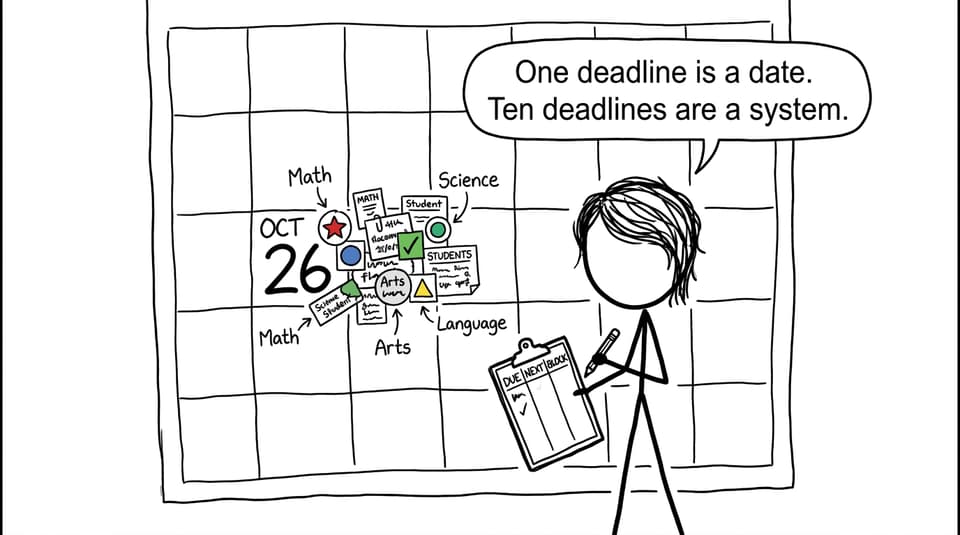
Build one reliable source of truth
Open every place where work is assigned, including learning platforms, email, classroom calendars, task sheets, and Personal Project schedules. Transfer each confirmed date into one calendar you will actually check.
For every entry, record:
- Subject and assignment name
- Final school deadline
- Submission method
- Assessment criteria or task requirements
- Estimated effort
- Next physical action
“Science report” is not a next action. “Graph the results and label both axes” is. “Language presentation” is not actionable. “Choose three supporting examples for slide two” is.
When information conflicts, ask the teacher rather than guessing. Internal deadlines can differ for projects, portfolios, drafts, and supervisor meetings. Your school is the authority for the dates that apply to you.
Turn deadlines into milestones
Break any task requiring more than one sitting into small deliverables:
| Milestone | Evidence of completion |
|---|---|
| Understand the task | Criteria highlighted and questions written down |
| Gather material | Sources or data collected and organized |
| Plan | Section outline completed |
| Draft | Complete rough version produced |
| Improve | Feedback applied and criteria checked |
| Submit | Correct file uploaded and submission confirmed |
Work backwards from the official deadline and place these milestones on your calendar. For a major assignment, aim to finish the complete draft several days early. A smaller task may need a shorter buffer.
The MYP Personal Project especially rewards visible process. Official IB guidance describes the process, product or outcome, and reflective report, with planning and self-management among the relevant approaches to learning. RevisionDojo's MYP Personal Project guide explains how to maintain milestones, evidence, and reflection throughout the project. The same principle applies to the MYP Community Project planning guide.
Prioritize by consequence, urgency, and effort
For each task, ask three questions:
- Consequence: How significant is this assessment or milestone?
- Urgency: How soon must meaningful progress happen?
- Effort: How much focused time remains?
Then assign one of three labels:
- Focus: Important, approaching, or demanding. Schedule a substantial block.
- Maintenance: Needs a small action so it does not become urgent later.
- Waiting: Blocked by feedback, group input, materials, or clarification.
Choose no more than two focus subjects on an ordinary school day. Other subjects can receive short maintenance blocks, such as reviewing Flashcards, fixing one paragraph, or completing a small Questionbank set. This rotation prevents one project from consuming the week while other deadlines approach.
RevisionDojo's MYP homework guidance applies a similar principle: urgent and important work comes first, important but non-urgent work is scheduled, and lower-value tasks receive a sensible limit.
Schedule outcomes, not intentions
“Study science from 5:00 to 6:00” leaves room for indecision. “Draft the method and create the raw-data table from 5:00 to 5:40” gives the session a finish line.
Each block needs a start time, a realistic duration, a named output, and a stop rule. Blocks of 25 to 50 minutes often work well, but the assignment should determine the length. Put demanding work when you usually think most clearly. Reserve lower-energy periods for formatting, citations, file organization, Flashcards, or process-journal updates.
Leave open space for tasks that take longer than expected, technical problems, illness, or new feedback. A calendar without buffers is a fragile plan.
Keep revision alive during coursework-heavy weeks
Coursework expands to fill available time unless revision has protected space. During a busy submission week, maintain subjects without immediate assignments through short sessions:
- Use Study Notes to repair one specific knowledge gap.
- Complete a small Questionbank set linked to that gap.
- Review errors and write one rule for the next attempt.
- Use Flashcards for definitions, processes, and command terms.
- Revisit the weak area after a day or two.
The MYP revision guide offers a broader routine built around criteria, concepts, practice, and reflection. The guide to MYP mathematics study techniques shows how practice can be organized around criteria instead of undirected question volume.
These MYP study tips separate maintenance from deep coursework. Ten focused minutes of retrieval can preserve knowledge without taking the block needed for a major draft.
Run a five-minute daily review
At the end of each school day, ask:
- What changed today?
- What is the next action for each focus task?
- Am I waiting for feedback or clarification?
- Which deadline needs a buffer?
- What must be prepared before tomorrow's first block?
Move unfinished work deliberately. If you repeatedly postpone an item, it is probably too vague, too large, or blocked by a question.
Once a week, look two weeks ahead, check every subject, and identify deadline collisions. Move milestone work earlier while the calendar still gives you choices.
Use RevisionDojo as a workflow, not another tab
RevisionDojo works best when each tool has a defined role. Use Study Notes for fast clarification, Questionbank for targeted application, and Flashcards for maintenance. Ask AI Chat to explain concepts or identify questions to investigate while keeping submitted work authentically your own.
For coursework, use Grading tools to locate unclear reasoning, then verify advice against your teacher's rubric. The Coursework Library can help you study structure and evidence without copying. Tutors provide human feedback when a recurring problem is difficult to diagnose alone.
As assessments approach, Mock Exams and Predicted Papers, where available for your course, can occupy timed-practice blocks. The MYP eAssessment preparation guide explains how to combine criteria-based review with realistic timing.
A calmer week starts with one visible next step
Good deadline management is rarely dramatic. It is a calendar checked before problems grow, a draft completed before the final evening, and a small task moved forward while it is still small.
Start by collecting your dates, creating milestones for the three largest assignments, and scheduling tomorrow's first concrete work block. RevisionDojo can carry the academic side of that routine, explanations, practice, feedback, models, and expert support, while your calendar protects the time needed to use it well.