If you have ever stared at a blank document titled “Community Project” and felt your brain try to negotiate a smaller life, you are not alone. The MYP Community Project is one of those assignments that sounds inspiring in theory and feels like a thousand tiny decisions in practice. The twist is that this same decision-making muscle is the exact one you will need for exam season: planning under pressure, choosing what matters, and proving your thinking with evidence.
This guide is a calm, student-first walkthrough of MYP Community Project planning. Not just “what to do,” but how to keep it manageable while you are still studying for tests, building routines, and trying to stay human.
The 10-minute MYP Community Project planning checklist
Use this as your quick reset when your project starts to sprawl.
-
Choose one community need you can describe in a single sentence.
-
Pick one MYP Global Context and write a “why it matters” paragraph.
-
Write 2--4 inquiry questions you can realistically answer.
-
Set a SMART goal plus 5--8 success criteria you can measure.
-
Build a timeline with weekly checkpoints and a buffer week.
-
Decide your action type: direct, indirect, advocacy, or research.
-
Start a process journal with dated entries and evidence.
-
Plan reflection prompts before you begin, not after.
When you want more examples of choosing a lens, read Identifying the Best Global Context for Your MYP Project.
What the MYP Community Project is really testing
The MYP Community Project is typically completed in Year 3 or 4. It asks you to notice a real need, design a response, take responsible action, and then reflect on what changed. The project is not only about “impact” as in big headlines. It is about showing the project cycle: investigating, planning, taking action, and reflecting.
That is why it connects so well to exam prep. Exams reward students who can do three things: focus, justify decisions, and explain learning clearly. Your MYP Community Project is practice for that.
If you want a broader view of MYP resources (and how the programme fits together), start at Middle Years Program (MYP).
Choose a Global Context that makes planning easier
A Global Context is not decoration. In the MYP, it is your reason for caring, written in academic language. Pick one, commit to it, and keep returning to it in your journal and final presentation.
Here are a few examples that tend to produce focused projects:
-
Identities and Relationships: a peer support resource for wellbeing at school.
-
Globalization and Sustainability: reducing waste in one specific space (one cafeteria, one corridor, one club).
-
Fairness and Development: improving access to a resource (revision guides, tutoring sign-ups, language support).
If you keep switching contexts, your project starts to feel like a collage. For a clear explanation of how contexts work, use MYP Personal Project Global Contexts Explained. The logic transfers directly to the Community Project.
Turn curiosity into inquiry questions (then into a SMART goal)
Most MYP projects fail quietly at the start. Not because the student is lazy, but because the topic stays a theme instead of becoming a testable goal.
Start with 2--4 inquiry questions:
-
What is the specific need, and what evidence shows it exists?
-
Who is affected, and what do they say they need?
-
What solutions already exist, and what is missing?
-
What would “better” look like in measurable terms?
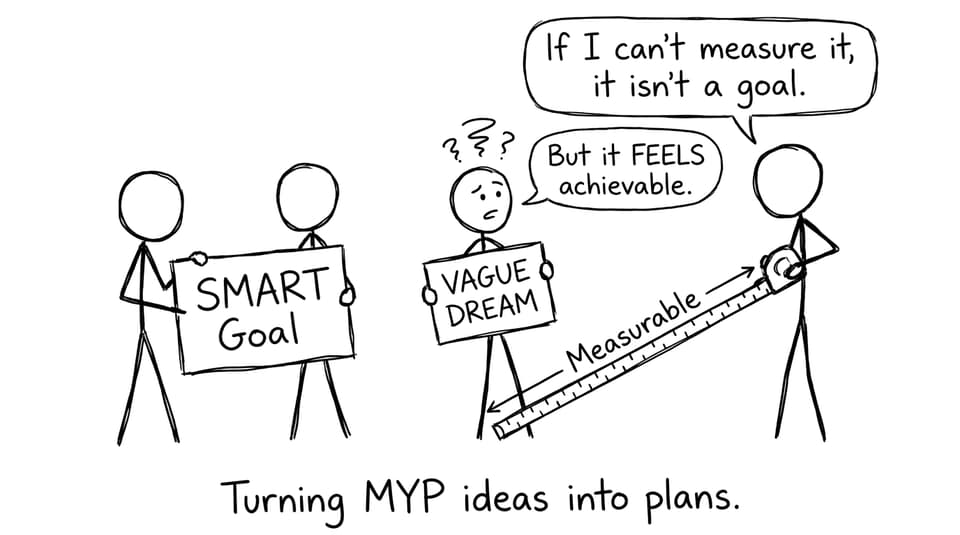
Then convert your best answer into a SMART goal. For example:
-
Weak: “Raise awareness about recycling.”
-
Strong: “Create and run a 2-week recycling campaign for Year 3 that increases correct sorting in one school area by 20%, measured by daily bin checks and a short student survey.”
The magic is not the numbers. The magic is that your future reflection becomes easy because you can evaluate something real.
For more examples of goals that actually score well, see MYP Personal Project Ideas That Score High.
Build a plan that survives real life (timeline, roles, risks)
A good MYP plan is not long. It is believable.
Use weekly checkpoints, not giant milestones
Create a timeline with weekly deliverables such as:
-
Week 1: research + first interview/survey
-
Week 2: draft solution + supervisor feedback
-
Week 3: version 1 action
-
Week 4: collect feedback + version 2 improvements
-
Week 5: final action + evidence collection
-
Week 6: presentation build + reflection polish
Add one buffer week. Something always happens.
If you work in a group, make roles visible
Group work can be brilliant in MYP when responsibilities are explicit. Assign roles (research lead, logistics lead, communications lead, evidence curator) and then rotate if needed so everyone can prove contribution.
Do basic risk planning
Write three “If X happens, I will do Y” statements. It sounds small, but it reduces panic.
To keep planning linked to reflection and assessment language, read Designing Effective MYP Service as Action Programs.
Taking action: choose the type that creates evidence
In the MYP, action can be:
-
Direct service: working with people face-to-face.
-
Indirect service: creating materials or resources.
-
Advocacy: campaigns, awareness, persuasive communication.
-
Research: collecting and sharing data that supports change.
Pick the type that fits your time, safety, and access to people. Then focus on evidence. Evidence is what turns “I did something” into “I can prove learning.”
Here is what to collect as you go:
-
photos/screenshots of drafts and versions
-
short survey results or feedback quotes
-
meeting notes with dates
-
a simple table of what changed after feedback
If you want help making your reflection sharper, Encouraging Reflection in MYP Assessments gives you prompts that avoid the classic “I learned a lot” trap.
Your process journal is your grade insurance
Think of your process journal as the story of decisions over time. In MYP, assessors want to see that research shaped your choices, plans adapted, and reflection is honest.
A strong entry is short and structured:
-
Date
-
What I did
-
What problem appeared
-
What I changed and why
-
Evidence attached
-
One ATL skill used (specific, not generic)
When you are tired, this format saves you. It also mirrors exam skills: explain, justify, evaluate.
How RevisionDojo fits into MYP project planning (without stealing your time)
Project season often overlaps with exam prep. The students who stay calm do not “work harder.” They build a stable system.
RevisionDojo is built for that system:
-
Use the AI Chat to refine inquiry questions and make your SMART goal measurable.
-
Use Study Notes when you need quick, clean explanations for background research.
-
Use Flashcards to lock in ATL phrasing and key definitions for stronger reflections.
-
Use the Questionbank to keep exam practice active while your project runs in parallel.
-
Use Grading tools to check whether your writing actually matches rubric expectations.
-
When your calendar tightens, lean on Mock Exams and Predicted Papers to stay exam-ready.
-
If you want feedback from a real person, RevisionDojo Tutors can help you tighten goal clarity and evaluation depth.
If you are also doing the Personal Project, the structure carries over nicely. Start with MYP Personal Project: The Ultimate Student Guide and, when you draft your write-up, use MYP Personal Project Report Structure Explained as a model.
Closing: make your MYP project feel lighter by making it clearer
The MYP Community Project is one of those assignments you will remember later, not because it was easy, but because it taught you how to move from intention to action. The students who enjoy it most are not the ones with the biggest ideas. They are the ones who build a small plan, collect evidence weekly, and reflect like a person who is paying attention.
If you want your MYP Community Project planning to stay calm during exam season, let RevisionDojo carry the “structure” part: keep your knowledge sharp with the Questionbank and Study Notes, lock in language with Flashcards, use AI Chat to untangle decisions, and polish your work with Grading tools. Then you can spend your energy on what actually matters: doing something real, and learning from it.