
Introduction: why the MYP Personal Project feels bigger than it is
The day your MYP Personal Project is announced, it can feel like someone quietly slid a second timetable under your desk. Same week: math test, language oral prep, maybe a tournament, and now you're supposed to become a one-person research team with a product, a report, and a reflective journal.
But the students who do well in the MYP Personal Project don't have better lives. They have smaller decisions. They pick a goal they can actually finish, they document as they go, and they treat the report like evidence, not a diary.
This guide is built for IB students who want clarity, not motivation posters. You'll learn what the MYP Personal Project is really assessing, how to plan without burning out, and how to turn your process into marks.
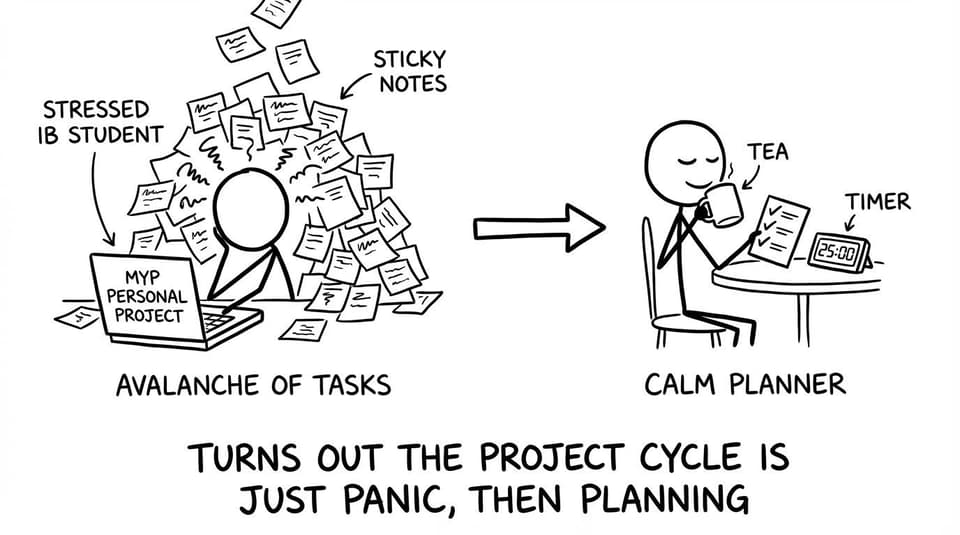
Stick-figure sticky note avalanche
Quick checklist: the MYP Personal Project in one page
If you do nothing else, do these:
-
Choose a MYP goal that is specific, measurable, and feasible.
-
Pick one Global Context and keep returning to it.
-
Define success criteria early (so you can evaluate later).
-
Keep a process journal with dated entries and evidence.
-
Map everything to Criteria A-D before you write the final report.
-
Build a "feedback loop": draft, get comments, improve, repeat.
Helpful RevisionDojo starting points:
-
Use the MYP Personal Project Grader to check how your writing aligns to the rubric.
-
Use Study Notes to tighten research summaries and explanations.
-
Use Flashcards to memorize ATL language, command terms, and key definitions.
What the MYP Personal Project is actually testing (and what it's not)
The MYP Personal Project is not a competition for the most impressive product. A simple product with a strong process can outscore a flashy product with weak documentation.
What it is testing is your ability to:
-
Investigate a topic with purpose and credible research.
-
Plan a realistic path and adapt when life happens.
-
Take action and create something that matches your goal.
-
Reflect with honesty, evidence, and learning language.
That's why the report matters so much: it's the place you prove you did the cycle.
If you want a clean breakdown of how the report is judged, read MYP Personal Project: Report Writing Breakdown alongside this guide.
Choosing a topic that scores well in MYP (without choosing something you hate)
A strong MYP topic has two qualities: you care about it, and you can finish it.
Here's the simplest way to choose:
Start with "interest" then add "constraint"
-
Interest: "I like fitness."
-
Constraint: "I can test a 6-week training plan and analyze results."
Constraint is your best friend. It forces your goal to become measurable.
Make the goal specific enough to evaluate
Your goal is the hinge of the entire MYP Personal Project. If it's vague, your evaluation becomes vague, and Criterion D suffers.
Examples of specific goals:
-
"Design and publish a 12-page beginner guitar guide and teach 3 peers using it."
-
"Create a short documentary (6-8 minutes) on local heritage using at least 2 interviews."
-
"Build a basic habit-tracking app prototype and test it with 10 users."
If you need idea sparks, use Real Examples of IB MYP Personal Projects for Inspiration.
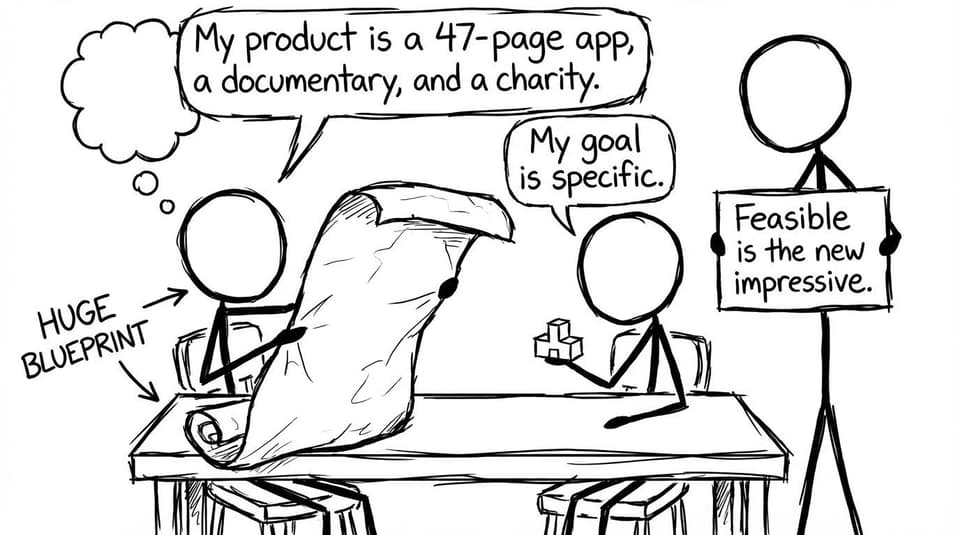
Feasible is the new impressive
Lock in the Global Context early
Your MYP Global Context is not decoration. It's the reason your project matters beyond "I wanted to." The best reports reference the Global Context in:
-
the goal justification,
-
the research choices,
-
the product decisions,
-
and the final reflection.
If you're stuck at topic stage, MYP Personal Project: Choosing a Topic You're Passionate About is a useful pre-planning read.
The MYP project cycle: how to turn the process into marks
Your MYP Personal Project is assessed with four criteria (A-D). A high-scoring student doesn't "do the project" and then "write the report." They build the report as they go.
Criterion A (Investigating): research that earns credit
High marks in MYP Criterion A usually come from:
-
A clear goal + personal justification.
-
A stated Global Context connection.
-
Research that influences decisions (not just information dumps).
Practical move: after each research session, write one sentence: "Because I learned X, I decided to change Y." Those sentences become your report.
How RevisionDojo helps:
-
Use Jojo AI to clarify concepts, generate research questions, and check whether your explanation is logically tight.
-
Build mini-recall sets with Flashcards so your research and ATL vocabulary stay usable under pressure.
Criterion B (Planning): a plan that can survive reality
A good MYP plan includes:
-
A timeline with milestones.
-
Resources you'll use (tools, people, websites, books).
-
Risk planning (what could go wrong, and what you'll do).
The hidden trick: document adjustments. If your plan changes, that's not failure. It's evidence of self-management.
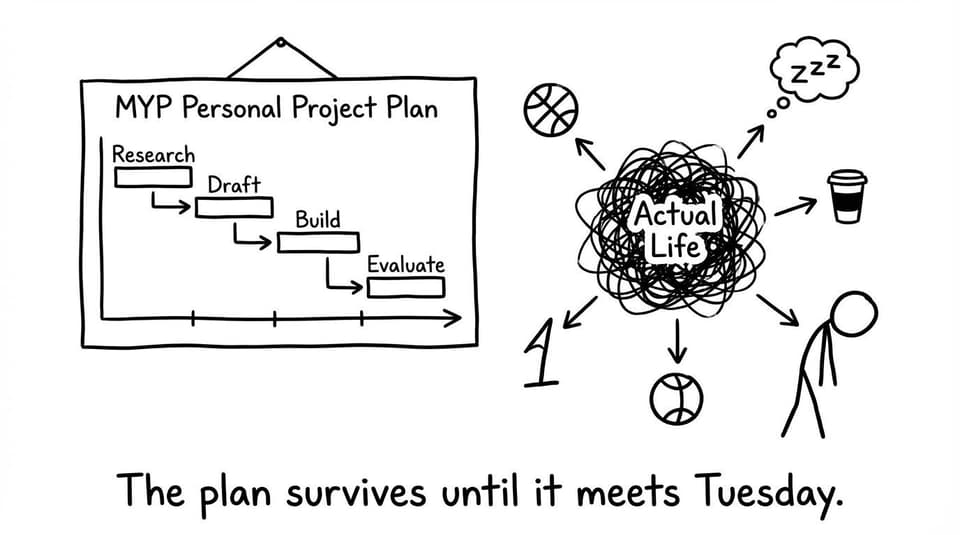
The plan survives until it meets Tuesday
Criterion C (Taking Action): show the work, not just the final thing
In MYP Criterion C, you're rewarded for evidence. Keep:
-
drafts, prototypes, screenshots,
-
photos of stages,
-
test results and feedback forms,
-
and short notes on why you changed something.
This is where students often lose marks: they create a product, but don't show the thinking that produced it.
RevisionDojo advantage: when you practice explaining your decisions, you're training an exam skill too. Use Exam Mode to run timed writing sprints for your report sections so you stop relying on "I'll write it later."
Writing the MYP Personal Project report like a scorer
Think of your MYP report as a legal case: every claim needs evidence.
Build your report from evidence blocks
Instead of writing in one long weekend, create "blocks" you can paste later:
-
Goal + justification paragraph.
-
Global Context explanation.
-
Research summary + how it shaped decisions.
-
Timeline screenshot + what changed.
-
Product development paragraph + proof.
-
Evaluation paragraph linked to criteria.
Use RevisionDojo's grader for a ruthless second opinion
Before you submit, run your draft through the MYP Personal Project Grader. Use it like a checklist:
-
Did you answer what the rubric strand is actually asking?
-
Did you provide evidence or just narrative?
-
Are you using ATL terms accurately and specifically?
And if you want to see what "good" looks like, compare structure and voice with annotated models in the IB Personal Project (MYP) Exemplars.
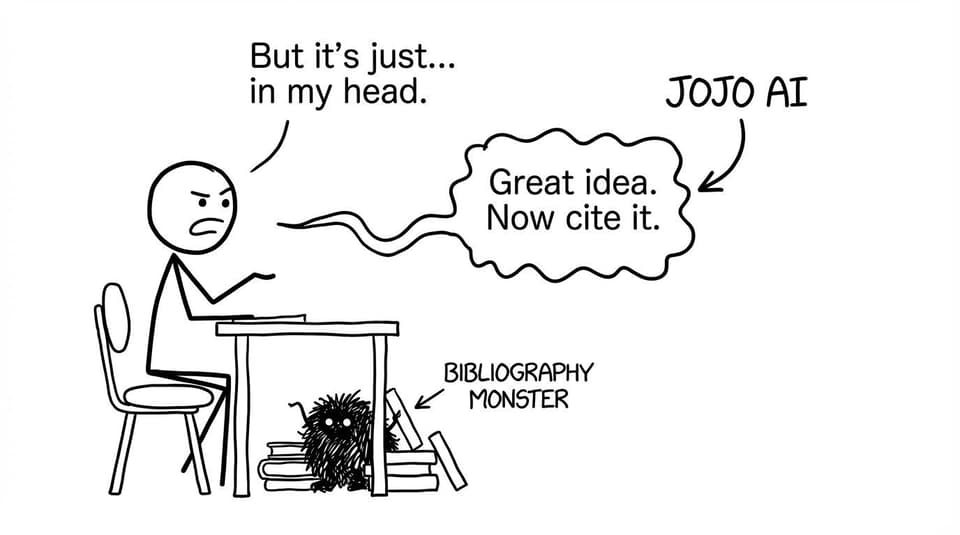
AI wants citations too
How to balance MYP Personal Project work with IB exam prep
If you're in exam season, treat the MYP Personal Project like a small weekly habit, not a second life.
Two routines that work:
-
Daily 20 minutes: update process journal + write one evidence sentence.
-
Weekly 60 minutes: one milestone + one paragraph draft.
Then, keep your "exam brain" moving using RevisionDojo:
-
Drill weak areas with the Questionbank.
-
Build memory with Flashcards.
-
Use Study Notes to fix conceptual gaps fast.
-
Use Exam Mode for timed practice to reduce stress.
This is the quiet advantage: when your MYP process is consistent, your report becomes assembly, not invention.
Conclusion: make the MYP Personal Project smaller, and it becomes powerful
The MYP Personal Project is a strange assignment because it's both personal and assessed. That tension is why it feels heavy. But if you keep it simple: a feasible goal, consistent evidence, and a report that maps directly to Criteria A-C, the whole project becomes manageable.
If you want the fastest path to confidence, build your feedback loop with RevisionDojo: use the MYP Personal Project Grader, compare structure with IB Personal Project (MYP) Exemplars, and keep your wider IB prep steady with the Questionbank, Study Notes, Flashcards, and Exam Mode.
Do the MYP cycle well once, and you'll recognize the same rhythm later in the DP: investigate, plan, act, reflect. Different stakes. Same skill.