
Choosing between IB History vs Geography is not really a choice between the past and the planet. It is a choice between two ways of thinking.
Choose IB History if you enjoy interpreting sources, debating causes, and constructing sustained arguments. Choose IB Geography if you prefer contemporary issues, spatial patterns, data, fieldwork, and combining scientific evidence with essay writing. Both require analysis, detailed examples, and independent investigation.
Then decide between HL and SL by considering university requirements, your wider subject combination, and whether you genuinely want the extra depth. The best choice is not the subject with the easiest reputation. It is the work you are more willing to practise.
IB History vs Geography at a glance
| Decision factor | IB History | IB Geography |
|---|---|---|
| Central question | Why did events happen, and how should evidence be interpreted? | Why do patterns occur across places, populations, and environments? |
| Typical material | Historical sources, competing perspectives, arguments | Maps, graphs, statistics, diagrams, case studies |
| Writing style | Historical argument and source analysis | Explanation, evaluation, and case-study application |
| Quantitative demand | Usually limited, although sources may contain numerical data | Regular interpretation of graphs, scales, and spatial information |
| Internal assessment | An independent historical investigation | A written report based on fieldwork |
| Main risk | Underestimating the precision needed for strong essays | Assuming the course is mainly map work or factual recall |
Read the broader IB History and Geography comparison, then check what your school teaches. Topic availability, fieldwork arrangements, teacher expertise, and timetable blocks can materially change the experience.
What studying History actually feels like
History rewards students who are comfortable with uncertainty. Historians can examine similar evidence and reach different conclusions because they assign different importance to economics, ideology, individuals, or institutions. Your job is to decide which explanation is most convincing and show why.
For students beginning the course in 2026, IB History follows the curriculum first assessed in 2028. Paper 1 remains source-based, while Paper 2 includes conceptual, short-response, and essay work. HL students also complete Paper 3, adding regional depth. At both levels, the internal assessment is a historical investigation involving an inquiry question and critical work with sources.
Ask yourself whether you enjoy explaining causes, assessing evidence, and challenging interpretations. Strong students learn facts as material for arguments, not as the final product. RevisionDojo’s guide to earning a 7 in IB History explores that distinction.
One useful test is to take a historical claim and ask what evidence would change your mind. If you enjoy weighing that evidence rather than simply defending your first opinion, the subject may suit you. Interest in documentaries can be a starting point, but assess whether you also enjoy the careful reading behind an explanation.
What studying Geography actually feels like
Geography begins with connections. A drought can affect food prices, migration, public policy, and health. An expanding city redistributes access to housing, transport, employment, and environmental resources.
The course sits between the social and natural sciences. You may move from a graph to a named case study, explain a process, and evaluate a response. Essays matter, but visual and numerical evidence appears frequently.
Under the current structure, SL students study the core and two optional themes. HL students study the core, three optional themes, and additional global interactions content. Both levels complete fieldwork leading to a written internal assessment report. Ask which optional themes your school offers.
For example, when examining urban transport, you might compare accessibility, environmental effects, and costs for different groups. The useful question is not only whether a policy works, but where, for whom, and under what conditions. If that movement between evidence and context interests you, Geography offers a way to develop it through structured study.
You may prefer Geography if you naturally notice spatial patterns or connect local decisions to global systems. For a fuller picture, read what IB Geography is really like.
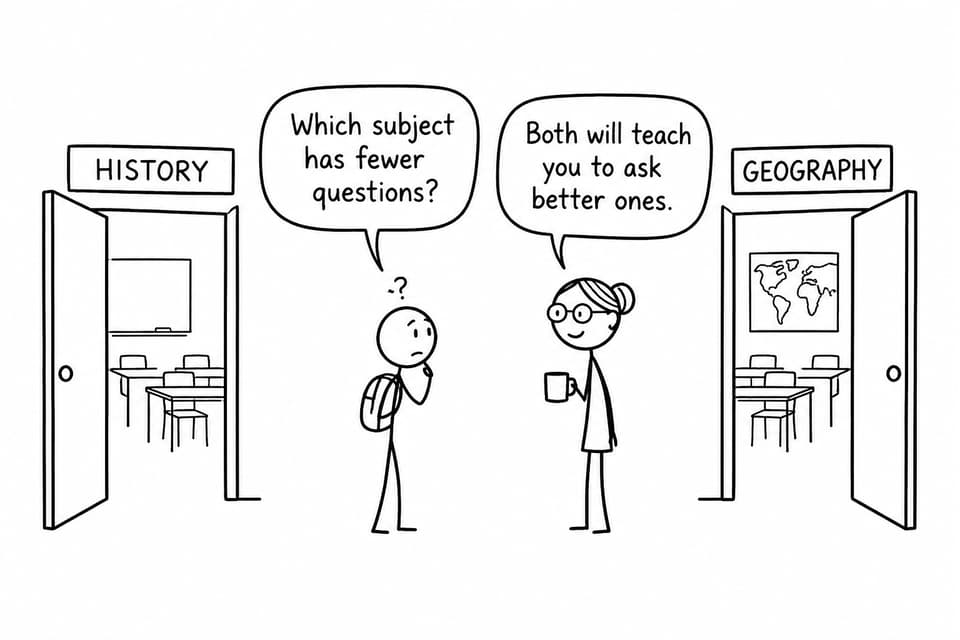
Two classroom doors offer different questions to explore.
Compare assessment, not just content
In History, success depends heavily on source handling and written argument. You must select relevant evidence, organise it quickly, address the command term, and avoid replacing analysis with narrative. Knowing what happened is not the same as explaining why it matters.
Geography draws on a broader mixture of response types. Tasks can involve unfamiliar resources, process explanations, precise case-study evidence, diagrams, and evaluation. The internal assessment adds fieldwork methods, data presentation, analysis, and evaluation.
Neither subject is automatically easier. History can exhaust someone who dislikes sustained writing. Geography can challenge someone who resists detailed examples or data interpretation.
Ask a teacher for one representative task from each course. Spend 20 minutes planning each response. Notice which task makes you curious enough to continue, and which difficulties you would willingly practise overcoming.
When reviewing your attempts, separate unfamiliar knowledge from an uncomfortable method. Not knowing a case study is fixable through learning; disliking every stage of data analysis is a different signal. Likewise, a weak first essay does not rule out History if you enjoy revising the argument. Look for willingness to improve, not evidence that you already possess every skill.
HL vs SL: where the decision changes
The IB recommends 240 teaching hours for HL and 150 for SL. Beyond the additional time, consider the extra content and assessment demands.
Choose History HL when
- Close reading and evidence-based writing are strengths.
- Detailed regional study genuinely interests you.
- Your other HL subjects leave room for regular essay practice.
- The subject supports a likely academic direction or demonstrates an important strength.
Choose Geography HL when
- You enjoy connecting local examples to global systems.
- You are comfortable switching between prose, diagrams, maps, and data.
- Additional global interactions content interests you.
- You can learn precise case studies while explaining their wider significance.
The IB Geography SL and HL comparison explains level-specific differences. For diploma planning, use how to choose your IB HL subjects wisely.
A strong previous grade is useful evidence, but it does not establish whether you will sustain the interest and practice HL requires over two years.
Consider your complete subject combination
Three individually sensible HL choices can become difficult together if they demand the same work simultaneously.
History HL may add substantial reading and timed writing to an essay-heavy programme. Geography can provide more varied tasks, although it still requires written analysis and case-study learning. A science-focused student might instead value History as a contrasting intellectual challenge.
University requirements vary by country, institution, and degree. Check current admissions pages rather than assuming one subject is essential, and discuss your findings with your counsellor.
Make the workload visible before deciding. Sketch a normal week containing reading, question practice, coursework, and commitments outside school. Then ask both teachers how assignments typically overlap with major deadlines. This will not predict every busy week, but it can reveal whether your preferred combination depends on having more time than you realistically possess.
If your plans remain open, the guide to choosing IB subjects when you are undecided about university can help preserve flexibility. Compare other options through the Group 3 subject and career guide, without treating broad career associations as admissions requirements.
Use this decision checklist
Give one point to the subject matching each genuine preference. Answer for the student you are, not the one you think you should become.
Give History one point if:
- You enjoy explaining causes and consequences.
- You like evaluating sources and competing interpretations.
- You prefer constructing arguments to analysing graphs.
- A historical investigation interests you more than fieldwork.
Give Geography one point if:
- Environmental, demographic, urban, or development issues interest you.
- You enjoy combining maps, data, diagrams, and written evidence.
- You connect news stories to wider systems.
- Collecting and evaluating fieldwork data appeals to you.
Then apply three filters: your school’s actual offering, the balance of your diploma, and any verified university requirements. A close score means both could work. Let teaching context and workload decide the tie.
Test the choice before committing
Try one source-analysis task in History and one data-response or case-study task in Geography. Read short notes, answer a question, and examine what the mark scheme rewards. Compare the learning process, not simply your first marks.
RevisionDojo brings the preparation together. Study Notes and Flashcards help you explore what you would learn, while the Questionbank shows what you would need to do. AI Chat can clarify unfamiliar concepts, and Grading tools can support feedback on your writing. Later, Predicted Papers and Mock Exams support timed practice, while the Coursework Library and Tutors offer further support. The RevisionDojo IB resource overview explains how these tools fit together.
After feedback, ask a revealing question: do you want to improve this answer? That response is often more useful than whether the first attempt felt easy.
Make a choice you can explain
Choose History if evidence, interpretation, and sustained argument are the kind of difficulty you want. Choose Geography if systems, places, contemporary issues, and mixed evidence hold your attention. Choose HL when that interest justifies the additional demands.
Write down your reasons and discuss them with your teacher or coordinator. Use RevisionDojo to test those reasons against actual learning and assessment tasks. You do not need certainty about your entire future. You need a subject choice grounded in the work you understand and are ready to undertake.